
N-Acetylaspartic
 Optimal Result:
0 - 38 mmol/mol creatinine.
Optimal Result:
0 - 38 mmol/mol creatinine.

N-acetylaspartic acid, primarily found in the brain, is a crucial marker for neuronal health and function. Elevated urinary levels of NAA may suggest a metabolic disturbance, with the most notable condition being Canavan disease, a rare genetic disorder characterized by a deficiency of the enzyme aspartoacylase, leading to an accumulation of NAA in the brain and its subsequent spillage into the urine. Monitoring NAA levels in an organic acids test can help in the early detection, diagnosis, and management of such metabolic abnormalities, providing clinicians with crucial information about an individual's metabolic profile.
What is Carnavan’s disease?
Canavan disease is a rare inherited disorder that damages the ability of nerve cells (neurons) in the brain to send and receive messages. This disease is one of a group of genetic disorders called leukodystrophies. Leukodystrophies disrupt the growth or maintenance of the myelin sheath, which is the covering that protects nerves and promotes the efficient transmission of nerve impulses.
Mutations in the ASPA gene cause Canavan disease. The ASPA gene provides instructions for making an enzyme called aspartoacylase. This enzyme normally breaks down N-acetyl-L-aspartic acid, which is predominantly found in neurons in the brain. The function of N-Acetylaspartic is unclear. Researchers had suspected that it played a role in the production of the myelin sheath, but recent studies suggest that N-Acetylaspartic does not have this function. The enzyme may instead be involved in the transport of water molecules out of neurons.
Mutations in the ASPA gene reduce the function of aspartoacylase, which prevents the normal breakdown of NAA. The mutations that cause the neonatal/infantile form of Canavan disease severely impair the enzyme's activity, allowing N-Acetylaspartic to build up to high levels in the brain. The mutations that cause the mild/juvenile form of the disorder have milder effects on the enzyme's activity, leading to less accumulation of N-Acetylaspartic.
Synonyms of Canavan Disease:
The symptoms of the disease can vary greatly.
Some of the most common symptoms are:
- larger-than-normal head circumference
- poor head and neck control
- reduced visual responsiveness and tracking
- unusual muscle tone, leading to stiffness or floppiness
- unusual posture, with legs often kept straight and arms flexed
- difficulty eating, with food sometimes flowing up into the nose
- difficulty sleeping
- seizures
The symptoms and progression of Canavan disease varies from case to case. The disorder usually becomes apparent between 3 and 6 months of age and the initial symptoms usually include extremely poor head control, an abnormally large head (macrocepahly), and severely diminished muscle tone (hypotonia) resulting in “floppiness.” Affected infants may be generally unresponsive (apathetic), lethargic or irritable. Some infants may experience difficulty swallowing (dysphagia), which contributes to feeding difficulties.
Affected infants also show delays in reaching developmental milestones (e.g., sitting or standing unassisted) and most never walk independently. The progressive loss of abilities requiring the coordination of mental and muscular activity (psychomotor regression) and mental retardation also become apparent during infancy. Most affected infants do learn to smile, laugh, raise their heads and interact socially.
Additional symptoms that affect children with Canavan disease include seizures, sleep disorders, feeding difficulties, nasal regurgitation, backflow of acid from the stomach to the esophagus (reflux) sometimes associated with vomiting, and deterioration of the nerves of the eyes (optic nerves) that transmit impulses from the nerve-rich membrane lining the eyes (retina) to the brain (optic atrophy). Optic atrophy may cause reduced visual responsiveness. In most case, hearing is unaffected, but hearing loss can occur.
As affected infants age, hypotonia may eventually develop into spasticity, a condition characterized by involuntary muscle spasms that result in slow, stiff movements of the legs. Affected individuals may eventually exhibit uncontrolled rigid extensions and rotations of the arms, legs, fingers, and toes (decerebrate rigidity) or paralysis. Canavan disease eventually progresses to cause life-threatening complications; however, the severity and progression of the disease varies. Some individuals develop life-threatening complications in infancy; others live beyond their teen-age years.
In the last few years, a mild form of Canavan disease has been recognized, with characteristic mutations of the ASPA gene and only slightly increased NAA in the urine. These children may be only slightly delayed, can learn and go to school. The head may be somewhat enlarged, but the typical white matter changes associated with Canavan may be absent. The prognosis is certainly much better.
Potential treatment options:
The treatment of Canavan disease is directed toward the specific symptoms that are apparent in each individual. Supportive care may alleviate some discomfort. Physical therapy and early intervention may help to improve posture and communication skills, respectively. If swallowing difficulties occur, feeding tubes may be useful to ensure proper nutrition and hydration. Seizures may be treated with anti-seizure (anti-convulsant) medications.
Genetic counseling and carrier testing will benefit families in which this disease occurs.
References:
https://link.springer.com/chapter/10.1007%2F978-3-642-55878-8_14
https://medlineplus.gov/genetics/condition/canavan-disease/
https://rarediseases.org/rare-diseases/canavan-disease/
Lab Results Explained and Tracked
What does it mean if your N-Acetylaspartic result is too high?
N-acetylaspartic acid (NAA) is a molecule found predominantly in the brain. It is often measured using magnetic resonance spectroscopy (MRS), a non-invasive method that can assess the chemical composition of brain tissue. Elevated levels of NAA can have various implications, but it's also crucial to understand that changes in NAA levels can be seen in different pathological conditions. Here's what elevated levels might indicate:
→ Normal Neuronal Activity: NAA is often considered a marker of neuronal health and viability. Elevated levels might simply represent areas of the brain with high neuronal density or activity.
→ Canavan Disease: This is a rare inherited metabolic disorder where there's an accumulation of NAA in the brain due to a deficiency of the enzyme aspartoacylase. Elevated levels of NAA in the brain, along with other clinical findings, can be indicative of Canavan disease.
→ Recovery from Injury: In some conditions, such as following a brain injury, an initial decrease in NAA might be observed due to neuronal damage. As the brain recovers, there might be a rebound increase in NAA levels.
→ Other Pathological Conditions: Changes in NAA levels, whether increased or decreased, can be seen in various other conditions, including brain tumors, multiple sclerosis, and neurodegenerative diseases. The significance of the change often depends on the context and the specific condition being considered.
It's essential to interpret NAA levels in conjunction with clinical symptoms, other imaging findings, and the specific context in which they are measured. Elevated levels, on their own, don't provide a definitive diagnosis but can offer valuable insights when combined with other clinical information.

All Your Lab Results.
One Simple Dashboard.
Import, Track, and Share Your Lab Results Easily
Import, Track, and Share Your Lab Results
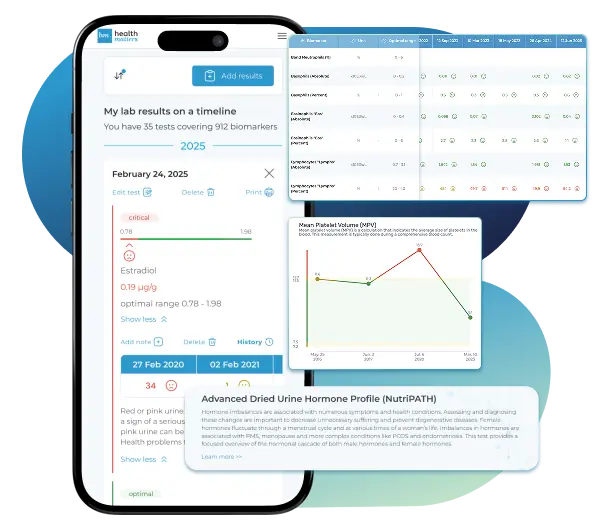
Import lab results from multiple providers, track changes over time, customize your reference ranges, and get clear explanations for each result. Everything is stored securely, exportable in one organized file, and shareable with your doctor—or anyone you choose.
Cancel or upgrade anytime
Article Review & Sources
All our content is backed by peer-reviewed studies, academic research, and trusted medical sources. We're committed to accuracy and transparency — see our editorial policy for details.
Laboratories
Bring All Your Lab Results Together — In One Place
We accept reports from any lab, so you can easily collect and organize all your health information in one secure spot.










Pricing Table
Gather Your Lab History — and Finally Make Sense of It
Finally, Your Lab Results Organized and Clear

Personal plans

$79/ year
Advanced Plan
Access your lab reports, explanations, and tracking tools.
- Import lab results from any provider
- Track all results with visual tools
- Customize your reference ranges
- Export your full lab history anytime
- Share results securely with anyone
- Receive 5 reports entered for you
- Cancel or upgrade anytime
$250/ once
Unlimited Account
Pay once, access everything—no monthly fees, no limits.
- Import lab results from any provider
- Track all results with visual tools
- Customize your reference ranges
- Export your full lab history anytime
- Share results securely with anyone
- Receive 10 reports entered for you
- No subscriptions. No extra fees.
$45/ month
Pro Monthly
Designed for professionals managing their clients' lab reports
- Import lab results from any provider
- Track lab results for multiple clients
- Customize reference ranges per client
- Export lab histories and reports
- Begin with first report entered by us
- Cancel or upgrade anytime
About membership
What's included in a Healthmatters membership
 Import Lab Results from Any Source
 See Your Health Timeline
 Understand What Your Results Mean

 Visualize Your Results

 Data Entry Service for Your Reports
 Securely Share With Anyone You Trust
Let Your Lab Results Tell the Full Story
Once your results are in one place, see the bigger picture — track trends over time, compare data side by side, export your full history, and share securely with anyone you trust.




Bring all your results together to compare, track progress, export your history, and share securely.
What Healthmatters Members Are Saying

I have been using Healthmatters.io since 2021. I travel all over the world and use different doctors and health facilities. This site has allowed me to consolidate all my various test results over 14 years in one place. And every doctor that I show this to has been impressed. Because with any health professional I talk to, I can pull up historical results in seconds. It is invaluable. Even going back to the same doctor, they usually do not have the historical results from their facility in a graph format. That has been very helpful.
Anthony
Unlimited Plan Member since 2021
What fantastic service and great, easy-to-follow layouts! I love your website; it makes it so helpful to see patterns in my health data. It's truly a pleasure to use. I only wish the NHS was as organized and quick as Healthmatters.io. You've set a new standard for health tracking!
Karin
Advanced Plan Member since 2020
As a PRO member and medical practitioner, Healthmatters.io has been an invaluable tool for tracking my clients' data. The layout is intuitive, making it easy to monitor trends and spot patterns over time. The ability to customize reports and charts helps me present information clearly to my clients, improving communication and outcomes. It's streamlined my workflow, saving me time and providing insights at a glance. Highly recommended for any practitioner looking for a comprehensive and user-friendly solution to track patient labs!
Paul
Healthmatters Pro Member since 2024

We implement proven measures to keep your data safe.
At HealthMatters, we're committed to maintaining the security and confidentiality of your personal information. We've put industry-leading security standards in place to help protect against the loss, misuse, or alteration of the information under our control. We use procedural, physical, and electronic security methods designed to prevent unauthorized people from getting access to this information. Our internal code of conduct adds additional privacy protection. All data is backed up multiple times a day and encrypted using SSL certificates. See our Privacy Policy for more details.