
Cardiolipin Antibody (IgG): What a Positive aCL IgG Result Means
Other names: Cardiolipin Ab (IgG), Anticardiolipin Antibodies, IgG, aCL IgG, Cardiolipin IgG, Phospholipid (Cardiolipin) Antibody, IgG, ACA IgG, Cardiolipin IgG EIA, Cardiolipin IgG IA
 Optimal Result:
0 - 14 GPL.
Optimal Result:
0 - 14 GPL.

In one sentence
Cardiolipin IgG is an autoantibody against one of the body's own phospholipids, and a positive result is a prompt to confirm persistence and look at the clinical picture — not a diagnosis on its own.
At a Glance
- What it measures: IgG antibodies to cardiolipin, a phospholipid, reported in GPL units
- What it is: an autoantibody — one of the antiphospholipid antibodies
- Why it is ordered: evaluation of antiphospholipid syndrome, usually after an unexplained clot or a specific pregnancy complication, or in lupus
- The finding that matters: a positive result — but only when confirmed persistent and paired with a clinical event
- Read with: cardiolipin IgM, anti-β₂-glycoprotein I, and the lupus anticoagulant
- What it cannot do: diagnose APS on its own, or from a single positive result
What cardiolipin is, and what the antibody does
Cardiolipin is a phospholipid — a fat molecule that forms part of cell membranes. It is found throughout the body and is especially abundant in the inner mitochondrial membrane, the structures that power cells. It is a normal, essential component of healthy cells.
A cardiolipin antibody is an autoantibody: an antibody the immune system has mistakenly made against this normal self-component. That is the key to the whole test. This is not an antibody against an infection, and it is not an antibody against a clotting factor. It is the immune system targeting one of the body's own building blocks — and when antibodies like this are present and persistent, they are associated with a tendency to form abnormal blood clots.
This is worth stating plainly because the relationship is easy to get backwards. The phospholipid itself is not what causes clots. The antibodies against it are the marker of the clotting tendency, in the condition called antiphospholipid syndrome.
There is a further subtlety worth knowing. Although these are called cardiolipin antibodies, many of the clinically important ones are β₂-glycoprotein I-dependent: they recognize a blood protein, β₂-glycoprotein I, when it has bound to cardiolipin, rather than binding cardiolipin directly. Infection-associated cardiolipin antibodies are often β₂-glycoprotein I-independent and transient, while β₂-glycoprotein I-dependent antibodies are more strongly associated with APS. This is one reason cardiolipin and anti-β₂-glycoprotein I results are often interpreted together.
What antiphospholipid syndrome is
Antiphospholipid syndrome (APS) is an autoimmune disorder in which antiphospholipid antibodies — cardiolipin antibodies among them — are associated with a raised risk of blood clots in veins or arteries and with specific pregnancy complications, including recurrent pregnancy loss. Cardiolipin IgG is one of the antibodies used to evaluate it. APS is uncommon, which is one reason a positive antibody is interpreted cautiously rather than taken as a diagnosis from a single test.
APS is not diagnosed from an antibody result alone. It requires a clinical event together with a confirmed, persistent antibody, and modern classification criteria weigh several antibodies and clinical features together.
Reading your result
Cardiolipin IgG is reported in GPL units against a laboratory cutoff. Results are usually grouped into tiers, because the level carries clinical weight — but the exact boundaries are assay-specific.
| Labcorp result band | Range (GPL) | What it generally means |
|---|---|---|
| Negative | <15 | The antibody was not detected above the cutoff. Lowers the likelihood of APS but does not exclude it alone. |
| Indeterminate | 15–20 | At the boundary of the reference range — not clearly positive or negative. Repeat testing is appropriate. |
| Low-medium positive | >20–80 | Detected. More likely to be transient or incidental at the lower end; still requires confirmation over 12 weeks and a clinical event to mean APS. |
| Positive | >80 | The strongest association with APS, but read the same way: confirmed over 12 weeks, paired with a clinical event, and alongside the rest of the antibody panel. |
These are Labcorp's result bands for test 161810 (GPL units). Cutoffs and tier boundaries differ between laboratories and assay platforms, so the bands printed on your own report are the ones that apply — a result of 18 is indeterminate on Labcorp's scale, for example, not positive. Separately, the international classification criteria for research (the 2023 ACR/EULAR system) weight standardized-ELISA values as moderate at 40–79 and high at ≥80; those are a research-classification scale, not a laboratory result band, and are not interchangeable with the reporting ranges above.
Why a positive result must be confirmed
A single positive cardiolipin IgG is not enough to mean anything lasting, because these antibodies are often temporary. They appear after infections — syphilis historically, but also common viral illnesses and mononucleosis — and after some medications, and then they fade. Transient antibodies of this kind generally do not carry the clotting risk that persistent ones do.
This is why confirmation is built into how the test is used: a positive result is repeated at least 12 weeks later, and only an antibody that is still present is treated as a durable finding. The 12-week interval reflects current criteria; some older guidance used a shorter six-week interval. Either way, the principle is the same — one positive is a prompt to recheck, not a conclusion.
Two people, same result
Person A has a low-medium positive result drawn shortly after an infection. Repeated at least 12 weeks later, it is negative — supporting a transient antibody rather than a persistent APS finding.
Person B has the same initial number, but it is still positive after 12 weeks. With an unexplained clot and positive companion antibodies, that same value is substantially more clinically important.
Same result, different meaning — decided by persistence, a clinical event, and the rest of the panel, not by the number.
What else causes a positive result
Cardiolipin IgG is not specific to APS. It also appears with:
- Infections — syphilis classically, and various viral infections and mononucleosis, usually transiently
- Systemic lupus erythematosus — the antibody is found in a substantial minority of people with lupus, and its presence is a marker of thrombosis risk in that setting
- Other autoimmune conditions and some malignancies
- Certain medications, which can induce the antibody
- Older age, where a low-level positive can appear without symptoms
Not all of these carry the same clotting risk, which is exactly why a positive result is interpreted with the clinical picture rather than as a standalone alarm.
Reading it alongside the other antiphospholipid antibodies
Cardiolipin IgG is rarely interpreted alone. The antiphospholipid workup tests several markers together, and the pattern across them — and how many are positive — carries more weight than any single result.
| This result | The companion tests | Why it matters |
|---|---|---|
| Cardiolipin IgG | Cardiolipin IgM | IgG carries more diagnostic weight; isolated IgM means less |
| Cardiolipin IgG | Anti-β₂-glycoprotein I (IgG/IgM) | A criteria antibody; concordance strengthens the picture |
| Cardiolipin IgG | Lupus anticoagulant | A functional clotting test; a strong independent predictor of risk |
| Any one positive | All three positive ("triple positivity") | Multiple positives carry substantially more risk than one |
This table describes patterns clinicians commonly consider. It is not a diagnostic algorithm, and no row substitutes for a specialist's reading of your full picture.
Triple positivity = highest concern. When all three criteria antibodies are positive — cardiolipin, anti-β₂-glycoprotein I, and the lupus anticoagulant — the associated clotting risk is substantially higher than for any single positive result. If you have one positive, the most informative next question is what the other two are doing.
What this test cannot tell you
- Whether you have APS, from one result. Diagnosis needs persistence and a clinical event, not a single number.
- Whether a positive is transient or lasting. Only the 12-week repeat answers that.
- Your clotting risk in isolation. That comes from the full antibody pattern, especially how many are positive, plus your history.
- Anything from a low result. A negative is reassuring toward APS but is not a health problem in itself.
Common interpretation mistakes
- Reading a single positive as a diagnosis of APS. It is a prompt to confirm, not a conclusion.
- Thinking the phospholipid causes clots. The autoantibody is the marker; cardiolipin itself is a normal cell component.
- Comparing your number to a friend's from another lab. Cutoffs and platforms are not interchangeable.
- Treating a transient post-infection positive as APS. Many positives fade and never carry the risk.
- Reading a negative as ruling APS out entirely. Other antiphospholipid antibodies can still be positive.
Questions your doctor may ask
- Have you had an unexplained blood clot in a vein or artery?
- Any history of recurrent miscarriage or other specific pregnancy complications?
- Have you recently had an infection or started a new medication?
- Do you have lupus or another autoimmune condition?
- Have the other antiphospholipid antibodies — IgM, anti-β₂-glycoprotein I, lupus anticoagulant — been tested?
- Has this result been repeated to check whether it persists?
Read together with
- Cardiolipin IgM — the companion isotype; IgG generally carries more weight
- Anti-β₂-glycoprotein I (IgG and IgM) — a criteria antiphospholipid antibody
- Lupus anticoagulant — a functional clotting assay and a strong risk predictor
- A repeat cardiolipin IgG at ≥12 weeks — the confirmation that establishes persistence
Things that can affect the result
Recent infection or a new medication can produce a transient positive. The assay platform matters — ELISA and the newer automated methods report on scales that are not directly interchangeable, so results are read against the reporting lab's own cutoff. Anticoagulant treatment does not affect the cardiolipin immunoassay itself (though it does affect the separate lupus anticoagulant test). As with other immunoassays, sample quality can influence results.
Clinical pearls
- The antibody, not the phospholipid, is the marker of clotting risk — cardiolipin is a normal cell-membrane component.
- A single positive is never enough: persistence over 12 weeks plus a clinical event is what points toward APS.
- The IgG isotype and higher titers carry more weight; isolated low-level or IgM-only positives carry less.
- Triple positivity — cardiolipin, anti-β₂-glycoprotein I, and lupus anticoagulant all positive — carries substantially more risk than a single positive.
- Transient positives after infection are common and generally benign; this is the single most important reason not to over-read one result.
Clinical Takeaway
A positive cardiolipin IgG is a prompt, not a verdict. It has to be confirmed as persistent over 12 weeks and read alongside a clinical event and the rest of the antiphospholipid panel before it points to antiphospholipid syndrome — and a large share of positives, especially after infections, fade and never carry that meaning. A negative result is reassuring toward APS and is not a problem in itself. Bring the result to your clinician with the rest of the panel and your history.
If you remember only one thing: one positive cardiolipin IgG is a reason to recheck in 12 weeks, not a diagnosis — the antibody is common and often temporary, and it means the most when it is high, persistent, and paired with a clinical event.
Bottom line. This test measures an autoantibody against the body's own phospholipid. A positive result is worth taking seriously and confirming, but it is a starting point for evaluation, not an answer by itself.
This page is not medical advice. Reference cutoffs differ between laboratories and assay platforms, and only your own clinician can interpret your result in the context of your history, symptoms, and other findings.
FAQ about CARDIOLIPIN AB (IGG)
-
What is a cardiolipin IgG antibody?
It is an autoantibody — an antibody the immune system makes against one of the body's own components, in this case cardiolipin, a phospholipid found in cell membranes. It is one of the antiphospholipid antibodies, and it is measured mainly when antiphospholipid syndrome (APS), an autoimmune clotting disorder, is being evaluated. The IgG isotype carries more weight for APS than IgM or IgA. -
What does a positive cardiolipin IgG result mean?
It means the antibody was detected above your laboratory's cutoff. On its own it does not mean you have antiphospholipid syndrome. Many positives are transient — they follow infections or medications and disappear — which is why a positive result has to be confirmed on a second sample at least 12 weeks later before it counts toward a diagnosis. Higher levels are more strongly associated with APS than borderline ones, and the result is always interpreted alongside your clinical history, not by the number alone. -
What is a normal or negative cardiolipin IgG level?
Results are reported in GPL units, and each laboratory sets its own cutoff, so the negative range on your own report is the one that applies. A common negative cutoff is below about 15 or 20 GPL. Values are often grouped as negative, low-positive, moderate, and high, because higher levels carry more clinical weight — but the exact boundaries are assay-specific and not interchangeable between labs. -
Does a positive result mean I have antiphospholipid syndrome?
No. Antiphospholipid syndrome is not diagnosed from an antibody result alone. It requires a clinical event — a blood clot or a specific pregnancy complication — together with a confirmed, persistent antibody, and current classification criteria weigh several antibodies and clinical features together. A positive cardiolipin IgG is one input into that picture, not the diagnosis. -
Can cardiolipin antibodies go away?
Yes. Many cardiolipin antibodies are transient — they appear after an infection or a medication and then disappear on their own. This is exactly why a positive result is repeated at least 12 weeks later: a lasting autoantibody is still there on the repeat, while a passing one has resolved. Antibodies that persist are the ones that carry clinical weight; ones that come and go with an infection generally do not. -
What conditions besides APS cause a positive cardiolipin IgG?
A range of things. Infections — including syphilis, some viral infections, and mononucleosis — can produce transient antibodies. So can certain medications. The antibody is also seen in other autoimmune conditions, particularly systemic lupus erythematosus, where it is found in a substantial minority of patients, and it can appear with some malignancies and simply with older age. Not all of these carry the same clotting risk, which is why the clinical context matters. -
Is cardiolipin IgG or IgM more important?
For antiphospholipid syndrome, the IgG isotype is generally weighted more heavily than IgM, and isolated IgM positivity carries less diagnostic weight on its own. That said, the fuller picture comes from testing the antiphospholipid antibodies together — cardiolipin IgG and IgM, anti-β₂-glycoprotein I, and the lupus anticoagulant — since the pattern across them, and having more than one positive, matters more than any single result. -
Can I lower my cardiolipin antibodies with diet or lifestyle?
No diet, exercise program, or supplement is established as a way to lower clinically meaningful cardiolipin antibodies. These antibodies reflect an immune process, and when they are clinically significant — part of a confirmed antiphospholipid syndrome with a clotting or pregnancy event — management is specialist-directed and centers on reducing clotting risk, not on changing the antibody number itself.
Lab Results Explained and Tracked
What does it mean if your CARDIOLIPIN AB (IGG) result is too high?
A positive cardiolipin IgG means the antibody was detected above your laboratory's cutoff, and results are usually graded — low-positive, moderate, or high — because the level carries clinical weight. What it means depends on two things. Persistence: cardiolipin antibodies often appear transiently after infections — including syphilis, some viral illnesses, and mononucleosis — and after certain medications, and these transient antibodies generally do not carry the clotting risk that persistent ones do. That is why a positive result must be confirmed on a repeat sample at least 12 weeks later before it counts toward a diagnosis. Context: the antibody is one input into a broader picture. Antiphospholipid syndrome is identified when a persistent antibody occurs together with a clinical event — a blood clot or a specific pregnancy complication — and current classification criteria weigh several antibodies and clinical features together rather than reading any single result as decisive.
Higher levels are more strongly associated with APS than borderline ones, and the IgG isotype carries more diagnostic weight than IgM or IgA. The antibody is also seen in other settings — systemic lupus erythematosus, other autoimmune conditions, some malignancies, and simply older age — which is another reason the result is interpreted in context rather than alone. What a positive result calls for is not alarm but follow-up: confirmation over time, the rest of the antiphospholipid panel, and a clinician's reading of the whole picture.

All Your Lab Results.
One Simple Dashboard.
Import, Track, and Share Your Lab Results Easily
Import, Track, and Share Your Lab Results
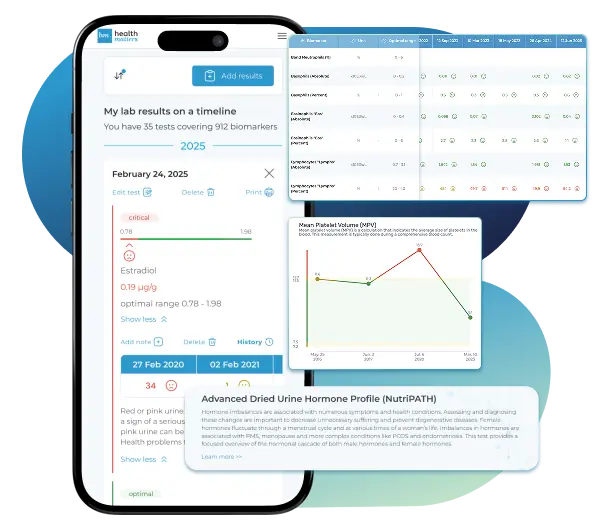
Import lab results from multiple providers, track changes over time, customize your reference ranges, and get clear explanations for each result. Everything is stored securely, exportable in one organized file, and shareable with your doctor—or anyone you choose.
Cancel or upgrade anytime
What does it mean if your CARDIOLIPIN AB (IGG) result is too low?
A negative or low cardiolipin IgG means the antibody was not detected above your laboratory's cutoff. If your report shows a low single-digit value — a result like 2.0, 1.6, or "<2.0" against a negative cutoff below about 15 GPL — that is a negative result: no clinically significant cardiolipin IgG antibody was detected. This is the straightforward direction of the test. There is no such thing as a cardiolipin antibody being harmfully "too low," because the antibody is not something the body needs — it is an autoantibody whose absence is unremarkable.
A negative result lowers the likelihood of antiphospholipid syndrome but does not exclude it on its own, since APS is evaluated across several antibodies — cardiolipin IgG and IgM, anti-β₂-glycoprotein I, and the lupus anticoagulant — and a person can be negative for one and positive for another. If the clinical suspicion is high, the rest of that panel and possibly repeat testing are what settle the question, not this single negative.
Related Biomarkers
Article Review & Sources
All our content is backed by peer-reviewed studies, academic research, and trusted medical sources. We're committed to accuracy and transparency — see our editorial policy for details.
Laboratories
Bring All Your Lab Results Together — In One Place
We accept reports from any lab, so you can easily collect and organize all your health information in one secure spot.











Pricing Table
Gather Your Lab History — and Finally Make Sense of It
Finally, Your Lab Results Organized and Clear

Personal plans

$79/ year
Advanced Plan
Access your lab reports, explanations, and tracking tools.
- Import lab results from any provider
- Track all results with visual tools
- Customize your reference ranges
- Export your full lab history anytime
- Share results securely with anyone
- Receive 5 reports entered for you
- Cancel or upgrade anytime
$250/ once
Unlimited Account
Pay once, access everything—no monthly fees, no limits.
- Import lab results from any provider
- Track all results with visual tools
- Customize your reference ranges
- Export your full lab history anytime
- Share results securely with anyone
- Receive 10 reports entered for you
- No subscriptions. No extra fees.
$45/ month
Pro Monthly
Designed for professionals managing their clients' lab reports
- Import lab results from any provider
- Track lab results for multiple clients
- Customize reference ranges per client
- Export lab histories and reports
- Begin with first report entered by us
- Cancel or upgrade anytime
About membership
What's included in a Healthmatters membership
 Import Lab Results from Any Source
 See Your Health Timeline
 Understand What Your Results Mean

 Visualize Your Results

 Data Entry Service for Your Reports
 Securely Share With Anyone You Trust
Let Your Lab Results Tell the Full Story
Once your results are in one place, see the bigger picture — track trends over time, compare data side by side, export your full history, and share securely with anyone you trust.




Bring all your results together to compare, track progress, export your history, and share securely.
What Healthmatters Members Are Saying

I have been using Healthmatters.io since 2021. I travel all over the world and use different doctors and health facilities. This site has allowed me to consolidate all my various test results over 14 years in one place. And every doctor that I show this to has been impressed. Because with any health professional I talk to, I can pull up historical results in seconds. It is invaluable. Even going back to the same doctor, they usually do not have the historical results from their facility in a graph format. That has been very helpful.
Anthony
Unlimited Plan Member since 2021
What fantastic service and great, easy-to-follow layouts! I love your website; it makes it so helpful to see patterns in my health data. It's truly a pleasure to use. I only wish the NHS was as organized and quick as Healthmatters.io. You've set a new standard for health tracking!
Karin
Advanced Plan Member since 2020
As a PRO member and medical practitioner, Healthmatters.io has been an invaluable tool for tracking my clients' data. The layout is intuitive, making it easy to monitor trends and spot patterns over time. The ability to customize reports and charts helps me present information clearly to my clients, improving communication and outcomes. It's streamlined my workflow, saving me time and providing insights at a glance. Highly recommended for any practitioner looking for a comprehensive and user-friendly solution to track patient labs!
Paul
Healthmatters Pro Member since 2024

We implement proven measures to keep your data safe.
At HealthMatters, we're committed to maintaining the security and confidentiality of your personal information. We've put industry-leading security standards in place to help protect against the loss, misuse, or alteration of the information under our control. We use procedural, physical, and electronic security methods designed to prevent unauthorized people from getting access to this information. Our internal code of conduct adds additional privacy protection. All data is backed up multiple times a day and encrypted using SSL certificates. See our Privacy Policy for more details.