
 Optimal Result:
0 - 15 GPL U/mL.
Optimal Result:
0 - 15 GPL U/mL.

The Anticardiolipin Antibody (Ab), IgG test checks for a specific type of antibody in your blood. Antibodies are usually helpful because they fight off infections. However, anticardiolipin antibodies can cause problems because they mistakenly attack healthy parts of the blood, which can lead to blood clots. This test is especially important for diagnosing a condition called antiphospholipid syndrome (APS). APS can make you more likely to get blood clots in your veins or arteries, and it can also cause complications with pregnancies, like miscarriages.
The "IgG" part of the test name tells us that it's looking for a particular variety of these antibodies, which is known to be linked with a higher risk of these blood clot issues than other types. By measuring how much of these antibodies are in the blood, doctors can figure out if you're at risk for APS, how severe it might be, and what the best treatment might be.
For people who have these antibodies or who have been diagnosed with APS, treatments usually involve taking medicine to reduce the risk of blood clots. This test is a key piece of the puzzle for doctors to help keep patients with APS safe and manage their condition effectively.
Lab Results Explained and Tracked
What does it mean if your Anticardiolipin Ab,IgG,Qn result is too high?
Positive and strongly-positive results for IgG and IgM phospholipid (cardiolipin) antibodies (>40 GPL and/or >40 MPL) are diagnostic criteria for antiphospholipid syndrome (APS). Lesser levels of IgG and IgM phospholipid (cardiolipin) antibodies and antibodies of the IgA isotype may occur in patients with clinical signs of APS but the results are not considered diagnostic. Phospholipid (cardiolipin) antibodies must be detected on 2 or more occasions at least 12 weeks apart to fulfill the laboratory diagnostic criteria for APS. An IgA phospholipid (cardiolipin) antibody result above 15 APL with negative IgG and IgM phospholipids (cardiolipin) antibody results is not diagnostic for APS.
These infection-induced antibodies are usually transient and are not associated with an increased risk of clinical complications. In general, all patients who test positive for Anticardiolipin antibodies should be retested after six to eight weeks to rule out transient antibodies that are usually of no clinical significance.
- Individuals with the antiphospholipid antibody syndrome (APS) have an increased risk for stroke, myocardial infarction, venous thrombosis, thromboembolism, thrombocytopenia, and/or recurrent miscarriages.
- Slightly or moderately positive results are sometimes temporarily observed in older individuals with no symptoms following an infection or after taking a medication. These results are most often of little clinical significance but must be interpreted along with other clinical information.
- Moderately or very high levels of anticardiolipin antibodies that persist for 12 weeks or more indicate a continued presence of these autoantibodies and an increased risk of abnormal clots and miscarriages.
- Anticardiolipin antibodies are often present in individuals with the antiphospholipid antibody syndrome.
- Anticardiolipin antibodies can often be observed during the convalescent phase of acute bacterial and viral infections and in individuals with syphilis.
- Anticardiolipin antibodies are frequently observed in patients with other autoimmune disorders and malignancies. Individuals with Anticardiolipin antibodies secondary to these other conditions are at increased risk of developing APS. A variety of therapeutic drugs can induce the production of Anticardiolipin antibodies. These drug-induced antibodies may be clinically significant if they persist. Anti-cardiolipin antibodies are by definition a major criterion for a diagnosis of APS. They are found in around 30-40% of patients with SLE (=Systemic lupus erythematosus). In both patients with primary and SLE associated APS positive results correlate with a predisposition for arterial or venous thrombosis, foetal loss, or thrombocytopenia. However, levels of anticardiolipin antibodies do not correlate well with disease activity or with specific features of SLE such as arthritis or renal involvement. Nevertheless, the presence of these autoantibodies serves as a marker for the risk of a thromboembolic event. Those SLE patients exhibiting high levels of these autoantibodies are 4 times more likely to have such an event than those not expressing the autoantibodies. Anti-cardiolipin antibodies are associated with recurrent spontaneous abortion and with thrombotic events in mothers shortly after birth. They are also found in up to 20% of young stroke patients. Anti-phospholipid antibodies are also found in infections including syphilis, malaria, parasitic diseases and infectious mononucleosis. Indeed, anticardiolipin antibodies can be transiently elevated in many infections. For this reason, positive results should always be confirmed after 8 -12 weeks.

All Your Lab Results.
One Simple Dashboard.
Import, Track, and Share Your Lab Results Easily
Import, Track, and Share Your Lab Results
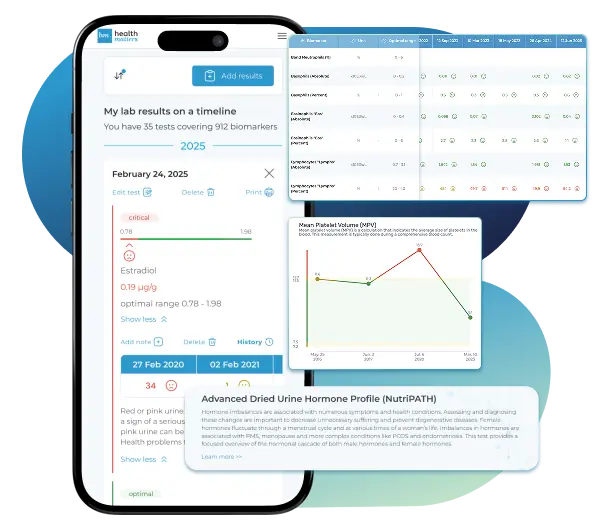
Import lab results from multiple providers, track changes over time, customize your reference ranges, and get clear explanations for each result. Everything is stored securely, exportable in one organized file, and shareable with your doctor—or anyone you choose.
Cancel or upgrade anytime
What does it mean if your Anticardiolipin Ab,IgG,Qn result is too low?
A negative anticardiolipin IgG or IgM result indicates that this type of antibody was not present or was present in too small a quantity in the blood sample being tested.
Related Biomarkers
Article Review & Sources
All our content is backed by peer-reviewed studies, academic research, and trusted medical sources. We're committed to accuracy and transparency — see our editorial policy for details.
Laboratories
Bring All Your Lab Results Together — In One Place
We accept reports from any lab, so you can easily collect and organize all your health information in one secure spot.











Pricing Table
Gather Your Lab History — and Finally Make Sense of It
Finally, Your Lab Results Organized and Clear

Personal plans

$79/ year
Advanced Plan
Access your lab reports, explanations, and tracking tools.
- Import lab results from any provider
- Track all results with visual tools
- Customize your reference ranges
- Export your full lab history anytime
- Share results securely with anyone
- Receive 5 reports entered for you
- Cancel or upgrade anytime
$250/ once
Unlimited Account
Pay once, access everything—no monthly fees, no limits.
- Import lab results from any provider
- Track all results with visual tools
- Customize your reference ranges
- Export your full lab history anytime
- Share results securely with anyone
- Receive 10 reports entered for you
- No subscriptions. No extra fees.
$45/ month
Pro Monthly
Designed for professionals managing their clients' lab reports
- Import lab results from any provider
- Track lab results for multiple clients
- Customize reference ranges per client
- Export lab histories and reports
- Begin with first report entered by us
- Cancel or upgrade anytime
About membership
What's included in a Healthmatters membership
 Import Lab Results from Any Source
 See Your Health Timeline
 Understand What Your Results Mean

 Visualize Your Results

 Data Entry Service for Your Reports
 Securely Share With Anyone You Trust
Let Your Lab Results Tell the Full Story
Once your results are in one place, see the bigger picture — track trends over time, compare data side by side, export your full history, and share securely with anyone you trust.




Bring all your results together to compare, track progress, export your history, and share securely.
What Healthmatters Members Are Saying

I have been using Healthmatters.io since 2021. I travel all over the world and use different doctors and health facilities. This site has allowed me to consolidate all my various test results over 14 years in one place. And every doctor that I show this to has been impressed. Because with any health professional I talk to, I can pull up historical results in seconds. It is invaluable. Even going back to the same doctor, they usually do not have the historical results from their facility in a graph format. That has been very helpful.
Anthony
Unlimited Plan Member since 2021
What fantastic service and great, easy-to-follow layouts! I love your website; it makes it so helpful to see patterns in my health data. It's truly a pleasure to use. I only wish the NHS was as organized and quick as Healthmatters.io. You've set a new standard for health tracking!
Karin
Advanced Plan Member since 2020
As a PRO member and medical practitioner, Healthmatters.io has been an invaluable tool for tracking my clients' data. The layout is intuitive, making it easy to monitor trends and spot patterns over time. The ability to customize reports and charts helps me present information clearly to my clients, improving communication and outcomes. It's streamlined my workflow, saving me time and providing insights at a glance. Highly recommended for any practitioner looking for a comprehensive and user-friendly solution to track patient labs!
Paul
Healthmatters Pro Member since 2024

We implement proven measures to keep your data safe.
At HealthMatters, we're committed to maintaining the security and confidentiality of your personal information. We've put industry-leading security standards in place to help protect against the loss, misuse, or alteration of the information under our control. We use procedural, physical, and electronic security methods designed to prevent unauthorized people from getting access to this information. Our internal code of conduct adds additional privacy protection. All data is backed up multiple times a day and encrypted using SSL certificates. See our Privacy Policy for more details.