
CH50 Blood Test (Complement, Total): What High, Low, and ">60" Results Mean
Other names: CH50, Complement Total CH50, Complement Total (CH50), CH50 Blood Test, Total Complement CH50, Complement CH50, CH50 High, CH50 Low, CH50 Greater Than 60, CH50 Higher Than 60, Complement Total >60, CH50 >60, CH50 60 U/mL, Complement Activity Total, Complement, Total (CH50) High, CH50 Test Interpretation, Elevated CH50, High CH50, Low CH50, CH50 Normal Range, CH50 Test, CH 50, CH50 Complement, Total Hemolytic Complement, Hemolytic Complement CH50, CH50 Complement Hémolytique Total (French), CH50 Élevé (French), CH50 Supérieur à 60 (French), CH50 Prise de Sang (French), Complemento Total CH50 (Spanish/Portuguese), CH50 Alto (Spanish/Portuguese), CH50 Kompleman Aktivitesi (Turkish), Gesamtaktivität CH50 (German), CH50 Erhöht (German)
 Optimal Result:
42 - 999999 U/mL.
Optimal Result:
42 - 999999 U/mL.

QUICK ANSWER
CH50 (Complement, Total) measures the overall functional activity of your complement system — a group of serum proteins that coordinate immune defense, inflammation, and clearance of immune complexes.
Normal range: 31–60 U/mL (most laboratories; ranges vary — always use your lab's reference range)
| Result | What it generally means |
|---|---|
| ">60" or "higher than 60" | At or above the upper detection limit — complement system is highly active; most commonly an acute-phase immune or inflammatory response |
| 31–60 U/mL | Normal complement activity |
| Below 31 U/mL | Low complement — may reflect complement consumption (autoimmune disease), complement deficiency, or liver disease |
| Undetectable / 0 | Severely low — may indicate hereditary complement deficiency |
What does ">60" mean on my CH50 result?
Most labs report CH50 using a functional hemolytic assay with an upper detection limit of 60 U/mL. When complement activity is very high, the assay cannot quantify above this threshold and reports the result as ">60" (or "greater than 60," "higher than 60," or ">60 U/mL"). This is not an error — it means your complement system is highly active. In many cases, a result of ">60" reflects an acute immune response, acute inflammation, or normal variation at the upper end of complement activity.
WHAT IS THE CH50 TEST?
The CH50 test measures the total hemolytic complement activity of serum — specifically, the ability of the entire classical complement pathway to lyse (break open) antibody-coated red blood cells. The "50" in CH50 refers to the amount of serum required to lyse 50% of sensitized red blood cells in the standard assay.
What the complement system does:
The complement system is a cascade of more than 20 serum proteins that works alongside antibodies to fight infections, clear immune complexes, and coordinate inflammation. It can be activated through three pathways:
- Classical pathway — triggered by antibody-antigen complexes (the CH50 primarily reflects this pathway)
- Lectin pathway — triggered by carbohydrates on microbial surfaces
- Alternative pathway — triggered directly by microbial surfaces (the AH50 test evaluates this pathway)
Why the CH50 is ordered:
The CH50 is used to screen for:
- Complement deficiency (hereditary or acquired)
- Complement consumption in autoimmune disease (particularly lupus/SLE)
- Monitoring response to SLE therapy
- Evaluating suspected immune complex disease, glomerulonephritis, or cryoglobulinemia
- Recurrent infections with encapsulated bacteria (suggesting complement pathway deficiency)
WHAT DOES ">60" OR "HIGHER THAN 60" MEAN?
This is the most searched question for this marker, and the current page does not address it.
When your CH50 result shows ">60," ">60 U/mL," "higher than 60," or "complement total >60," it means the result exceeded the upper detection limit of the assay — not that there is a specific value above 60. The assay cannot measure precisely above this threshold, so it reports the result as greater-than.
In most cases, a ">60" CH50 result means:
- Your complement system is highly active
- The classical complement pathway is functioning at full capacity
- This is most commonly seen in acute-phase reactions and inflammatory states
Common causes of CH50 ">60" or elevated CH50:
| Cause | Notes |
|---|---|
| Acute-phase inflammatory response | The most common cause — complement proteins are acute-phase reactants that increase during infection, injury, or inflammation |
| Active infection (bacterial, viral) | Complement activation as part of the immune response |
| Ulcerative colitis / IBD | Chronic inflammatory conditions elevate acute-phase complement proteins |
| Sarcoidosis | Associated with elevated complement activity |
| Cancer / malignancy | Certain cancers (lymphoma, leukemia, solid tumors) are associated with elevated complement — see below |
| Acute myocardial infarction | Post-MI inflammatory response can elevate complement |
| Behçet's disease | Vasculitic condition associated with elevated complement |
| Obesity / metabolic syndrome | Chronic low-grade inflammation elevates complement |
Is a high CH50 or ">60" dangerous?
In most cases, no. An elevated CH50 is a sign that the complement system is active — which is appropriate during infection or inflammation. It is far less clinically significant than a low CH50. However, persistently elevated CH50 without an obvious inflammatory trigger may warrant further evaluation.
CH50 AND CANCER
Several queries in the data specifically ask about the cancer connection ("high ch50 and cancer," "cancers associated with high ch50"). This deserves explicit coverage.
Elevated CH50 has been observed in association with various malignancies, including lymphoma (Hodgkin's and non-Hodgkin's), leukemia, sarcoma, and some solid tumors. The mechanism is thought to involve tumor-associated inflammation and acute-phase protein production.
Important caveats:
- Elevated CH50 is not diagnostic for cancer
- Most people with elevated CH50 do not have cancer — the most common causes are infection and inflammation
- Elevated CH50 is not a screening test for cancer
- In the context of cancer, CH50 may be used as one of many markers to monitor disease activity, not to diagnose it
If elevated CH50 is discovered without an obvious inflammatory explanation, a clinician will evaluate the full clinical picture rather than acting on this single marker.
WHAT DOES LOW CH50 MEAN?
Low CH50 (below 31 U/mL on most labs, or below the lab's lower reference limit) is more clinically significant than elevated CH50. It indicates that the complement system is either deficient in one or more components, or that complement is being consumed faster than it is produced.
Two main mechanisms of low CH50:
1. Complement consumption (more common in clinical practice) The complement system is being actively used — typically to fight immune complexes in autoimmune disease. The proteins are "consumed" faster than the liver can replenish them.
2. Complement deficiency (less common) One or more complement proteins are absent due to hereditary deficiency. Because the CH50 requires all classical pathway components to be present and functional, a deficiency in any single component can result in a CH50 of zero or near-zero.
Common causes of low CH50:
| Cause | Notes |
|---|---|
| Systemic lupus erythematosus (SLE) | Classic cause — complement consumption by immune complexes; low CH50 correlates with disease activity |
| Acute and chronic glomerulonephritis | Complement consumption in kidney immune complex disease |
| Cryoglobulinemia | Abnormal proteins consume complement |
| Rheumatoid arthritis | Can cause mild complement consumption |
| Subacute bacterial endocarditis | Complement consumed fighting persistent infection |
| Hemolytic anemias | Red cell destruction activates complement |
| Hereditary complement deficiency | C1q, C2, C4 deficiencies are most common; C2 deficiency is the most prevalent hereditary complement deficiency in Caucasians |
| Liver disease | The liver produces most complement proteins; severe liver disease reduces production |
| Graft rejection | Complement activation during transplant rejection |
| Malnutrition | Reduced protein synthesis affects complement production |
HIGH CH50 BUT NORMAL C3 AND C4
This specific clinical pattern appears in the GSC query data ("high ch50 but normal c3, c4," "ch50 élevé c3, c4 normal") and is worth addressing directly.
When CH50 is elevated but C3 and C4 are normal, it typically suggests:
- Acute-phase elevation — CH50 is elevated because complement proteins are broadly upregulated as acute-phase reactants, but no specific consumption of C3 or C4 has occurred
- Normal physiological variation — the upper end of normal complement activity without pathological complement consumption
- Laboratory threshold effect — a result just above the detection limit (e.g. 62 U/mL being reported as ">60") may reflect minor assay variability
This pattern is generally reassuring compared to a pattern of low C3, low C4, and low CH50, which would suggest active complement consumption (typical of lupus flares).
CH50 IN CONTEXT: CH50 vs C3 AND C4
The CH50 is a functional test of the overall complement pathway. C3 and C4 are individual complement protein concentration tests. Together they provide more diagnostic information than any single test alone.
| Test | What it measures | Most useful for |
|---|---|---|
| CH50 | Functional activity of entire classical pathway | Screening for complement deficiency; overall activity |
| C3 | Concentration of complement protein C3 | Monitoring complement consumption in SLE and glomerulonephritis |
| C4 | Concentration of complement protein C4 | Monitoring classical pathway activity; hereditary C4 deficiency |
Common interpretation patterns:
| Pattern | What it suggests |
|---|---|
| Low CH50 + Low C3 + Low C4 | Active complement consumption — typical of SLE flare, cryoglobulinemia, active glomerulonephritis |
| Low CH50 + Normal C3 + Normal C4 | Possible terminal pathway complement deficiency (C5–C9); also seen in AH50-detectable alternative pathway deficiency |
| Low CH50 + Low C4 + Normal C3 | C4 deficiency or early classical pathway consumption |
| High CH50 + Normal C3 + Normal C4 | Acute-phase elevation; generally benign |
| Normal CH50 + Low C3 or C4 | Partial complement changes; interpret with clinical context |
FAQ about Complement, Total (CH50)
-
What does "CH50 higher than 60" or ">60" mean?
A result of ">60" on a CH50 test means your complement activity exceeded the upper detection limit of the assay — the lab cannot measure precisely above 60 U/mL, so it reports the result as "greater than 60." This means your complement system is highly active. In most cases this reflects an acute-phase immune response or inflammation and is not a sign of disease. It is far less concerning than a low CH50. If you have no symptoms of infection or inflammation and your result is ">60," discuss with your doctor whether any follow-up is warranted. -
What is a normal CH50 range?
The normal reference range for CH50 varies by laboratory and assay method. On most standard assays, the normal range is approximately 31–60 U/mL. Quest Diagnostics uses a range of 31–60 U/mL for adults. Some labs may report a range of 41–90 U/mL or similar. Always use the reference range printed on your own lab report, not a general reference. A result above the upper limit of the assay is reported as ">60" rather than as a specific number. -
What does high CH50 mean?
High CH50 means the complement system is highly active — typically because of an acute inflammatory response, active infection, or a chronic inflammatory condition. Common causes include acute infection, inflammatory bowel disease, sarcoidosis, certain cancers, and post-heart-attack inflammation. Elevated CH50 is generally less clinically significant than low CH50. If it is elevated without an obvious inflammatory cause, a physician may investigate further. -
What does low CH50 mean?
Low CH50 indicates that the complement system is underactive — either because complement proteins are being consumed faster than they are produced (as in autoimmune diseases like lupus), or because one or more complement proteins are deficient (hereditary deficiency). Common causes of low CH50 include lupus (SLE), glomerulonephritis, cryoglobulinemia, hereditary complement deficiency, and severe liver disease. Low CH50 is more clinically significant than high CH50 and typically warrants further investigation. -
Can high CH50 indicate cancer?
Elevated CH50 has been observed in some patients with lymphoma, leukemia, sarcoma, and certain solid tumors, but it is not a diagnostic test for cancer. The most common causes of high CH50 are infection and acute inflammation — not cancer. An elevated CH50 alone does not indicate cancer and should not be interpreted in isolation. If elevated CH50 is found without an obvious cause, a physician will evaluate the full clinical picture. -
What does it mean if CH50 is high but C3 and C4 are normal?
This pattern — elevated CH50 with normal C3 and C4 — most commonly reflects an acute-phase elevation of complement proteins without specific consumption of individual components. It is generally a reassuring pattern, as it suggests complement is being produced in excess rather than consumed. It does not typically indicate autoimmune disease. Compare this with the more concerning pattern of low CH50 with low C3 and low C4, which suggests active complement consumption, as seen in lupus flares. -
What is the CH50 test used for?
The CH50 is used to screen for overall complement system function, diagnose hereditary complement deficiencies, monitor autoimmune diseases (particularly lupus/SLE) where complement is consumed during flares, evaluate suspected immune complex diseases and glomerulonephritis, and investigate recurrent infections with encapsulated bacteria (meningococcus, pneumococcus) that suggest complement deficiency. -
What is the difference between CH50 and AH50?
CH50 evaluates the classical complement activation pathway. AH50 (alternative hemolytic complement) evaluates the alternative pathway. Together they can help identify which complement pathway is deficient. A low CH50 with a normal AH50 suggests a classical pathway deficiency. A low AH50 with a normal CH50 suggests an alternative pathway deficiency. Both tests being low may indicate a deficiency in the terminal complement components (C5–C9) shared by both pathways.
Lab Results Explained and Tracked
What does it mean if your Complement, Total (CH50) result is too high?
Elevated CH50 (Complement, Total) indicates the complement system is highly active. A result reported as ">60" or "higher than 60 U/mL" means the result exceeded the upper detection limit of the assay — not a specific value above 60. High CH50 is most commonly caused by acute infection, inflammatory conditions, ulcerative colitis, sarcoidosis, or post-inflammatory responses. It is also associated with certain malignancies including lymphoma, leukemia, and sarcoma, though cancer is far less common than inflammatory causes. Elevated CH50 with normal C3 and C4 typically reflects an acute-phase response without complement consumption, which is generally benign. Persistently elevated CH50 without an obvious trigger warrants clinical evaluation.
Related Health Conditions

All Your Lab Results.
One Simple Dashboard.
Import, Track, and Share Your Lab Results Easily
Import, Track, and Share Your Lab Results
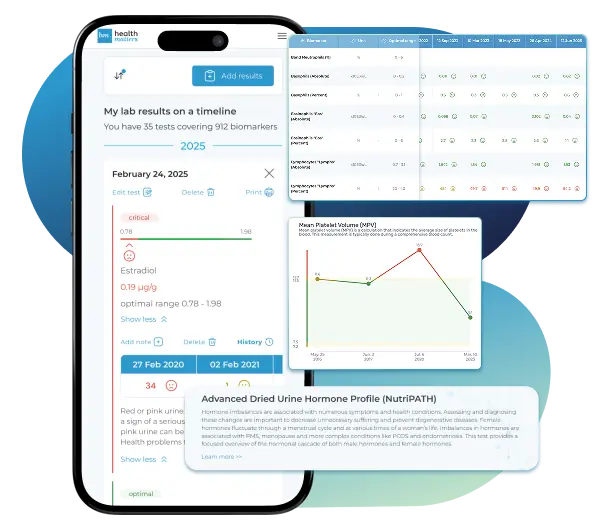
Import lab results from multiple providers, track changes over time, customize your reference ranges, and get clear explanations for each result. Everything is stored securely, exportable in one organized file, and shareable with your doctor—or anyone you choose.
Cancel or upgrade anytime
What does it mean if your Complement, Total (CH50) result is too low?
Low CH50 (below the lower reference limit, typically below 31 U/mL) indicates reduced complement system activity. This is more clinically significant than elevated CH50. The two main mechanisms are complement consumption — where complement proteins are used up faster than the liver can produce them, as in lupus (SLE), glomerulonephritis, and cryoglobulinemia — and hereditary complement deficiency, where one or more complement components are absent. Low CH50 in the context of an autoimmune disease may reflect active disease. A CH50 of zero or near-zero with no obvious consumption cause suggests hereditary deficiency of a classical pathway component. Low CH50 should always be evaluated alongside C3, C4, and clinical history.
Related Biomarkers
Article Review & Sources
All our content is backed by peer-reviewed studies, academic research, and trusted medical sources. We're committed to accuracy and transparency — see our editorial policy for details.
Laboratories
Bring All Your Lab Results Together — In One Place
We accept reports from any lab, so you can easily collect and organize all your health information in one secure spot.











Pricing Table
Gather Your Lab History — and Finally Make Sense of It
Finally, Your Lab Results Organized and Clear

Personal plans

$79/ year
Advanced Plan
Access your lab reports, explanations, and tracking tools.
- Import lab results from any provider
- Track all results with visual tools
- Customize your reference ranges
- Export your full lab history anytime
- Share results securely with anyone
- Receive 5 reports entered for you
- Cancel or upgrade anytime
$250/ once
Unlimited Account
Pay once, access everything—no monthly fees, no limits.
- Import lab results from any provider
- Track all results with visual tools
- Customize your reference ranges
- Export your full lab history anytime
- Share results securely with anyone
- Receive 10 reports entered for you
- No subscriptions. No extra fees.
$45/ month
Pro Monthly
Designed for professionals managing their clients' lab reports
- Import lab results from any provider
- Track lab results for multiple clients
- Customize reference ranges per client
- Export lab histories and reports
- Begin with first report entered by us
- Cancel or upgrade anytime
About membership
What's included in a Healthmatters membership
 Import Lab Results from Any Source
 See Your Health Timeline
 Understand What Your Results Mean

 Visualize Your Results

 Data Entry Service for Your Reports
 Securely Share With Anyone You Trust
Let Your Lab Results Tell the Full Story
Once your results are in one place, see the bigger picture — track trends over time, compare data side by side, export your full history, and share securely with anyone you trust.




Bring all your results together to compare, track progress, export your history, and share securely.
What Healthmatters Members Are Saying

I have been using Healthmatters.io since 2021. I travel all over the world and use different doctors and health facilities. This site has allowed me to consolidate all my various test results over 14 years in one place. And every doctor that I show this to has been impressed. Because with any health professional I talk to, I can pull up historical results in seconds. It is invaluable. Even going back to the same doctor, they usually do not have the historical results from their facility in a graph format. That has been very helpful.
Anthony
Unlimited Plan Member since 2021
What fantastic service and great, easy-to-follow layouts! I love your website; it makes it so helpful to see patterns in my health data. It's truly a pleasure to use. I only wish the NHS was as organized and quick as Healthmatters.io. You've set a new standard for health tracking!
Karin
Advanced Plan Member since 2020
As a PRO member and medical practitioner, Healthmatters.io has been an invaluable tool for tracking my clients' data. The layout is intuitive, making it easy to monitor trends and spot patterns over time. The ability to customize reports and charts helps me present information clearly to my clients, improving communication and outcomes. It's streamlined my workflow, saving me time and providing insights at a glance. Highly recommended for any practitioner looking for a comprehensive and user-friendly solution to track patient labs!
Paul
Healthmatters Pro Member since 2024

We implement proven measures to keep your data safe.
At HealthMatters, we're committed to maintaining the security and confidentiality of your personal information. We've put industry-leading security standards in place to help protect against the loss, misuse, or alteration of the information under our control. We use procedural, physical, and electronic security methods designed to prevent unauthorized people from getting access to this information. Our internal code of conduct adds additional privacy protection. All data is backed up multiple times a day and encrypted using SSL certificates. See our Privacy Policy for more details.