
Vasoactive Intestinal Polypeptide (VIP), Plasma
Other names: VIP, Plasma
 Optimal Result:
0 - 58.8 pg/mL.
Optimal Result:
0 - 58.8 pg/mL.

Vasoactive intestinal peptide (= VIP) is a neurotransmitter, widely distributed through the central and peripheral nervous system with the highest concentration occurring in the submucosal postganglionic intrinsic nerves of the intestinal tract.
Normally VIP has a low blood concentration and does not change with meals.
What are the functions of Vasoactive intestinal peptide?
VIP is considered a hormone and is found in the pancreas, intestine, and central nervous system. It has many functions in the body, such as:
→ functions as a neuromodulator and neurotransmitter
→ helping to control the secretion of water, salts, enzymes, and gastric acid during digestion.
→ regulates smooth muscle activity, epithelial cell secretion, and blood flow in the gastrointestinal tract
→ being a potent vasodilator [open (dilate) blood vessels]
→ has effects on the immune system and the central nervous system.
→ it functions as a neurohormone and paracrine mediator, being released from nerve terminals and acting locally on receptor-bearing cells.
Certain tumors in the pancreas make large amounts of vasoactive intestinal peptide. Vasoactive intestinal polypeptide secreting tumors (VIPomas) are very rare pancreatic neuroendocrine tumors (PNETs) associated with profuse diarrhea. The VIPoma syndrome is also known as Verner-Morrison syndrome, watery diarrhea, hypokalemia, and hypochlorhydria or achlorhydria (WDHA) syndrome, and pancreatic cholera syndrome. VIPomas are functional neuroendocrine tumors that secrete excessive amounts of VIP. VIPoma tumors present as sporadic, solitary pancreatic neoplasias (= abnormal mass of tissue that forms when cells grow and divide more than they should or do not die when they should).
References:
Sandhu S, Jialal I. ViPoma. 2022 Jun 21. In: StatPearls [Internet]. Treasure Island (FL): StatPearls Publishing; 2023 Jan–. PMID: 29939520.
Iwasaki M, Akiba Y, Kaunitz JD. Recent advances in vasoactive intestinal peptide physiology and pathophysiology: focus on the gastrointestinal system. F1000Res. 2019 Sep 12;8:F1000 Faculty Rev-1629. doi: 10.12688/f1000research.18039.1. PMID: 31559013; PMCID: PMC6743256.
Vu JP, Larauche M, Flores M, Luong L, Norris J, Oh S, Liang LJ, Waschek J, Pisegna JR, Germano PM. Regulation of Appetite, Body Composition, and Metabolic Hormones by Vasoactive Intestinal Polypeptide (VIP). J Mol Neurosci. 2015 Jun;56(2):377-87. doi: 10.1007/s12031-015-0556-z. Epub 2015 Apr 23. PMID: 25904310; PMCID: PMC4458420.
Una Cidon E. Vasoactive intestinal peptide secreting tumour: An overview. World J Gastrointest Oncol. 2022 Apr 15;14(4):808-819. doi: 10.4251/wjgo.v14.i4.808. PMID: 35582098; PMCID: PMC9048535.
Schizas D, Mastoraki A, Bagias G, Patras R, Moris D, Lazaridis II, Arkadopoulos N, Felekouras E. Clinicopathological data and treatment modalities for pancreatic vipomas: a systematic review. J BUON. 2019 Mar-Apr;24(2):415-423. PMID: 31127985.
Ito T, Igarashi H, Jensen RT. Pancreatic neuroendocrine tumors: clinical features, diagnosis and medical treatment: advances. Best Pract Res Clin Gastroenterol. 2012 Dec;26(6):737-53. doi: 10.1016/j.bpg.2012.12.003. PMID: 23582916; PMCID: PMC3627221.
Jensen RT, Cadiot G, Brandi ML, de Herder WW, Kaltsas G, Komminoth P, Scoazec JY, Salazar R, Sauvanet A, Kianmanesh R; Barcelona Consensus Conference participants. ENETS Consensus Guidelines for the management of patients with digestive neuroendocrine neoplasms: functional pancreatic endocrine tumor syndromes. Neuroendocrinology. 2012;95(2):98-119. doi: 10.1159/000335591. Epub 2012 Feb 15. PMID: 22261919; PMCID: PMC3701449.
Halfdanarson TR, Rubin J, Farnell MB, Grant CS, Petersen GM. Pancreatic endocrine neoplasms: epidemiology and prognosis of pancreatic endocrine tumors. Endocr Relat Cancer. 2008 Jun;15(2):409-27. doi: 10.1677/ERC-07-0221. PMID: 18508996; PMCID: PMC2693313.
Ghaferi AA, Chojnacki KA, Long WD, Cameron JL, Yeo CJ. Pancreatic VIPomas: subject review and one institutional experience. J Gastrointest Surg. 2008 Feb;12(2):382-93. doi: 10.1007/s11605-007-0177-0. PMID: 17510774.
Smith SL, Branton SA, Avino AJ, Martin JK, Klingler PJ, Thompson GB, Grant CS, van Heerden JA. Vasoactive intestinal polypeptide secreting islet cell tumors: a 15-year experience and review of the literature. Surgery. 1998 Dec;124(6):1050-5. doi: 10.1067/msy.1998.92005. PMID: 9854582.
Yao JC, Eisner MP, Leary C, Dagohoy C, Phan A, Rashid A, Hassan M, Evans DB. Population-based study of islet cell carcinoma. Ann Surg Oncol. 2007 Dec;14(12):3492-500. doi: 10.1245/s10434-007-9566-6. Epub 2007 Sep 26. PMID: 17896148; PMCID: PMC2077912.
Thompson R, Landry CS. Multiple endocrine neoplasia 1: a broad overview. Ther Adv Chronic Dis. 2021 Aug 12;12:20406223211035288. doi: 10.1177/20406223211035288. PMID: 34413971; PMCID: PMC8369854.
Lab Results Explained and Tracked
What does it mean if your Vasoactive Intestinal Polypeptide (VIP), Plasma result is too high?
Values >75 pg/mL may indicate presence of enteropancreatic tumor causing hypersecretion of vasoactive intestinal polypeptide (VIP).
Values >200 pg/mL are strongly suggestive of VIP producing tumors (VIPoma).
Oversecretion of VIP from VIPomas is responsible for the rare Verner-Morrison or WDHA (watery diarrhea, hypokalaemia, achlorhydria) syndrome. It is characterized by profuse watery diarrhea, dehydration, hypotension, flushing, intestinal ileus, hypokalaemia, achlorhydria, hypomagnesaemia and metabolic acidosis. Hyperglycaemia and hypercalcaemia can also occur. While achlorhydria or hypochlorhydria distinguishes this diarrhoeal syndrome from gastrinoma, absence of this feature in some VIPoma patients is possible.
Pancreatic VIPomas (90%) are commonly located in the body and tail of pancreas while extra-pancreatic VIPomas occur in the autonomic nervous system.
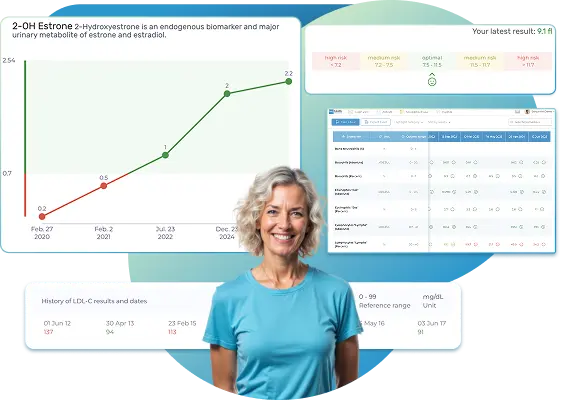
All Your Lab Results.
One Simple Dashboard.
Import, Track, and Share Your Lab Results Easily
Import, Track, and Share Your Lab Results
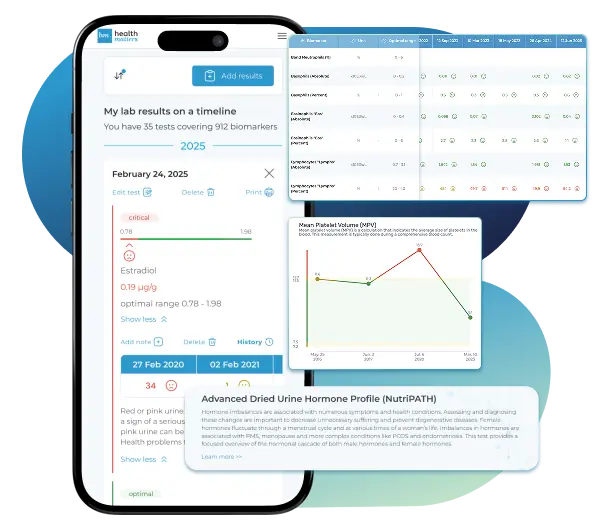
Import lab results from multiple providers, track changes over time, customize your reference ranges, and get clear explanations for each result. Everything is stored securely, exportable in one organized file, and shareable with your doctor—or anyone you choose.
Cancel or upgrade anytime
Article Review & Sources
All our content is backed by peer-reviewed studies, academic research, and trusted medical sources. We're committed to accuracy and transparency — see our editorial policy for details.
Laboratories
Bring All Your Lab Results Together — In One Place
We accept reports from any lab, so you can easily collect and organize all your health information in one secure spot.











Pricing Table
Gather Your Lab History — and Finally Make Sense of It
Finally, Your Lab Results Organized and Clear

Personal plans

$79/ year
Advanced Plan
Access your lab reports, explanations, and tracking tools.
- Import lab results from any provider
- Track all results with visual tools
- Customize your reference ranges
- Export your full lab history anytime
- Share results securely with anyone
- Receive 5 reports entered for you
- Cancel or upgrade anytime
$250/ once
Unlimited Account
Pay once, access everything—no monthly fees, no limits.
- Import lab results from any provider
- Track all results with visual tools
- Customize your reference ranges
- Export your full lab history anytime
- Share results securely with anyone
- Receive 10 reports entered for you
- No subscriptions. No extra fees.
$45/ month
Pro Monthly
Designed for professionals managing their clients' lab reports
- Import lab results from any provider
- Track lab results for multiple clients
- Customize reference ranges per client
- Export lab histories and reports
- Begin with first report entered by us
- Cancel or upgrade anytime
About membership
What's included in a Healthmatters membership
 Import Lab Results from Any Source
 See Your Health Timeline
 Understand What Your Results Mean

 Visualize Your Results

 Data Entry Service for Your Reports
 Securely Share With Anyone You Trust
Let Your Lab Results Tell the Full Story
Once your results are in one place, see the bigger picture — track trends over time, compare data side by side, export your full history, and share securely with anyone you trust.




Bring all your results together to compare, track progress, export your history, and share securely.
What Healthmatters Members Are Saying

I have been using Healthmatters.io since 2021. I travel all over the world and use different doctors and health facilities. This site has allowed me to consolidate all my various test results over 14 years in one place. And every doctor that I show this to has been impressed. Because with any health professional I talk to, I can pull up historical results in seconds. It is invaluable. Even going back to the same doctor, they usually do not have the historical results from their facility in a graph format. That has been very helpful.
Anthony
Unlimited Plan Member since 2021
What fantastic service and great, easy-to-follow layouts! I love your website; it makes it so helpful to see patterns in my health data. It's truly a pleasure to use. I only wish the NHS was as organized and quick as Healthmatters.io. You've set a new standard for health tracking!
Karin
Advanced Plan Member since 2020
As a PRO member and medical practitioner, Healthmatters.io has been an invaluable tool for tracking my clients' data. The layout is intuitive, making it easy to monitor trends and spot patterns over time. The ability to customize reports and charts helps me present information clearly to my clients, improving communication and outcomes. It's streamlined my workflow, saving me time and providing insights at a glance. Highly recommended for any practitioner looking for a comprehensive and user-friendly solution to track patient labs!
Paul
Healthmatters Pro Member since 2024

We implement proven measures to keep your data safe.
At HealthMatters, we're committed to maintaining the security and confidentiality of your personal information. We've put industry-leading security standards in place to help protect against the loss, misuse, or alteration of the information under our control. We use procedural, physical, and electronic security methods designed to prevent unauthorized people from getting access to this information. Our internal code of conduct adds additional privacy protection. All data is backed up multiple times a day and encrypted using SSL certificates. See our Privacy Policy for more details.