Optimal Result:
50 - 375 #/cumm.
Optimal Result:
50 - 375 #/cumm.

CD1656 are an important NK (Natural killer) cell subset.
Quick facts:
- NK cells are best known for killing virally infected cells, and detecting and controlling early signs of cancer. As well as protecting against disease, specialized NK cells are also found in the placenta and may play an important role in pregnancy.
- Natural killer T (NKT) cells represent a specialized T-cell population that is distinct from conventional T cells. They express an invariant T-cell receptor (TCR) that recognizes self and bacterial glycosphingolipid antigens presented by the MHC class I-like molecule, CD1d.
- Human natural killer (NK) cells can be subdivided in several subpopulations on the basis of the relative expression of the adhesion molecule CD56 and the activating receptor CD16.
- NK cells serve an important role in host defense against viral infections, as well as tumor surveillance. They are also a component of the adaptive immune response through cytokine production.
- NK cell functions are governed by a balance between activating receptors and inhibitory receptors.
What are Natural killer (NK) cells?
Natural killer (NK) cells are the founding members of the innate lymphoid cell family. Natural Killer (NK) Cells are lymphocytes in the same family as T and B cells, coming from a common progenitor. However, as cells of the innate immune system, NK cells are classified as group I Innate Lymphocytes (ILCs) and respond quickly to a wide variety of pathological challenges.
NK cells' main functions are:
- natural cytotoxicity against tumor cells or infected cells without prior immunization,
- antibody-dependent cellular cytotoxicity (ADCC) against antibody-coated target cells,
- and cytokine and chemokine production and secretion, which not only are important in innate immunity but also influence the subsequent adaptive immune response.
- Considered for decades, as exclusively innate lymphocytes, NK cells have been shown to display memory functions as well.
- They can act as suppressive cells under certain conditions.
- NK cells were first noticed for their ability to kill tumour cells without any priming or prior activation (in contrast to cytotoxic T cells, which need priming by antigen presenting cells). They are named for this ‘natural’ killing. Additionally, NK cells secrete cytokines such as IFNγ and TNFα, which act on other immune cells like Macrophage and Dendritic cells to enhance the immune response.
- While on patrol NK cells constantly contact other cells. Whether or not the NK cell kills these cells depends on a balance of signals from activating receptors and inhibitory receptors on the NK cell surface.
More details on how NK cells work and how they fit into the immune system:
Activating receptors recognize molecules that are expressed on the surface of cancer cells and infected cells, and ‘switch on’ the NK cell. Inhibitory receptors act as a check on NK cell killing. Most normal healthy cells express MHC (=major histocompatibility complex) I receptors which mark these cells as ‘self’. Inhibitory receptors on the surface of the NK cell recognize cognate MHC I, and this ‘switches off’ the NK cell, preventing it from killing.
Cancer cells and infected cells often lose their MHC I, leaving them vulnerable to NK cell killing. Once the decision is made to kill, the NK cell releases cytotoxic granules containing perforin and granzymes, which leads to lysis of the target cell. The genes for both MHC I and the NK cell inhibitory receptors which recognize them vary a lot between individuals.
NK cells and HIV:
HIV-1 patients show a gradual loss of NK cells that correlates with disease progression. There is a selective loss of CD56(dim) NK cells, while the numbers of CD56(bright) NK cells remain the same. There appears to be a defect in differentiation from immature CD56- NK cells to mature CD56(dim) NK cells, with an expansion of the former (CD56-CD16+) NK cells in HIV viremic patients. Differential mobilization of NK-cell subsets has also been reported related to acute exercise, with CD56(bright) NK cells being less responsive than CD56(dim) NK cells and the ratio of CD56(bright):CD56(dim) favors the former at least up to 1-hour post-exercise.
NK cells and herpes:
NK cells also play an important role in regulating viral infections, and their deficiency predisposes to susceptibility with herpes virus infections. NKG2D expression has been reported to decrease during human CMV (=Cytomegalovirus) infection. Cytomegalovirus infection is a common herpesvirus infection.
Licensed versus unlicensed NK cells:
NK cells that express inhibitory receptors to self-MHC class I molecules are called "licensed, " which means they are functionally more responsive to stimulation, while "unlicensed" NK cells lack receptors for self-MHC class I and are hyporesponsive. Contrary to the hypothesis that "licensed" NK cells are key for viral immunity, the depletion of "unlicensed" NK cells impairs control of viremia, suggesting that these cells are critical for protection against viral infection.
References:
- https://www.frontiersin.org/articles/10.3389/fimmu.2017.00699/full
Lab Results Explained and Tracked
What does it mean if your Lymphocyte Absolute CD16&56 (NK) Count result is too high?
NK-cell lymphocytosis (=a higher-than-normal amount of lymphocytes) is seen in the following conditions:
- NK-neoplasias,
- extranodal NK/T-cell lymphoma,
- aggressive NK-cell leukemia,
- and blastic NK-cell lymphoma.
Chronic NK-cell lymphocytosis (CNKL) is an indolent disorder characterized by proliferation of CD3-CD56+CD16- NK cells.
NK cells and EBV:
Epstein-Barr virus (EBV) can infect non neoplastic NK cells, and there is an expansion of CD16+CD56(dim) NK cells. Chronic active EBV infection involving NK cells can present with severe inflammatory and necrotic skin reactions typically associated with EBV+ NK-cell lymphoproliferative disease.

All Your Lab Results.
One Simple Dashboard.
Import, Track, and Share Your Lab Results Easily
Import, Track, and Share Your Lab Results
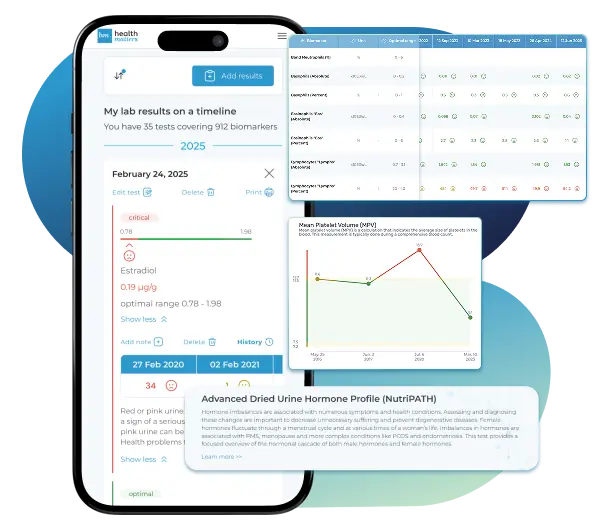
Import lab results from multiple providers, track changes over time, customize your reference ranges, and get clear explanations for each result. Everything is stored securely, exportable in one organized file, and shareable with your doctor—or anyone you choose.
Cancel or upgrade anytime
What does it mean if your Lymphocyte Absolute CD16&56 (NK) Count result is too low?
NK cell deficiencies can be present as part of a larger immunological syndrome or as an isolated deficiency. Some of the primary (monogenic) immunodeficiencies that affect NK cell function or numbers include:
- autoimmune lymphoproliferative syndrome (ALPS) related to CASP8 (caspase 8 mutations);
- familial hemophagocytic lymphohistiocytosis (FHL) types 2, 3, and 4 due to mutations in the PFP1 (encoding perforin), UNC13D (encoding the Munc13-4 protein) and STX-11 (encoding syntaxin -11), respectively;
- Hermansky-Pudlak syndrome (AP3B1);
- Papillon-Lefevre syndrome (CTSC, cathepsin C);
- nuclear factor kappa-beta essential modulator deficiency (NEMO) due to mutations in the IKBKG gene;
- severe combined immunodeficiencies due to mutations in the IL-2RG, JAK3, ADA, PNP, ADK2 genes;
- bare lymphocyte syndrome (TAP2 gene);
- X-linked inhibitor of apoptosis deficiency (XIAP gene);
- X-linked lymphoproliferative disease (XLP): XLP-1 (due to mutations in the SAP gene);
- Griscelli syndrome (RAB27A gene);
- Chediak-Higashi syndrome (LYST gene);
- and Wiskott-Aldrich syndrome (WAS gene).
Patients with X-linked inhibitors of apoptosis protein (XIAP) deficiency have been variably reported as having either normal numbers of NKT cells or low numbers of NKT cells.
Related Biomarkers
Article Review & Sources
All our content is backed by peer-reviewed studies, academic research, and trusted medical sources. We're committed to accuracy and transparency — see our editorial policy for details.
Laboratories
Bring All Your Lab Results Together — In One Place
We accept reports from any lab, so you can easily collect and organize all your health information in one secure spot.











Pricing Table
Gather Your Lab History — and Finally Make Sense of It
Finally, Your Lab Results Organized and Clear

Personal plans

$79/ year
Advanced Plan
Access your lab reports, explanations, and tracking tools.
- Import lab results from any provider
- Track all results with visual tools
- Customize your reference ranges
- Export your full lab history anytime
- Share results securely with anyone
- Receive 5 reports entered for you
- Cancel or upgrade anytime
$250/ once
Unlimited Account
Pay once, access everything—no monthly fees, no limits.
- Import lab results from any provider
- Track all results with visual tools
- Customize your reference ranges
- Export your full lab history anytime
- Share results securely with anyone
- Receive 10 reports entered for you
- No subscriptions. No extra fees.
$45/ month
Pro Monthly
Designed for professionals managing their clients' lab reports
- Import lab results from any provider
- Track lab results for multiple clients
- Customize reference ranges per client
- Export lab histories and reports
- Begin with first report entered by us
- Cancel or upgrade anytime
About membership
What's included in a Healthmatters membership
 Import Lab Results from Any Source
 See Your Health Timeline
 Understand What Your Results Mean

 Visualize Your Results

 Data Entry Service for Your Reports
 Securely Share With Anyone You Trust
Let Your Lab Results Tell the Full Story
Once your results are in one place, see the bigger picture — track trends over time, compare data side by side, export your full history, and share securely with anyone you trust.




Bring all your results together to compare, track progress, export your history, and share securely.
What Healthmatters Members Are Saying

I have been using Healthmatters.io since 2021. I travel all over the world and use different doctors and health facilities. This site has allowed me to consolidate all my various test results over 14 years in one place. And every doctor that I show this to has been impressed. Because with any health professional I talk to, I can pull up historical results in seconds. It is invaluable. Even going back to the same doctor, they usually do not have the historical results from their facility in a graph format. That has been very helpful.
Anthony
Unlimited Plan Member since 2021
What fantastic service and great, easy-to-follow layouts! I love your website; it makes it so helpful to see patterns in my health data. It's truly a pleasure to use. I only wish the NHS was as organized and quick as Healthmatters.io. You've set a new standard for health tracking!
Karin
Advanced Plan Member since 2020
As a PRO member and medical practitioner, Healthmatters.io has been an invaluable tool for tracking my clients' data. The layout is intuitive, making it easy to monitor trends and spot patterns over time. The ability to customize reports and charts helps me present information clearly to my clients, improving communication and outcomes. It's streamlined my workflow, saving me time and providing insights at a glance. Highly recommended for any practitioner looking for a comprehensive and user-friendly solution to track patient labs!
Paul
Healthmatters Pro Member since 2024

We implement proven measures to keep your data safe.
At HealthMatters, we're committed to maintaining the security and confidentiality of your personal information. We've put industry-leading security standards in place to help protect against the loss, misuse, or alteration of the information under our control. We use procedural, physical, and electronic security methods designed to prevent unauthorized people from getting access to this information. Our internal code of conduct adds additional privacy protection. All data is backed up multiple times a day and encrypted using SSL certificates. See our Privacy Policy for more details.