
 Optimal Result:
0 - 6.1 ng/g.
Optimal Result:
0 - 6.1 ng/g.

Aatoxin B2 (AFB2) is a mycotoxin produced by several Aspergillus spp. and found in contaminated foods or hay exposed to water or humid conditions. Exposure routes are primarily ingestion or inhalation. Ingestion can either occur directly from food such as grains, tree nuts, and oilseeds or can also occur from ingestion of milk or meat from animals fed contaminated feed. Toxicity of aatoxins can be categorized as follows, in descending order of known toxic effects: aatoxin B1, aatoxin G1, aatoxin B2, and aatoxin G2. Animal studies have indicated that AFB2 has hepatotoxic, teratogenic, and carcinogenic effects.
Aflatoxins were initially isolated and identified as the causative toxins in Turkey X disease (necrosis of the liver) in 1960 when over 100,000 turkeys died in England (Asao, 1963). They are the most studied mycotoxins with over 5,000 research papers published through 2002. There are four generally recognized Aflatoxins designated B1, B2, G1 and G2 . The metabolites, M1 & M2, are found in milk (Thirumala-Devi et al (2002).
The order of toxicity is B1 greater than G1, greater than G2, greater than B2. (IARC, 1976). However, Aflatoxin B1 is the major mycotoxin produced by most species under culture conditions (Ciegler & Bennet, 1980). Because of this and its toxicity, B1 is the most frequently studied of the four.
Aflatoxins are produced by different species of Aspergillus, particularly flavus, oryzae, fumigatus and parasiticus, as well as members of the genera Penicillium (El-Naghy et al, 1991; Searle 1976; Aflatoxins 2002). Strains of Aspergillus flavus and parasiticus produce mycotoxins under favorable conditions.
Aflatoxins can contaminate corn, cereals, sorghum, peanuts and other oil-seed crops. Thus, food contamination by this group of mycotoxins has been implicated in both animal and human Aflatoxicosis.
Aflatoxins are carcinogenic to humans and animals. Overall summary evaluation of carcinogenic risk to humans is Group 1 (IARC, 1976; Searle, 1976; Dominguez-Malagon & Gaytan-Graham (2001).
Aflatoxin B1 is a potent liver carcinogen in a variety of experimental animals. It causes liver tumors in mice, rats, fish, marmosets, tree shrews and monkeys following administration by various routes. Types of cancers described in research animals include hepatocellular carcinoma (rats), colon and kidney (rats), cholangiocellular cancer (hamsters), lung adenomas (mice), and osteogenic sarcoma, adenocarcinoma of the gall bladder and carcinoma of the pancreas (monkeys) (IARC, 1976).
In humans, Aflatoxin B1 has been linked to hepatocellular carcinoma from three studies reported in the medical literature, as follows:
An increased incidence (10 % excess) of hepatocellular carcinoma was reported in the southeastern portion of the U.S. in areas of high daily intake of Aflatoxin B1. The daily intake of B1 in the southeastern subjects was 13-197 ug/kg body weight as compared to those in northern and western areas with a daily intake of 0.2-0.3 ug/kg body weight (IARC, 1987).
In China, a strong correlation between the intake of peanut, peanut oil and corn and increased mortality rates for liver cancer were reported in five groups of inhabitants from four villages. The mortality rates were 125, 97.40, 41.65, 24.01 and 1.05, respectively. The median intake of aflatoxin B1 for each group was 6.05, 6.36, 2.69, 1.83 and 0 ug/day. The median daily urine concentrations of M1 metabolite were 16.46, 8, 29, 4.78 and 1.21 ng/person. A significant correlation was found between the mortality rates of primary liver cancer and intake of aflatoxin B1. Further, analysis of M1 in the urine can be used as an index for human exposure to aflatoxin B1 in an epidemiological study (Aflatoxins, 2002).
Cancer in 67 men who had inhaled particles contaminated with aflatoxin were reported in an 11-year follow up study. They worked in a mill crushing peanuts and other oil seeds. Two of the men developed fatal liver disease, while eleven developed cancers of various organs. The 13 men had inhaled doses estimated to be between 160 to 395 ug/cubic meter/man/wk. In 55 matched control men, 4 developed cancer and none died from liver disease. The excess cancers in this study was not significant, however the number of subjects was insufficient to exclude a significant positive correlation (Aflatoxins, 2002; IARC,1976).
Finally, it was reported that in hepatocellular carcinoma cases exposed to aflatoxin B1, mutation of p53 gene is fixed at codon 249 third base and takes the form of G to T transversion. It appears from the reported observations that it is a definite marker of mutation, which is induced by aflatoxin B1 mutagen and is applicable for molecular epidemiology survey of sufferers of aflatoxin B1 exposure among hepatocellular carcinoma cases (Deng & Ma, 1998).
Lab Results Explained and Tracked
What does it mean if your Aflatoxin B2 result is too high?
Aflatoxins are some of the most carcinogenic substances in the environment. Aflatoxin susceptibility is dependent on multiple different factors such as age, sex, and diet. Aflatoxin can be found in beans, corn, rice, tree nuts, wheat, milk, eggs, and meat. In cases of lung aspergilloma, aflatoxin has been found in human tissue specimens. Aflatoxin can lead to liver damage, cancer, mental impairment, abdominal pain, hemorrhaging, coma, and death. Aflatoxin has been shown to inhibit leucocyte proliferation. Clinical signs of aflatoxicosis are non-pruritic macular rash, headache, gastrointestinal dysfunction (often extreme), lower extremity edema, anemia, and jaundice. Treatment should include fluid support to prevent dehydration. The toxicity of Aflotoxin is increased in the presence of Ochratoxin and Zearalenone. The drug Oltipraz can increase glutathione conjugation of aflatoxin while inhibiting the toxic effect of P450 oxidation, reducing liver toxicity and promoting safer elimination. A diet of carrots, parsnips, celery, and parsley may reduce the carcinogenic effects of aflatoxin. Bentonite clay is reported to reduce the absorption of aflatoxins found in food. Supplementation with chlorophyllin, zinc, and vitamins A, E, and C has been used to treat aflatoxicosis.

All Your Lab Results.
One Simple Dashboard.
Import, Track, and Share Your Lab Results Easily
Import, Track, and Share Your Lab Results
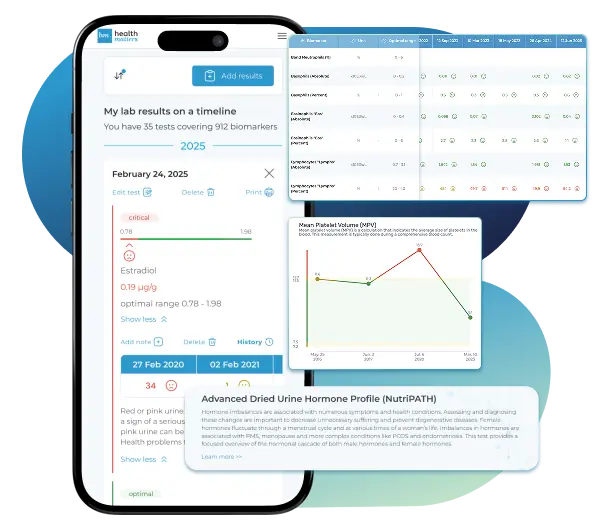
Import lab results from multiple providers, track changes over time, customize your reference ranges, and get clear explanations for each result. Everything is stored securely, exportable in one organized file, and shareable with your doctor—or anyone you choose.
Cancel or upgrade anytime
Article Review & Sources
All our content is backed by peer-reviewed studies, academic research, and trusted medical sources. We're committed to accuracy and transparency — see our editorial policy for details.
Laboratories
Bring All Your Lab Results Together — In One Place
We accept reports from any lab, so you can easily collect and organize all your health information in one secure spot.











Pricing Table
Gather Your Lab History — and Finally Make Sense of It
Finally, Your Lab Results Organized and Clear

Personal plans

$79/ year
Advanced Plan
Access your lab reports, explanations, and tracking tools.
- Import lab results from any provider
- Track all results with visual tools
- Customize your reference ranges
- Export your full lab history anytime
- Share results securely with anyone
- Receive 5 reports entered for you
- Cancel or upgrade anytime
$250/ once
Unlimited Account
Pay once, access everything—no monthly fees, no limits.
- Import lab results from any provider
- Track all results with visual tools
- Customize your reference ranges
- Export your full lab history anytime
- Share results securely with anyone
- Receive 10 reports entered for you
- No subscriptions. No extra fees.
$45/ month
Pro Monthly
Designed for professionals managing their clients' lab reports
- Import lab results from any provider
- Track lab results for multiple clients
- Customize reference ranges per client
- Export lab histories and reports
- Begin with first report entered by us
- Cancel or upgrade anytime
About membership
What's included in a Healthmatters membership
 Import Lab Results from Any Source
 See Your Health Timeline
 Understand What Your Results Mean

 Visualize Your Results

 Data Entry Service for Your Reports
 Securely Share With Anyone You Trust
Let Your Lab Results Tell the Full Story
Once your results are in one place, see the bigger picture — track trends over time, compare data side by side, export your full history, and share securely with anyone you trust.




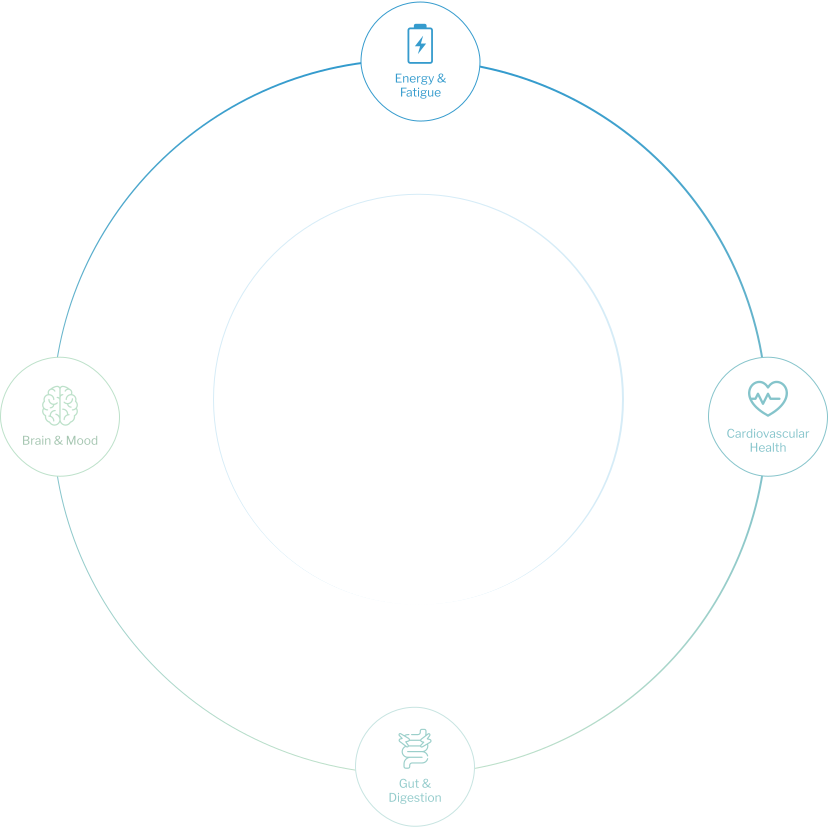
Bring all your results together to compare, track progress, export your history, and share securely.
What Healthmatters Members Are Saying

I have been using Healthmatters.io since 2021. I travel all over the world and use different doctors and health facilities. This site has allowed me to consolidate all my various test results over 14 years in one place. And every doctor that I show this to has been impressed. Because with any health professional I talk to, I can pull up historical results in seconds. It is invaluable. Even going back to the same doctor, they usually do not have the historical results from their facility in a graph format. That has been very helpful.
Anthony
Unlimited Plan Member since 2021
What fantastic service and great, easy-to-follow layouts! I love your website; it makes it so helpful to see patterns in my health data. It's truly a pleasure to use. I only wish the NHS was as organized and quick as Healthmatters.io. You've set a new standard for health tracking!
Karin
Advanced Plan Member since 2020
As a PRO member and medical practitioner, Healthmatters.io has been an invaluable tool for tracking my clients' data. The layout is intuitive, making it easy to monitor trends and spot patterns over time. The ability to customize reports and charts helps me present information clearly to my clients, improving communication and outcomes. It's streamlined my workflow, saving me time and providing insights at a glance. Highly recommended for any practitioner looking for a comprehensive and user-friendly solution to track patient labs!
Paul
Healthmatters Pro Member since 2024

We implement proven measures to keep your data safe.
At HealthMatters, we're committed to maintaining the security and confidentiality of your personal information. We've put industry-leading security standards in place to help protect against the loss, misuse, or alteration of the information under our control. We use procedural, physical, and electronic security methods designed to prevent unauthorized people from getting access to this information. Our internal code of conduct adds additional privacy protection. All data is backed up multiple times a day and encrypted using SSL certificates. See our Privacy Policy for more details.