Optimal Result:
0 - 24 mg/g creat.
Optimal Result:
0 - 24 mg/g creat.

Ketones, such as 3-hydroxybutyric and acetoacetic acids, are the end-products of rapid or excessive fatty acid breakdown.
3-Hydroxybutyric acid is a typical partial-degradation product of branched-chain amino acids (primarily valine) released from muscle for hepatic and renal gluconeogenesis. This acid metabolizes by 3-hydroxybutyrate dehydrogenase—the enzyme functions in nervous tissues and muscles, enabling circulating hydroxybutyrate as a fuel. In the liver mitochondrial matrix, the enzyme can also catalyze the reverse reaction, a step in ketogenesis. Like the other ketone bodies (acetoacetate and acetone), levels of 3-hydroxybutyrate in blood and urine are raised in ketosis. In humans, 3-hydroxybutyrate is synthesized in the liver from acetyl-CoA and can be used as an energy source by the brain when blood glucose is low.
Blood levels of 3-hydroxybutyric acid levels may be monitored in diabetic patients to look for diabetic ketoacidosis. Persistent mild hyperketonemia is a common finding in newborns. Ketone bodies serve as an indispensable energy source for extrahepatic tissues, especially the brain and lung of developing mammals. Another important function of ketone bodies is to provide acetoacetyl-CoA and acetyl-CoA to synthesize cholesterol, fatty acids, and complex lipids. During the early postnatal period, acetoacetate (AcAc) and beta-hydroxybutyrate are preferred over glucose as substrates for the synthesis of phospholipids and sphingolipids accord with requirements for brain growth and myelination.
Lab Results Explained and Tracked
What does it mean if your 3-Hydroxybutyric result is too high?
Acetoacetic acid and 3-hydroxybutyric acid, respectively, are ketones. Ketones in themselves are breakdown products of fatty acid metabolism. When fat is used as an energy source, it is converted into ketones in the liver through ketogenesis. First, free fatty acids are released and converted into acetyl CoA via beta-oxidation in the liver’s mitochondria. Two of these acetyl-CoA molecules are then combined to make ketone bodies. These ketones then leave the liver and make their way to extrahepatic tissues via the bloodstream. In the cell, ketones are broken down into acetyl CoA via beta-oxidation to enter the Citric Acid Cycle. This process is always occurring on some level in the body.
In times of elevated urinary ketones, this means that beta-oxidation has been upregulated, as it is our primary pathway for fatty acid metabolism. In times of increased ketogenesis, more ketones are being formed, and the turnover into acetyl CoA is not keeping up with ketone production. This is due to more ketones being produced than the energy needed by the body, so ketones will build up and be excreted into the urine, leading to an increase in Acetoacetic acid and 3-hydroxybutyric acid.
Possible reasons for elevation:
There are many biologic processes that lead to this phenomenon. Some common, more purposeful, processes are mainly common dietary changes. Ketogenic diets, low carb inspired diets, and also 12-18 hour fasting are all purposeful reasons for elevated ketones. Due to the surge in low carb eating and intermittent fasting, elevations in Acetoacetic acid and 3-hydroxybutyric acid are common. These markers can come in handy when monitoring someone on a keto or low carb eating plan. Whenever elevations are present, it is a good idea to rule out dietary changes that could impact these values.
Other, more concerning reasons for these elevations in ketones include a myriad of processes:
- A common reason in those with G.I. upset is vomiting and diarrhea. The purging associated with these processes leads to an increase in ketogenesis as all sources of energy are being purged, and fat must be used to continue biological processes.
- B12 deficiency is another cause of increased ketones. Due to the requirement of B12 as a cofactor for the enzyme methylmalonyl CoA reductase needed for beta-oxidation of odd chain fatty acids, B12 deficiency can cause a buildup of urinary ketones. This enzyme converts methylmalonyl CoA to succinyl CoA for the incorporation into the CAC or gluconeogenesis for ATP production. Due to a buildup of methylmalonyl CoA and a decrease in succinyl CoA, the body upregulates ketogenesis to meet our energy needs. To determine B12 deficiency is a possible cause be sure to review the marker methylmalonic acid.
- Another possibility is an eating disorder. This could be due to diagnosed or undiagnosed anorexia or bulimia. When the system is malnourished or going through a prolonged fast or purging, the body will upregulate fatty acid metabolism and ketogenesis for adequate energy production.
- Situations, where the body cannot utilize carbohydrates for energy production, will also lead to increased ketones. One common cause is insulin resistance. In times of blood sugar dysregulation, due to a lack of insulin production or insulin resistance, the body must rely on fat metabolism to make ATP. This leads to an increase in ketones in the urine. Potentially this leads to a life-threatening state of ketoacidosis. In an individual consuming carbs in their diet, but also has ketones elevated, insulin resistance should be ruled out. This phenomenon can happen in relation to diabetes type 1 and type 2. An additional culprit for urinary ketones is fungal overgrowth. The fungus can readily absorb and metabolize carbohydrates. When in our intestinal tract, these organisms come into contact with the carbs we eat. In an overgrowth, more fungus is present and can potentially absorb and metabolize enough of the carbs eaten to switch the body into glycogenolysis and eventually ketogenesis. In absence of a low carb diet, all possible causes of elevation should be assessed.
------------
Common causes of elevated ketones, such as 3-hydroxybutyric and acetoacetic acids, are:
- prolonged fasting
- protein malnutrition
- high-fat diet
- vitamin B12 deficiency
- severe GI Candida overgrowth
- pulmonary infections.
Potential treatment option (please discuss with your doctor):
Regardless of the cause, supplementation with L-carnitine or acetyl-L-carnitine (500-1000mg per day) may be beneficial.

All Your Lab Results.
One Simple Dashboard.
Import, Track, and Share Your Lab Results Easily
Import, Track, and Share Your Lab Results
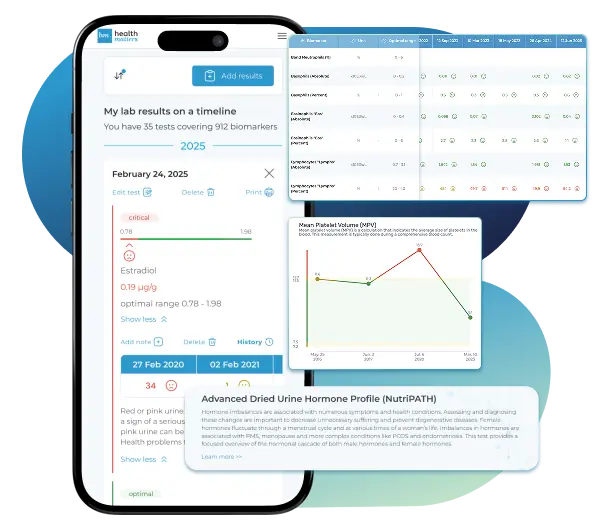
Import lab results from multiple providers, track changes over time, customize your reference ranges, and get clear explanations for each result. Everything is stored securely, exportable in one organized file, and shareable with your doctor—or anyone you choose.
Cancel or upgrade anytime
What does it mean if your 3-Hydroxybutyric result is too low?
Low levels of 3-Hydroxybutyric acid (=beta-hydroxybutyrate) may occur if there are low levels of precursors (fat, amino acids), if there are nutritional enzyme inhibitions, or if a low-activity enzyme variant is inherited. Ketone bodies are derived from fatty acids, levels may be lower on high carbohydrate diets. Ketogenesis occurs within the liver mitochondria, which are sensitive to oxidative stress and environmental toxins. Liver disorders may impair ketone synthesis and abnormally low levels of ketone bodies may impair liver functions.
Low levels of malate or orotate may also impair liver function.
→ Consider supporting synthesis pathways with vitamin B3 and phosphatidyl choline. Increasing healthy dietary fats, digestion and absorption may improve beta-hydroxybutyrate levels.
→ Review Citric Acid Cycle Metabolites and consider nutritional support for mitochondria.
Article Review & Sources
All our content is backed by peer-reviewed studies, academic research, and trusted medical sources. We're committed to accuracy and transparency — see our editorial policy for details.
Laboratories
Bring All Your Lab Results Together — In One Place
We accept reports from any lab, so you can easily collect and organize all your health information in one secure spot.











Pricing Table
Gather Your Lab History — and Finally Make Sense of It
Finally, Your Lab Results Organized and Clear

Personal plans

$79/ year
Advanced Plan
Access your lab reports, explanations, and tracking tools.
- Import lab results from any provider
- Track all results with visual tools
- Customize your reference ranges
- Export your full lab history anytime
- Share results securely with anyone
- Receive 5 reports entered for you
- Cancel or upgrade anytime
$250/ once
Unlimited Account
Pay once, access everything—no monthly fees, no limits.
- Import lab results from any provider
- Track all results with visual tools
- Customize your reference ranges
- Export your full lab history anytime
- Share results securely with anyone
- Receive 10 reports entered for you
- No subscriptions. No extra fees.
$45/ month
Pro Monthly
Designed for professionals managing their clients' lab reports
- Import lab results from any provider
- Track lab results for multiple clients
- Customize reference ranges per client
- Export lab histories and reports
- Begin with first report entered by us
- Cancel or upgrade anytime
About membership
What's included in a Healthmatters membership
 Import Lab Results from Any Source
 See Your Health Timeline
 Understand What Your Results Mean

 Visualize Your Results

 Data Entry Service for Your Reports
 Securely Share With Anyone You Trust
Let Your Lab Results Tell the Full Story
Once your results are in one place, see the bigger picture — track trends over time, compare data side by side, export your full history, and share securely with anyone you trust.




Bring all your results together to compare, track progress, export your history, and share securely.
What Healthmatters Members Are Saying

I have been using Healthmatters.io since 2021. I travel all over the world and use different doctors and health facilities. This site has allowed me to consolidate all my various test results over 14 years in one place. And every doctor that I show this to has been impressed. Because with any health professional I talk to, I can pull up historical results in seconds. It is invaluable. Even going back to the same doctor, they usually do not have the historical results from their facility in a graph format. That has been very helpful.
Anthony
Unlimited Plan Member since 2021
What fantastic service and great, easy-to-follow layouts! I love your website; it makes it so helpful to see patterns in my health data. It's truly a pleasure to use. I only wish the NHS was as organized and quick as Healthmatters.io. You've set a new standard for health tracking!
Karin
Advanced Plan Member since 2020
As a PRO member and medical practitioner, Healthmatters.io has been an invaluable tool for tracking my clients' data. The layout is intuitive, making it easy to monitor trends and spot patterns over time. The ability to customize reports and charts helps me present information clearly to my clients, improving communication and outcomes. It's streamlined my workflow, saving me time and providing insights at a glance. Highly recommended for any practitioner looking for a comprehensive and user-friendly solution to track patient labs!
Paul
Healthmatters Pro Member since 2024

We implement proven measures to keep your data safe.
At HealthMatters, we're committed to maintaining the security and confidentiality of your personal information. We've put industry-leading security standards in place to help protect against the loss, misuse, or alteration of the information under our control. We use procedural, physical, and electronic security methods designed to prevent unauthorized people from getting access to this information. Our internal code of conduct adds additional privacy protection. All data is backed up multiple times a day and encrypted using SSL certificates. See our Privacy Policy for more details.