
Taurine
 Optimal Result:
4.41 - 10.99 qmol/dL.
Optimal Result:
4.41 - 10.99 qmol/dL.

Taurine differs from other amino acids because a sulfur group replaces the carboxyl group of what would be the nonessential amino acid, β-alanine. It takes part in biochemical reactions and is not fully incorporated into proteins. In most tissues, it remains a free amino acid.
Taurine’s highest concentration is in muscle, platelets, and the central nervous system. Taurine is mainly obtained via dietary sources (dairy, shellfish, turkey, energy drinks), but can also come from sulfur amino acid metabolism (methionine and cysteine).
It has been proposed that taurine acts as an antioxidant, intracellular osmolyte, membrane stabilizer, and a neurotransmitter.
In the CNS, taurine is second only to glutamate in abundance. Taurine is extensively involved in neurological activities, (calming neural excitability, cerebellar functional maintenance, and motor behavior modulation), through interaction with dopaminergic, adrenergic, serotonergic, and cholinergic receptors, and through glutamate.
In cardiovascular disease, taurine’s benefits are multifactorial. Because taurine’s main physiologic role is in bile acid conjugation in the liver, it has been demonstrated that taurine is capable of reducing plasma LDL, total lipid concentration, and visceral fat in diabetic, obese patients.
Taurine has been shown to be a protector of endothelial structure and function after exposure to inflammatory cells, their mediators, or other chemicals.
Taurine is thought to be involved in cell volume regulation and intracellular free calcium concentration modulation. Because of these effects, experimental evidence shows promise for taurine therapy in preventing cardiac damage during bypass surgery, heart transplantation and myocardial infarction. Moreover, severe taurine extravasation from cardiomyocytes during an ischemia–reperfusion insult may increase ventricular remodeling and heart failure risk.
Recent work has revealed taurine’s action in the retina as a photoreceptor cell promoter.
The human fetus has no ability to synthesize taurine. Taurine is found in breast milk, but it is also routinely added to infant formulas.
Although taurine is very beneficial, it is often unnecessary to supplement. Dietary intake and sulfur amino metabolism are usually more than adequate to meet the body’s needs. Newborns, patients with restricted diets, or patients with various diseases may be depleted in taurine and can benefit from supplementation.
References:
- Hayes K. Taurine requirement in primates. Nutr Rev. 1985;43(3):65-70.
- Wojcik OP, Koenig KL, Zeleniuch-Jacquotte A, Costa M, Chen Y. The potential protective effects of taurine on coronary heart disease. Atherosclerosis. 2010;208(1):19-25.
- Ripps H, Shen W. Taurine: a “very essential” amino acid. Molec Vision. 2012;18:2673.
- Vanitha M, Baskaran K, Periyasamy K, et al. A review on the biomedical importance of taurine. Int J Pharm Res Health Sci. 2015;3(3):680-686.
- Schaffer SW, Jong CJ, Ito T, Azuma J. Effect of taurine on ischemia–reperfusion injury. Amino Acids. 2014;46(1):21-30.
- Brosnan JT, Jacobs RL, Stead LM, Brosnan ME. Methylation demand: a key determinant of homocysteine metabolism. ACTA BIOCHIM POLON. 2004;51:405-414.
- Ripps H, Shen W. Review: taurine: a “very essential” amino acid. Molec Vision. 2012;18:2673-2686.
- Hayes KC. Taurine requirement in primates. Nutr Rev.1985;43(3):65-70
- Lonsdale D, Shamberger RJ, Obrenovich ME. Dysautonomia in autism spectrum disorder: case reports of a family with review of the literature. Autism Res Treat. 2011;2011:129795.
- Belaidi AA, Schwarz G. Molybdenum cofactor deficiency: metabolic link between taurine and S-sulfocysteine. Adv Exp Med Biol. 2013;776:13-19.
- Blom HJ, Smulders Y. Overview of homocysteine and folate metabolism. With special references to cardiovascular disease and neural tube defects. J Inherit Metab Dis. 2011;34(1):75-81.
- Wu XY, Lu L. Vitamin B6 deficiency, genome instability and cancer. Asian Pac J Cancer Prev. 2012;13(11):5333-5338.
- Bird RP. The Emerging Role of Vitamin B6 in Inflammation and Carcinogenesis. Adv Food Nutr Res. 2018;83:151-194.
- Durlach J, Bara M, Guiet-Bara A, Rinjard P. Taurine and magnesium homeostasis: New data and recent advances. In: Magnesium Cellular Proc Med. Karger Publishers; 1987:219- 238.
- Millart H, Durlach V, Durlach J. Red blood cell magnesium concentrations: analytical problems and significance. Magnesium Res. 1995;8(1):65-76.
- Yamori Y, Taguchi T, Mori H, Mori M. Low cardiovascular risks in the middle aged males and females excreting greater 24- hour urinary taurine and magnesium in 41 WHO-CARDIAC study populations in the world. J Biomed Sci. 2010;17 Suppl 1:S21.
Lab Results Explained and Tracked
What does it mean if your Taurine result is too high?
Excessive dietary intake of taurine-rich foods/beverages may result in elevated taurine levels (i.e. energy drinks, dairy, shellfish, and turkey).
Because taurine is part of the transsulfuration pathway, a single nucleotide polymorphism (SNP) in the cystathioninebeta-synthase (CBS) enzyme can elevate taurine, but only in the absence of oxidative stress and presence of adequate glutathione levels.
However, because oxidative stress and inflammation can upregulate transsulfuration in general, taurine may also be elevated in response to those factors. Antioxidants, such as vitamins A and E, as well as plant-based antioxidants, can help to mitigate oxidative damage. As with all sulfur-containing amino acids, the enzyme sulfite oxidase catabolizes the amino acid into sulfite for excretion. An important cofactor for this enzyme is molybdenum. With that, insufficient molybdenum can contribute to elevated taurine levels.
Because renal excretion of taurine depends on a sodium chloride transporter which is regulated by vitamin B1, irregular renal excretion of taurine can be seen in functional vitamin B1 insuffiencies.
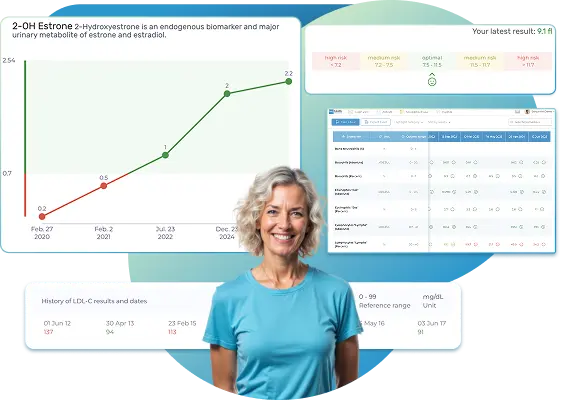
All Your Lab Results.
One Simple Dashboard.
Import, Track, and Share Your Lab Results Easily
Import, Track, and Share Your Lab Results
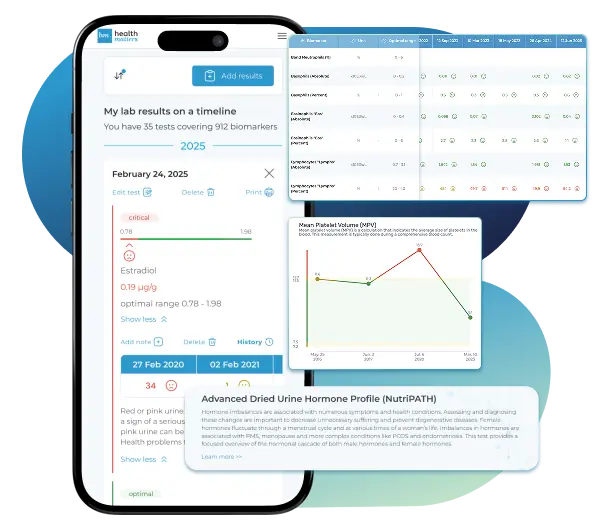
Import lab results from multiple providers, track changes over time, customize your reference ranges, and get clear explanations for each result. Everything is stored securely, exportable in one organized file, and shareable with your doctor—or anyone you choose.
Cancel or upgrade anytime
What does it mean if your Taurine result is too low?
Low levels of amino acids can be seen with poor dietary intake, GI tract malabsorption, or maldigestion. Because of taurine’s role in the transsulfuration pathway, low levels of taurine may also be due to excessive oxidative stress, lack of precursors, or deficient enzymatic cofactors.
Article Review & Sources
All our content is backed by peer-reviewed studies, academic research, and trusted medical sources. We're committed to accuracy and transparency — see our editorial policy for details.
Laboratories
Bring All Your Lab Results Together — In One Place
We accept reports from any lab, so you can easily collect and organize all your health information in one secure spot.









Pricing Table
Gather Your Lab History — and Finally Make Sense of It
Finally, Your Lab Results Organized and Clear

Personal plans

$79/ year
Advanced Plan
Access your lab reports, explanations, and tracking tools.
- Import lab results from any provider
- Track all results with visual tools
- Customize your reference ranges
- Export your full lab history anytime
- Share results securely with anyone
- Receive 5 reports entered for you
- Cancel or upgrade anytime
$250/ once
Unlimited Account
Pay once, access everything—no monthly fees, no limits.
- Import lab results from any provider
- Track all results with visual tools
- Customize your reference ranges
- Export your full lab history anytime
- Share results securely with anyone
- Receive 10 reports entered for you
- No subscriptions. No extra fees.
$45/ month
Pro Monthly
Designed for professionals managing their clients' lab reports
- Import lab results from any provider
- Track lab results for multiple clients
- Customize reference ranges per client
- Export lab histories and reports
- Begin with first report entered by us
- Cancel or upgrade anytime
About membership
What's included in a Healthmatters membership
 Import Lab Results from Any Source
 See Your Health Timeline
 Understand What Your Results Mean

 Visualize Your Results

 Data Entry Service for Your Reports
 Securely Share With Anyone You Trust
Let Your Lab Results Tell the Full Story
Once your results are in one place, see the bigger picture — track trends over time, compare data side by side, export your full history, and share securely with anyone you trust.




Bring all your results together to compare, track progress, export your history, and share securely.
What Healthmatters Members Are Saying

I have been using Healthmatters.io since 2021. I travel all over the world and use different doctors and health facilities. This site has allowed me to consolidate all my various test results over 14 years in one place. And every doctor that I show this to has been impressed. Because with any health professional I talk to, I can pull up historical results in seconds. It is invaluable. Even going back to the same doctor, they usually do not have the historical results from their facility in a graph format. That has been very helpful.
Anthony
Unlimited Plan Member since 2021
What fantastic service and great, easy-to-follow layouts! I love your website; it makes it so helpful to see patterns in my health data. It's truly a pleasure to use. I only wish the NHS was as organized and quick as Healthmatters.io. You've set a new standard for health tracking!
Karin
Advanced Plan Member since 2020
As a PRO member and medical practitioner, Healthmatters.io has been an invaluable tool for tracking my clients' data. The layout is intuitive, making it easy to monitor trends and spot patterns over time. The ability to customize reports and charts helps me present information clearly to my clients, improving communication and outcomes. It's streamlined my workflow, saving me time and providing insights at a glance. Highly recommended for any practitioner looking for a comprehensive and user-friendly solution to track patient labs!
Paul
Healthmatters Pro Member since 2024

We implement proven measures to keep your data safe.
At HealthMatters, we're committed to maintaining the security and confidentiality of your personal information. We've put industry-leading security standards in place to help protect against the loss, misuse, or alteration of the information under our control. We use procedural, physical, and electronic security methods designed to prevent unauthorized people from getting access to this information. Our internal code of conduct adds additional privacy protection. All data is backed up multiple times a day and encrypted using SSL certificates. See our Privacy Policy for more details.