
MPV Blood Test High or Low: What Your Result Means
Other names: MPV, Mean Platelet Volume, Mean Platelet Volume (MPV), Platelet Mean Volume, Mean Platelet Vol, Platelet Volume Mean, Average Platelet Size, Platelet Size, MPV Blood Test
 Optimal Result:
7.5 - 11.5 fl.
Optimal Result:
7.5 - 11.5 fl.

At a Glance
MPV is the average size of your platelets, reported in femtoliters (fL). It is measured by the analyzer while it counts them, and it is reported with the complete blood count.
- What to check first: your platelet count, and the range printed on your own report.
- High MPV: your platelets were larger on average than the range allows. When the platelet count is low, that can support increased turnover or loss.
- Low MPV: they were smaller on average. When the platelet count is also low, reduced production may be considered.
- What MPV cannot do: diagnose a disease, measure how well platelets work, or determine your bleeding or clotting risk by itself.
This marker stores 7.5 to 11.5 fL as its range, and that is the interval your result here is flagged against. It is not a universal number. Analyzer, anticoagulant and the time between the draw and the measurement all move MPV, so the interval printed on your own report may differ — and where it does, yours is the one that applies to your blood.
How to read your result
Before looking for causes, answer four questions.
- Did the laboratory flag it? Use the range on your report, not one found online.
- What is the platelet count? This is the companion result, and it changes what MPV means more than anything else does.
- Is the rest of the complete blood count normal? Changes across several cell lines shift the significance of the finding.
- Is this persistent, on comparable testing? A single small deviation can be biological or measurement variation.
Then read the pair.
| MPV | Platelet count | What the pattern can suggest | What it does not establish |
|---|---|---|---|
| In range | In range | No platelet size or count abnormality is apparent | Normal MPV does not prove normal platelet function |
| High | Low | Increased turnover or peripheral loss may be considered | It does not diagnose immune thrombocytopenia or identify a cause |
| Low or in range | Low | Reduced production may be considered | It cannot confirm marrow suppression or a marrow disorder |
| High | In range | An isolated size finding; compare with previous results and the rest of the count | It does not by itself establish cancer, inflammation or a clotting disorder |
| Low | In range | Limited meaning by itself | Confirm the range and compare with prior same-laboratory results |
| High | High | Nonspecific; needs the wider clinical picture | MPV cannot separate a reactive platelet rise from a clonal disorder |
These are patterns, not diagnoses. Published cutoffs vary by population and analyzer, and results overlap between causes.
What a specific MPV number means
Read your value against the interval on your own report. Against the 7.5 to 11.5 fL this record stores, the flags fall like this:
| Value | How this record flags it | What the number establishes |
|---|---|---|
| 8.7 or 8.9 fL | In range | Average size falls inside this interval |
| 9.3 fL | In range | Average size falls inside this interval |
| 10.8 fL | In range, upper half | Still inside this interval |
| 11.2 or 11.3 fL | In range, near the top | Still inside this interval |
| 11.5 fL | At the upper limit | Still inside this interval |
| 11.6 or 11.8 fL | High | Just above this interval |
| 12.2 or 12.6 fL | High | Above this interval |
| 12.7 or 12.8 fL | High | Further above it — but the number alone identifies no cause and no severity |
Notice how much of that list sits between 11 and 12.8 — either side of one boundary. That is where most people arrive, and it is exactly where the interval you read against decides the answer: a laboratory using a different range will label some of these values differently. The distance above the limit is also not a severity scale: 12.7 fL is not automatically more serious than 11.6 fL. Platelet count, symptoms, the rest of the count and specimen quality all carry more than the size of the gap.
What does high MPV mean?
Larger platelets on average than the range allows.
With a low platelet count, a high MPV can support the possibility that platelets are being destroyed, consumed or lost, and that the marrow is responding by releasing larger ones. That is one reading among several. It cannot establish immune thrombocytopenia, infection, inflammation or bleeding.
With a normal platelet count, an isolated high MPV gives far less direction. Look at the rest of the count, previous results, symptoms, medications, and whether both tests came from the same laboratory. It does not by itself establish cancer or a clotting disorder.
With a high platelet count, MPV does not tell you whether the rise is reactive or driven by a marrow disorder. The count itself, the clinical setting and follow-up testing decide that.
What does low MPV mean?
Smaller platelets on average than the range allows.
With a low platelet count, a low or in-range MPV can support reduced production. It cannot confirm marrow suppression, chemotherapy effect, aplastic anemia, myelodysplastic syndrome or leukemia.
With a normal platelet count, a mildly low MPV may carry little on its own. Check whether it is new, whether the laboratory changed, and whether the report carries a platelet-clumping or giant-platelet comment.
Low MPV does not itself cause symptoms. Symptoms come from an underlying condition or from the platelet count — not from the size number.
If you remember only one thing
Platelet count tells you how many platelets you have; MPV tells you their average size. Neither is read without the other. An MPV flag is a prompt to look at the platelet count and the rest of the complete blood count — not a finding that stands on its own, and not a diagnosis of anything.
Two people, same result
Two reports both read 12.2 fL.
The first belongs to someone whose platelet count is inside the range, whose count is otherwise unremarkable, who has no bleeding or bruising, and whose MPV was similar on previous tests at the same laboratory. This is an isolated, stable finding, and it generally carries less information than the same value accompanied by an abnormal platelet count or symptoms.
The second belongs to someone with a low platelet count, new unexplained bruising, and other abnormalities across the count. The same 12.2 now sits inside a pattern that needs looking at.
The MPV did not change. The platelet count, the symptoms, the rest of the results and the trend changed what it meant.
Why MPV can differ between tests
MPV is unusually sensitive to how the sample was handled. Platelets swell after blood is drawn, so the result moves with the anticoagulant in the tube, the storage conditions, the time between collection and measurement, and the analyzer technology. Published work comparing EDTA and citrate samples over time found platelet volume changing after collection and differing between tubes — which is why laboratories set their own intervals and their own timing rules.
Trends are easiest to interpret when testing uses the same laboratory and method. A change between laboratories may reflect method as well as biology.
None of that means an abnormal MPV should be waved away as a laboratory quirk. It means MPV needs its own report's range, the platelet count beside it, and any specimen comments before conclusions get drawn.
What this result cannot tell you
Whether your platelets work. Size is not function.
Whether you will bleed or clot. MPV does not predict either on its own.
Whether production is definitely up or down. It can support a direction; it cannot confirm one.
Whether you have immune thrombocytopenia, cancer, infection, inflammation or a marrow disorder. None of these is established by a size measurement.
Why the value changed, or whether anything needs treating.
A normal MPV does not rule out a platelet disorder, and an abnormal one does not establish it.
Common interpretation mistakes
Using a range from the internet instead of the one on the report. MPV intervals are method-dependent and genuinely differ.
Reading MPV without the platelet count. This removes the companion result that does the interpretive work.
Treating larger as more dangerous. Bigger average platelets do not automatically mean abnormal clotting or higher risk.
Turning a pattern into a diagnosis. High MPV with low platelets can support increased turnover; it does not prove immune destruction. Low MPV with low platelets can support reduced production; it does not prove marrow failure.
Comparing two laboratories as though the numbers were interchangeable. Analyzer and processing differences shift MPV.
Ignoring the laboratory comments. A note about platelet clumping or unusually large platelets bears on how the platelet count and MPV should be read.
Questions your doctor may ask
Is the platelet count low, normal or high?
Is this MPV new, or has it been stable across previous tests?
Were the earlier tests run by the same laboratory?
Any bleeding, bruising, petechiae, heavy periods or prolonged bleeding from small cuts?
Any recent illness, new medication, supplement, or pregnancy?
Are hemoglobin or white cell results also abnormal?
Does the report mention platelet clumping, giant platelets or another analyzer flag?
Read together with
Platelet count / Platelets — how many platelets are present. The companion result MPV is read against.
Immature Platelet Fraction — a more direct measure of newly released platelets, where it is available.
Platelet Distribution Width (PDW) — how much platelet size varies, rather than its average.
Platelet-large cell ratio (P-LCR) — the proportion of platelets that are large.
Plateletcrit (PCT) — the share of blood volume made up of platelets, combining count and size.
Clinical pearls
MPV is a size measurement, not a function test and not a diagnosis. Platelet number, platelet size and platelet function are three different things, and this marker measures only the second.
When a result deserves a conversation. Take it to the clinician who ordered it when the platelet count is low or high, when MPV stays outside the range on comparable testing, when several results in the count are abnormal, when the report mentions clumping or giant platelets, when you have unexplained bruising, petechiae, frequent nosebleeds, bleeding gums, unusually heavy periods or prolonged bleeding, or when you take a medication that can affect platelet production or survival. Seek urgent care for heavy bleeding that will not stop, blood in vomit or stool, or a sudden severe headache with neurological symptoms.
Read the laboratory comments, not only the numbers. Platelet clumping in the collection tube is a recognized cause of a falsely low platelet count, and reporting of platelet indices is not uniform — institutions differ on which of the parameters their analyzers produce are actually released. A comment about clumping or unusually large platelets bears on the whole platelet line, and a blood film review may be what settles it.
Same laboratory, same method, for trends. A change measured across two laboratories may reflect method as well as biology, so it is weaker evidence of a real change. This is the most useful habit for anyone tracking platelet indices over time, and it costs nothing.
Clinical Takeaway
MPV is the analyzer's estimate of mean platelet volume, reported with the complete blood count where the laboratory releases it, and flagged here against a stored interval of 7.5 to 11.5 fL. Interpretation rests on the platelet count: high MPV with thrombocytopenia may support increased turnover or peripheral loss, while low or in-range MPV with thrombocytopenia may support reduced production — neither establishes a cause, and published cutoffs vary by population and analyzer. Isolated MPV abnormalities with a normal platelet count carry limited information. MPV is preanalytically sensitive, varying with anticoagulant, storage and time to analysis, so trends are easiest to interpret when testing uses the same laboratory and method, and a change between laboratories may reflect method as well as biology. It does not measure platelet function and cannot determine an individual's bleeding or clotting risk by itself.
In one sentence
MPV measures average platelet size, and it becomes useful only when read with the platelet count, the range on your own report, the rest of the blood count and whether the pattern persists.
Bottom line
A high or low MPV is not a diagnosis. Start with two things: the range printed beside your result, and your platelet count. Those two together explain most of what an MPV flag is telling you.
Then widen out. Look at the rest of the complete blood count, any symptoms, previous results from the same laboratory, and any analyzer comments about clumping or giant platelets. MPV can contribute a clue about whether platelets are being produced or lost faster than usual — above all when the platelet count is low — but it cannot name the cause, and it cannot tell you about bleeding risk, clotting risk or cancer by itself.
If your platelet count is normal and the MPV is only slightly outside the range, that finding may carry limited information by itself. If the platelet count is also abnormal, or you have bruising or bleeding you cannot explain, that is the conversation to have with the clinician who ordered the test.
FAQ about Mean Platelet Volume (MPV)
-
What is MPV in a blood test?
MPV stands for mean platelet volume. It is the average size of the platelets in your sample, reported in femtoliters (fL), and the analyzer works it out while it is counting them — which is why it appears on the complete blood count without being ordered separately, where the laboratory releases it. Platelets are the small cell fragments that gather at an injured blood vessel and help stop bleeding. The important distinction is between number and size: the platelet count says how many you have, and MPV says how large they are on average. Those two answer different questions and are read together, because MPV on its own tells you very little. Larger platelets can include ones released recently from the bone marrow, so the average size can hint at whether production is keeping pace — but MPV is an average, not a count of young platelets. -
What is a normal MPV level?
There is no single MPV range that every laboratory uses. This record stores 7.5 to 11.5 fL and flags results against it, but that is this record's interval rather than a universal one, and the range printed on your own report is the one that applies to your blood. The differences are real rather than cosmetic: MPV depends on the analyzer technology, on the anticoagulant in the collection tube, and on how long the sample sat before it was measured, because platelets swell after the blood is drawn. Laboratories therefore establish their own intervals and their own timing rules. The practical consequence is that a value someone else was told is normal may be flagged on your report, and the same value can be flagged differently by two laboratories. Read your number against the range beside it, and read both alongside your platelet count. -
What does high MPV mean?
A high MPV means the platelets in your sample were larger on average than your laboratory's range allows. What that suggests depends almost entirely on the platelet count beside it. When the platelet count is low, a high MPV can support the possibility that platelets are being destroyed, consumed or lost, and that the bone marrow is responding by releasing larger, newer ones. That is one reading of the pattern rather than a diagnosis — it does not establish immune thrombocytopenia, infection, inflammation or any other specific cause. When the platelet count is normal, an isolated high MPV gives much less direction and does not by itself establish cancer or a clotting disorder. When the platelet count is high, MPV cannot tell you whether the rise is reactive or driven by a marrow disorder. In every case it is read with the rest of the complete blood count. -
What does low MPV mean?
A low MPV means the platelets in your sample were smaller on average than your laboratory's range allows. When the platelet count is also low, a low or in-range MPV can support reduced platelet production — a marrow that is not replacing platelets is not releasing the larger, newer ones that pull the average up. What it cannot do is confirm a cause: marrow suppression, chemotherapy effect, aplastic anemia, myelodysplastic syndrome and leukemia all need other tests to establish or exclude. When the platelet count is normal, a mildly low MPV often carries very little on its own, and the useful questions are whether it is new, whether the laboratory changed between tests, and whether the report mentions platelet clumping or giant platelets. A low MPV does not itself cause symptoms — those come from an underlying condition or from the platelet count. -
Is an MPV of 12 high?
Against this record's stored interval of 7.5 to 11.5 fL, a value of 12 is above the top and would be flagged high — as are 11.6, 12.2 and 12.6, which are among the values people search most. Against a laboratory using a wider interval it might not be, which is why the range printed beside your own result is the one that settles it. But the more useful point is what being flagged does and does not mean. A value of 12 with a normal platelet count, no symptoms, and a similar MPV on earlier tests from the same laboratory is an isolated finding with limited information in it. The same 12 alongside a low platelet count and new unexplained bruising sits inside a pattern that needs looking at. The distance above the limit is also not a severity scale — 13 is not automatically more serious than 12. Platelet count, symptoms and the rest of the blood count carry far more than the size of the gap. -
What does high MPV with low platelets mean?
This is the pattern where MPV adds the most. Larger platelets can include ones released recently from the bone marrow, so a high MPV alongside a low platelet count can support the possibility that platelets are being destroyed, consumed or lost in the circulation while the marrow responds by producing more. That is a useful direction, and it is genuinely different from the picture of a marrow that is not producing enough, where MPV tends to be low or unremarkable. What the pattern does not do is prove immune thrombocytopenia or name any other cause — published cutoffs vary by population and analyzer, and the values for different causes of a low platelet count overlap considerably. Clinical history, examination, the rest of the complete blood count and often a blood film review are what narrow it down. The pattern is a reason for that assessment, not a substitute for it. -
What does abnormal MPV with a normal platelet count mean?
Usually less than people expect. MPV is at its most informative when the platelet count is abnormal, because the two together describe whether platelet production appears to be keeping pace with turnover. When the count is normal, an isolated high or low MPV loses most of that context. The questions worth asking are whether the finding is new or long-standing, whether earlier tests came from the same laboratory and analyzer, whether the rest of the complete blood count is unremarkable, and whether the report carries an analyzer comment about platelet clumping or giant platelets that could have affected the measurement. An isolated MPV abnormality with a normal count does not by itself establish cancer, inflammation, a clotting problem or a marrow disorder. It is worth mentioning to your clinician, alongside the actual numbers, rather than acting on. -
Is high MPV a sign of cancer?
A high MPV on its own cannot diagnose or exclude cancer, and it is not a cancer screening test. Blood cancers can change several measurements in a complete blood count, so MPV may be abnormal in someone who has one — but so can any number of ordinary things, including how the sample was handled. The measurement describes average platelet size and nothing more. What actually carries information is the whole picture: the platelet count, whether other cell lines are abnormal, whether the finding persists on repeat testing at the same laboratory, whether there are symptoms, and what a blood film shows if one is reviewed. An isolated high MPV with a normal platelet count and an otherwise normal count is a weak signal in any direction. If you are worried, the productive step is to take the full report to your clinician rather than to read one line of it. -
Does high MPV mean I have a clotting problem?
No conclusion about clotting can be drawn from MPV alone. The measurement describes how large your platelets are on average; it does not test how they behave. Whether platelets stick to a damaged vessel wall, activate and clump together is a matter of platelet function, and that needs different tests entirely. Research has looked at whether average platelet size tracks with cardiovascular risk across populations, but a population-level association is not a prediction about an individual. MPV is not used by itself in routine care to determine an individual's clotting risk. Larger platelets are not simply more dangerous ones. If clotting risk is the actual question, it is assessed from history, symptoms, examination and tests chosen for that purpose. MPV on a routine blood count is not one of them, and a high value is not a reason to start or change any medication. -
Why can MPV change between laboratories?
Because MPV is unusually sensitive to things that have nothing to do with you. Platelets swell after blood is drawn, so the measured volume moves with the anticoagulant in the tube, the storage conditions and the time between collection and analysis — published work comparing EDTA and citrate samples found platelet volume changing after collection and differing between tube types. Analyzer technology differs as well, and laboratories set their own reference intervals to match their own method and timing. The practical consequences are two. First, a value flagged at one laboratory may be unflagged at another, and neither is wrong. Second, trends are easiest to interpret when testing uses the same laboratory and method — a change between laboratories may reflect method as well as biology, so it is weaker evidence of a real change rather than no evidence at all. -
Does MPV measure platelet function?
No. MPV measures average platelet size, which is a physical dimension, not a measure of performance. Platelet function is whether platelets adhere to a damaged vessel wall, activate, release their granules and aggregate into a plug — and that is assessed with dedicated tests such as platelet function analysis or aggregometry, not with a size measurement on a routine blood count. The three concepts worth keeping separate are number, size and function: the platelet count gives the number, MPV gives the size, and neither addresses function. This matters in both directions. A normal MPV does not mean your platelets work normally, and it does not exclude an inherited or acquired platelet function disorder. An abnormal MPV does not mean they work badly. If a function problem is suspected — for example, bleeding out of proportion to a normal platelet count — that calls for different testing. -
Why is MPV missing from my blood test results?
MPV may be absent because some laboratories do not routinely report every platelet parameter their analyzers produce. A clinical laboratory science review notes that institutions vary in which platelet indices they release, so a missing MPV does not by itself mean something was wrong with your sample. First check whether the laboratory routinely reports MPV, and whether the report contains a comment. A note about platelet clumping or unusually large platelets is a separate reason to interpret the platelet results carefully, because clumping can make the platelet count falsely low. Without a specific laboratory comment, however, do not assume that clumping explains the missing MPV. Your clinician can ask the laboratory whether MPV was measured, and whether repeating the complete blood count would be useful. -
Is MVP the same as MPV on a blood test?
Almost certainly you mean MPV, and the letters are easy to reverse. MPV is mean platelet volume — the average size of your platelets, reported on a complete blood count in femtoliters. MVP is an unrelated abbreviation, used in medicine for mitral valve prolapse, a heart valve condition that has nothing to do with platelets and is not something a blood count reports. If you are looking at a complete blood count, check whether the label is MPV, whether it appears near the platelet count, and whether it is reported in fL. If instead a doctor has mentioned MVP in the context of your heart, that is a different subject entirely and this page is not about it. For what a blood count's MPV value means, read it alongside your platelet count and the range printed beside it.
Lab Results Explained and Tracked
What does it mean if your Mean Platelet Volume (MPV) result is too high?
A result flagged high measured above this record's stored interval of 7.5 to 11.5 fL — the platelets in your sample were larger on average than that range allows. Check it against the interval printed on your own report first, because laboratories set their own and a value flagged here can sit inside the range yours used.
Where the result is genuinely high, the platelet count is what gives it meaning.
With a low platelet count, larger platelets can include ones released recently from the bone marrow, so a high MPV can support the possibility that platelets are being destroyed, consumed or lost and that production is responding. This is one reading of the pattern. It does not establish immune thrombocytopenia, and it does not identify why the count is low.
With a normal platelet count, an isolated high MPV gives far less direction. Compare it with previous results from the same laboratory, look at the rest of the complete blood count, and check for any laboratory comment about unusually large platelets or clumping. It does not by itself establish cancer, inflammation or a clotting disorder.
With a high platelet count, MPV cannot separate a reactive rise from one driven by a marrow disorder. That distinction comes from the count itself, the clinical setting and follow-up testing.
How far above the limit the value sits is not a severity scale. Take a flagged result to the clinician who ordered it, with your platelet count and any earlier results from the same laboratory.

All Your Lab Results.
One Simple Dashboard.
Import, Track, and Share Your Lab Results Easily
Import, Track, and Share Your Lab Results
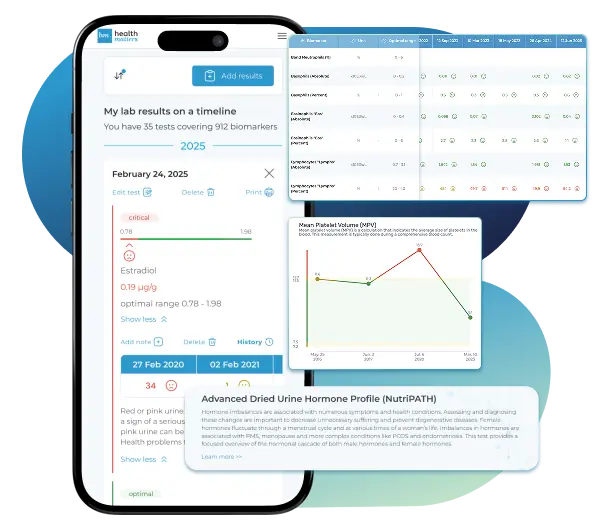
Import lab results from multiple providers, track changes over time, customize your reference ranges, and get clear explanations for each result. Everything is stored securely, exportable in one organized file, and shareable with your doctor—or anyone you choose.
Cancel or upgrade anytime
What does it mean if your Mean Platelet Volume (MPV) result is too low?
A result flagged low measured below this record's stored interval of 7.5 to 11.5 fL — the platelets in your sample were smaller on average than that range allows. Check it against the interval on your own report first, since laboratories publish different ones.
Where the result is genuinely low, the platelet count again decides most of the meaning.
With a low platelet count, a low or in-range MPV can support reduced platelet production, because a marrow that is not replacing platelets is not releasing the larger, newer ones that raise the average. It cannot confirm marrow suppression, chemotherapy effect, aplastic anemia, myelodysplastic syndrome or leukemia. Those need other tests.
With a normal platelet count, a mildly low MPV may carry very little on its own. Worth checking: whether it is a new finding or a long-standing one, whether the testing laboratory changed between results, and whether the report carries a platelet-clumping or giant-platelet comment that affected the measurement.
A low MPV does not itself produce symptoms. Bruising, bleeding or fatigue come from an underlying condition or from the platelet count, not from the average size of the platelets.
As with a high result, a single value is compared against earlier ones from the same laboratory before it means much. Take it to the clinician who ordered the test along with the platelet count.
Related Biomarkers
Article Review & Sources
All our content is backed by peer-reviewed studies, academic research, and trusted medical sources. We're committed to accuracy and transparency — see our editorial policy for details.
Laboratories
Bring All Your Lab Results Together — In One Place
We accept reports from any lab, so you can easily collect and organize all your health information in one secure spot.











Pricing Table
Gather Your Lab History — and Finally Make Sense of It
Finally, Your Lab Results Organized and Clear

Personal plans

$79/ year
Advanced Plan
Access your lab reports, explanations, and tracking tools.
- Import lab results from any provider
- Track all results with visual tools
- Customize your reference ranges
- Export your full lab history anytime
- Share results securely with anyone
- Receive 5 reports entered for you
- Cancel or upgrade anytime
$250/ once
Unlimited Account
Pay once, access everything—no monthly fees, no limits.
- Import lab results from any provider
- Track all results with visual tools
- Customize your reference ranges
- Export your full lab history anytime
- Share results securely with anyone
- Receive 10 reports entered for you
- No subscriptions. No extra fees.
$45/ month
Pro Monthly
Designed for professionals managing their clients' lab reports
- Import lab results from any provider
- Track lab results for multiple clients
- Customize reference ranges per client
- Export lab histories and reports
- Begin with first report entered by us
- Cancel or upgrade anytime
About membership
What's included in a Healthmatters membership
 Import Lab Results from Any Source
 See Your Health Timeline
 Understand What Your Results Mean

 Visualize Your Results

 Data Entry Service for Your Reports
 Securely Share With Anyone You Trust
Let Your Lab Results Tell the Full Story
Once your results are in one place, see the bigger picture — track trends over time, compare data side by side, export your full history, and share securely with anyone you trust.




Bring all your results together to compare, track progress, export your history, and share securely.
What Healthmatters Members Are Saying

I have been using Healthmatters.io since 2021. I travel all over the world and use different doctors and health facilities. This site has allowed me to consolidate all my various test results over 14 years in one place. And every doctor that I show this to has been impressed. Because with any health professional I talk to, I can pull up historical results in seconds. It is invaluable. Even going back to the same doctor, they usually do not have the historical results from their facility in a graph format. That has been very helpful.
Anthony
Unlimited Plan Member since 2021
What fantastic service and great, easy-to-follow layouts! I love your website; it makes it so helpful to see patterns in my health data. It's truly a pleasure to use. I only wish the NHS was as organized and quick as Healthmatters.io. You've set a new standard for health tracking!
Karin
Advanced Plan Member since 2020
As a PRO member and medical practitioner, Healthmatters.io has been an invaluable tool for tracking my clients' data. The layout is intuitive, making it easy to monitor trends and spot patterns over time. The ability to customize reports and charts helps me present information clearly to my clients, improving communication and outcomes. It's streamlined my workflow, saving me time and providing insights at a glance. Highly recommended for any practitioner looking for a comprehensive and user-friendly solution to track patient labs!
Paul
Healthmatters Pro Member since 2024

We implement proven measures to keep your data safe.
At HealthMatters, we're committed to maintaining the security and confidentiality of your personal information. We've put industry-leading security standards in place to help protect against the loss, misuse, or alteration of the information under our control. We use procedural, physical, and electronic security methods designed to prevent unauthorized people from getting access to this information. Our internal code of conduct adds additional privacy protection. All data is backed up multiple times a day and encrypted using SSL certificates. See our Privacy Policy for more details.