
MXD Blood Test: Normal Range (0–12%), High & Low Meaning
Other names: MXD, MXD%, MXD#, Mixed Cells, Mixed Cells Blood Test, MXD Blood Test, MXD in Blood Test, MXD CBC, Mixed White Blood Cells, MXD Percentage, MXD Count, MID, MID Blood Test, MID Cells, Middle Cells, Mixed Differential, MXD Normal Range, MXD High, MXD Full Form, Mixed Cells CBC, Monocytes Eosinophils Basophils Combined, MXD K/UL, Mixed Absolute Blood Test, Mixed Cells Absolute, Mixed Cells Percent, MXD Meaning Blood Test
 Optimal Result:
0 - 12 %.
Optimal Result:
0 - 12 %.

MXD in a blood test is the combined percentage of monocytes, eosinophils, and basophils — three types of white blood cells grouped together on an automated CBC (complete blood count). The normal range is 0–12%. High values are most often linked to allergies, infection, or inflammation. Low values are uncommon and rarely clinically significant.
If your lab report shows MXD%, MXD#, or Mixed Cells, you are looking at the combined proportion or absolute count of these three white blood cell types. Some analyzers label the same grouping MID (middle cells) — the meaning is identical.
MXD blood test — quick answer
- Full form: Mixed cells (monocytes + eosinophils + basophils)
- Normal range MXD%: 0–12%
- Normal range MXD#: 0.1–1.2 × 10³/µL
- High MXD: most often allergy, infection, or inflammation
- Low MXD: usually not clinically significant
- Also called: MID, Mixed Cells, Middle Cells
At a Glance
- MXD stands for mixed cells — the combined group of monocytes, eosinophils, and basophils
- MXD% is the percentage of these cells out of all white blood cells; MXD# is the absolute count in 10³/µL (K/µL)
- The normal range for MXD% is 0–12% on most analyzers, though lab-specific ranges vary slightly
- A high MXD% suggests increased activity in one or more of these three cell types — most often in response to allergy, infection, or inflammation
- A low MXD% is uncommon and rarely clinically significant on its own
- MXD is a screening grouping — when elevated, individual follow-up for monocytes, eosinophils, and basophils separately will identify which cell type is driving the result
What does MXD mean in a blood test?
MXD stands for mixed cells — a shorthand label used by certain automated hematology analyzers (most commonly Mindray) to group monocytes, eosinophils, and basophils into a single combined value on the CBC differential. The grouping reflects how these analyzers classify cells by size and light-scattering properties: these three types fall in the "middle" range of the cell size distribution, which is why some analyzers use the label MID (middle cells) instead.
MXD is not a single cell type — it is a composite measurement. Because the three cell types it includes serve different immune functions and are elevated in different clinical situations, MXD is most useful as a screening indicator. An elevated MXD% is a signal to look more closely at the individual components.
MXD full form in medical terms: Mixed cells — referring to the combined population of monocytes, eosinophils, and basophils.
MXD# vs MXD% — what is the difference?
MXD% is the percentage of mixed cells out of the total white blood cell count. If your WBC is 7.0 × 10³/µL and your MXD% is 8%, mixed cells account for 8% of all white blood cells.
MXD# is the absolute count — the actual number of mixed cells per microlitre of blood, expressed in × 10³/µL or K/µL. A typical normal value is 0.1–1.2 × 10³/µL.
Most labs report both. The percentage is more commonly used for clinical interpretation; the absolute count is useful when the total WBC is very high or very low, as percentage values can be misleading in those situations.
What are the three cell types in MXD?
Monocytes The largest of the three, monocytes are phagocytic cells that engulf bacteria, dead cells, and debris. They circulate in the blood for one to three days before migrating into tissues, where they mature into macrophages. Monocytes are elevated in chronic infections (such as tuberculosis), inflammatory conditions (rheumatoid arthritis, inflammatory bowel disease), and some blood disorders including monocytic leukaemia.
Eosinophils Eosinophils are involved in the immune response to parasitic infections and in allergic reactions including asthma, eczema, hay fever, and allergic rhinitis. They are also elevated in certain autoimmune conditions, drug reactions, and eosinophilic disorders. A raised eosinophil count is the most common reason for an elevated MXD% in everyday clinical practice.
Basophils The rarest of the three, basophils release histamine and other chemicals during allergic reactions and inflammatory responses. They are elevated in certain allergic conditions and more significantly in myeloproliferative disorders such as chronic myelogenous leukaemia (CML), where a markedly raised basophil count can be a key diagnostic finding.
MXD normal range
| Measurement | Normal range | Units |
|---|---|---|
| MXD% | 0–12% | % of total WBC |
| MXD# | 0.1–1.2 | × 10³/µL (K/µL) |
These ranges apply to most adult laboratory reference ranges. Some labs use slightly narrower or broader cutoffs — always refer to your specific laboratory's reference range printed alongside your result.
MXD normal range in females vs males The MXD normal range does not differ significantly between males and females. Both sexes share the same reference interval of 0–12% for MXD%. Minor hormonal influences on eosinophil and monocyte counts have been reported in research studies, but these do not translate into separate clinical reference ranges for routine CBC interpretation. Your lab report will use the same range regardless of sex.
Interpreting values above the normal range
| MXD% | General interpretation |
|---|---|
| 0–12% | Normal |
| 12–15% | Mildly elevated — often non-specific; may reflect allergy, recent illness, or stress response |
| 15–20% | Moderately elevated — warrants review of individual cell components (monocytes, eosinophils, basophils) |
| >20% | Significantly elevated — individual differential values and clinical context are essential |
The HealthMatters optimal range for MXD% is 0–12%.
What does high MXD mean in a blood test?
A high MXD% means the combined percentage of monocytes, eosinophils, and basophils is above the reference range. Because MXD groups three different cell types, the cause depends on which one is elevated — identifiable from the individual differential values on your CBC.
If eosinophils are driving the elevation: Allergic conditions (asthma, hay fever, eczema, allergic rhinitis, food allergy), parasitic infections (particularly intestinal helminths), drug reactions, and eosinophilic disorders.
If monocytes are driving the elevation: Chronic or recovering infections (tuberculosis, viral infections, subacute bacterial endocarditis), inflammatory conditions (rheumatoid arthritis, IBD, SLE), recovery phase after acute infection or neutropenia, and monocytic or myelomonocytic leukaemia.
If basophils are driving the elevation: Allergic reactions and chronic urticaria, myeloproliferative disorders (CML, polycythaemia vera, myelofibrosis), hypothyroidism, and inflammatory bowel disease.
A mildly elevated MXD% (12–15%) in isolation, without symptoms or other CBC abnormalities, is often a non-specific finding — particularly if driven by a mild eosinophilia in the context of allergy or a recent respiratory illness. More significant or persistent elevations, or those accompanied by other abnormal CBC findings, warrant further investigation.
What does low MXD mean in a blood test?
A low MXD% is uncommon and clinically less significant than a high result in most cases. Because monocytes, eosinophils, and basophils together normally constitute a small fraction of total white blood cells, low values often simply reflect normal variation or a relative shift — for example, when neutrophils or lymphocytes are proportionally elevated, reducing the percentage contributions of all other cell types.
Very low or absent eosinophils (eosinopenia) can occur with corticosteroid use, acute bacterial infections, Cushing's syndrome, or high physiological stress. Isolated low monocyte or basophil counts are rarely clinically meaningful without other supporting findings.
What is the difference between MXD and MID on a blood test?
MXD and MID refer to the same combined cell group — monocytes, eosinophils, and basophils — but the label depends on the analyzer:
- MXD — used by Mindray hematology analyzers
- MID (middle cells) — used by some Sysmex and older analyzer models
- Some analyzers report each cell type individually without a combined grouping at all
If your report shows MID instead of MXD, the interpretation and reference ranges are identical.
MXD in other languages — quick reference
This test is searched worldwide under many names. Common international equivalents:
- German: MXD Blutwert, MXD im Blutbild, MXD Blut — gemischte Zellen (Monozyten, Eosinophile, Basophile)
- Arabic: تحليل MXD — النسبة الطبيعية 0–12%
- French: MXD analyse de sang — cellules mixtes (monocytes, éosinophiles, basophiles)
- Spanish: MXD en sangre, MXD hemograma — células mixtas, rango normal 0–12%
- Vietnamese: MXD trong xét nghiệm máu — tế bào hỗn hợp (bạch cầu đơn nhân, bạch cầu ái toan, bạch cầu ái kiềm)
- Indonesian: MXD dalam darah — sel campuran, nilai normal 0–12%
In all cases, MXD refers to the same combined monocyte + eosinophil + basophil grouping, and the normal range of 0–12% applies universally.
FAQ about MXD %
-
What is MXD in a blood test?
MXD stands for mixed cells — the combined group of monocytes, eosinophils, and basophils on a CBC with differential. These three white blood cell types are grouped together by certain automated analyzers as a single percentage (MXD%) or absolute count (MXD#). The normal range is 0–12%. -
What is the MXD normal range?
The normal range for MXD% is 0–12% of total white blood cells. For MXD# (absolute count), the typical normal range is 0.1–1.2 × 10³/µL. The same range applies to both males and females. -
What is MXD full form in medical terms?
MXD stands for Mixed cells — the combined population of monocytes, eosinophils, and basophils as reported on an automated CBC differential. -
What does high MXD mean in a blood test?
A high MXD% means one or more of the three cell types — monocytes, eosinophils, or basophils — is elevated. The most common causes are allergic conditions (raised eosinophils), chronic or recovering infections (raised monocytes), and occasionally myeloproliferative or inflammatory disorders. A mild elevation in isolation is often non-specific. -
What does MXD# mean in a blood test?
MXD# is the absolute count of mixed cells — the actual number of monocytes, eosinophils, and basophils per microlitre of blood, in × 10³/µL or K/µL. The normal range is approximately 0.1–1.2 × 10³/µL. -
What is the difference between MXD and MID in a blood test?
MXD and MID refer to the same cell grouping — monocytes, eosinophils, and basophils combined. MXD is the label used by Mindray analyzers; MID (middle cells) is used by some Sysmex and older models. The interpretation is identical. -
What is MXD normal range in percentage for females?
The normal MXD% range for females is 0–12% — the same as for males. There is no clinically significant sex-based difference in the reference interval for MXD%. -
What does low MXD mean in a blood test?
A low MXD% most often reflects a relative shift in the WBC differential rather than a specific problem. Very low eosinophils can occur with corticosteroid use or acute infections. Isolated low MXD% without other abnormalities is rarely clinically meaningful. -
Is MXD the same as monocytes?
No. MXD is a combined grouping of monocytes, eosinophils, and basophils. Monocytes are one of the three cell types included. If your lab reports these separately, those values are more specific than the MXD grouping. -
What causes high MXD in a blood test?
The most common causes are allergic conditions (asthma, hay fever, eczema), parasitic infections, chronic or recovering bacterial or viral infections, inflammatory conditions (rheumatoid arthritis, IBD), and myeloproliferative disorders. A mild elevation is often non-specific and transient. -
Was ist MXD im Blutbild?
MXD steht für gemischte Zellen — die Summe aus Monozyten, Eosinophilen und Basophilen im Differentialblutbild. Der Normalbereich liegt bei 0–12%. Erhöhte Werte deuten häufig auf Allergien, Infektionen oder Entzündungen hin. -
ما هو تحليل MXD في الدم؟
MXD هو نسبة الخلايا المختلطة — وهي مجموع الخلايا الوحيدة والحمضات والقاعدات في تعداد الدم الكامل. النسبة الطبيعية هي 0–12%.
Lab Results Explained and Tracked
What does it mean if your MXD % result is too high?
Elevated MXD (%) or MXD # — What It Means
A high MXD result means the combined level of monocytes, eosinophils, and basophils is above the normal range (0–12%).
In most cases, this is not serious and reflects a mild or temporary immune response — most commonly due to allergies or recent infection.
How to interpret your result
- 12–15% (slightly elevated)
Usually a normal variation or mild immune response - 15–20% (moderately elevated)
Often linked to allergy, infection, or inflammation - >20% (significantly elevated)
Less common — follow-up testing is recommended
Most common causes
- Allergies (most frequent; eosinophils)
- Infection or recovery phase
- General inflammation or immune activation
What to check next
- Review your CBC differential (monocytes, eosinophils, basophils)
- Check related markers:
- Match with symptoms:
- Allergy symptoms → eosinophils
- Infection or fatigue → monocytes
Bottom line
A high MXD is a non-specific immune signal, not a diagnosis.
Most elevations are mild and temporary, especially when related to allergies or recent illness.
Related Health Conditions

All Your Lab Results.
One Simple Dashboard.
Import, Track, and Share Your Lab Results Easily
Import, Track, and Share Your Lab Results
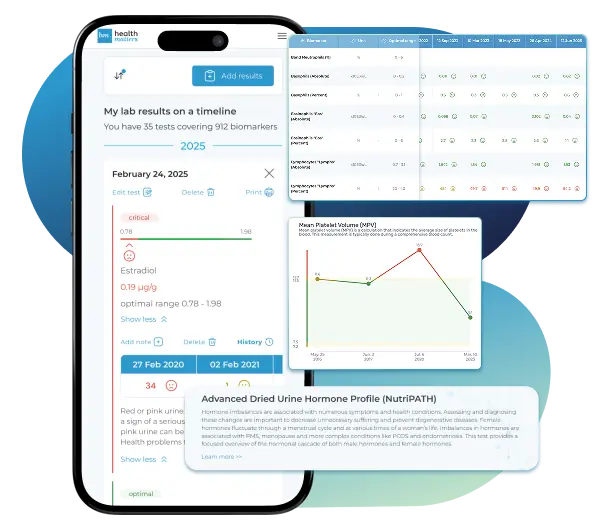
Import lab results from multiple providers, track changes over time, customize your reference ranges, and get clear explanations for each result. Everything is stored securely, exportable in one organized file, and shareable with your doctor—or anyone you choose.
Cancel or upgrade anytime
Related Biomarkers
Article Review & Sources
All our content is backed by peer-reviewed studies, academic research, and trusted medical sources. We're committed to accuracy and transparency — see our editorial policy for details.
Laboratories
Bring All Your Lab Results Together — In One Place
We accept reports from any lab, so you can easily collect and organize all your health information in one secure spot.











Pricing Table
Gather Your Lab History — and Finally Make Sense of It
Finally, Your Lab Results Organized and Clear

Personal plans

$79/ year
Advanced Plan
Access your lab reports, explanations, and tracking tools.
- Import lab results from any provider
- Track all results with visual tools
- Customize your reference ranges
- Export your full lab history anytime
- Share results securely with anyone
- Receive 5 reports entered for you
- Cancel or upgrade anytime
$250/ once
Unlimited Account
Pay once, access everything—no monthly fees, no limits.
- Import lab results from any provider
- Track all results with visual tools
- Customize your reference ranges
- Export your full lab history anytime
- Share results securely with anyone
- Receive 10 reports entered for you
- No subscriptions. No extra fees.
$45/ month
Pro Monthly
Designed for professionals managing their clients' lab reports
- Import lab results from any provider
- Track lab results for multiple clients
- Customize reference ranges per client
- Export lab histories and reports
- Begin with first report entered by us
- Cancel or upgrade anytime
About membership
What's included in a Healthmatters membership
 Import Lab Results from Any Source
 See Your Health Timeline
 Understand What Your Results Mean

 Visualize Your Results

 Data Entry Service for Your Reports
 Securely Share With Anyone You Trust
Let Your Lab Results Tell the Full Story
Once your results are in one place, see the bigger picture — track trends over time, compare data side by side, export your full history, and share securely with anyone you trust.




Bring all your results together to compare, track progress, export your history, and share securely.
What Healthmatters Members Are Saying

I have been using Healthmatters.io since 2021. I travel all over the world and use different doctors and health facilities. This site has allowed me to consolidate all my various test results over 14 years in one place. And every doctor that I show this to has been impressed. Because with any health professional I talk to, I can pull up historical results in seconds. It is invaluable. Even going back to the same doctor, they usually do not have the historical results from their facility in a graph format. That has been very helpful.
Anthony
Unlimited Plan Member since 2021
What fantastic service and great, easy-to-follow layouts! I love your website; it makes it so helpful to see patterns in my health data. It's truly a pleasure to use. I only wish the NHS was as organized and quick as Healthmatters.io. You've set a new standard for health tracking!
Karin
Advanced Plan Member since 2020
As a PRO member and medical practitioner, Healthmatters.io has been an invaluable tool for tracking my clients' data. The layout is intuitive, making it easy to monitor trends and spot patterns over time. The ability to customize reports and charts helps me present information clearly to my clients, improving communication and outcomes. It's streamlined my workflow, saving me time and providing insights at a glance. Highly recommended for any practitioner looking for a comprehensive and user-friendly solution to track patient labs!
Paul
Healthmatters Pro Member since 2024

We implement proven measures to keep your data safe.
At HealthMatters, we're committed to maintaining the security and confidentiality of your personal information. We've put industry-leading security standards in place to help protect against the loss, misuse, or alteration of the information under our control. We use procedural, physical, and electronic security methods designed to prevent unauthorized people from getting access to this information. Our internal code of conduct adds additional privacy protection. All data is backed up multiple times a day and encrypted using SSL certificates. See our Privacy Policy for more details.