
Anti-DNA (DS) Ab Qn: Normal Range, "<1" Meaning & High Results
Other names: Anti-DNA (DS) Ab Qn, Anti-DNA DS Ab Qn, Anti-dsDNA, Anti-dsDNA Antibody, Anti-Double Stranded DNA Antibody, Anti-ds DNA, DNA (DS) Antibody, dsDNA Ab Qn, dsDNA Antibody Quantitative, Anti-dsDNA Qn, Anti-dsDNA Qn Interp, dsDNA Ab Quant, DNA DS Antibody, DNA (DS) AB, Anti-DNA (DS) Ab, Anti-dsDNA Ab, Anti-dsDNA Numeric, dsDNA Ab Quantitative, DNA Double Strand Antibody, Double Stranded DNA Antibody, Double Stranded DNA Ab, Anti-Double Stranded DNA, Anti-ds DNA Antibody, Anti-DNA Blood Test, DNA Ab DS, DNA DS Ab Blood Test, dsDNA Antibody Test, Anti-DNA Ab Qn, Anti-DNA (DS), Anti-dsDNA IU/mL, DNA (DS) Antibody IU/mL, Anticuerpos Anti-DNA (Spanish), Anti-ADN (French), Anti-DNS (German), Anti-dsDNA البشرية (Arabic)
 Optimal Result:
0 - 4 IU/ml.
Optimal Result:
0 - 4 IU/ml.

QUICK ANSWER
Anti-DNA (DS) Ab Qn measures autoantibodies against your own DNA. A result of <1 or 1 IU/mL is normal and not a cause for concern. Elevated levels — particularly above the lab's upper reference limit — are associated with lupus (SLE) and are used alongside other tests and clinical findings to diagnose and monitor the condition.
Normal range: 0–4 IU/mL. Results below this range (reported as <1) are negative. A result of 1 IU/mL is at the detection threshold and is considered normal.
A positive or elevated anti-dsDNA result does not diagnose lupus on its own. Diagnosis requires clinical evaluation, symptoms, and a physician's interpretation of the full picture.
WHAT DOES "ANTI-DNA (DS) AB QN 1" OR "<1 IU/mL" MEAN?
This is the most searched result on this page — and fortunately, also the most reassuring.
A result of 1 IU/mL or "<1 IU/mL" is a normal, negative finding and does not by itself suggest lupus. It means autoantibodies against double-stranded DNA were either undetectable or at the very limit of detection. Many healthy individuals have results reported as <1 or 1 IU/mL.
Why "1" appears on some reports: Some lab systems report values below the assay's sensitivity floor as the floor value itself (1 IU/mL) rather than as "<1." The clinical meaning is identical — both indicate no significant anti-dsDNA antibodies were found.
Why "<1" appears: When the concentration is below the lower detection limit of the assay, the lab reports it as "less than 1" because the instrument cannot reliably measure below this threshold.
What this means clinically: This is considered a negative result and is not generally concerning for lupus on its own. In someone with no other signs or symptoms of lupus, a result of <1 or 1 IU/mL requires no follow-up for anti-dsDNA specifically.
Key takeaway: A result of "<1" or "1 IU/mL" is a normal negative finding and does not by itself suggest lupus. Elevated anti-dsDNA becomes clinically meaningful only when interpreted alongside symptoms, ANA testing, and other autoimmune markers. Most people who receive this test do not ultimately have lupus.
MOST COMMON RESULTS AT A GLANCE
| Your result (IU/mL) | What it usually means |
|---|---|
| < 1 (reported as "<1") | Negative — below detection threshold; normal finding |
| 1 | At detection threshold — normal; equivalent to <1 |
| 2–3 | Within reference range — normal |
| 4 | At upper reference limit — borderline at most labs |
| 5 | Mildly above reference range — borderline elevation |
| 7–10 | Moderately elevated — correlate with ANA and symptoms |
| 15 | Clinically significant elevation — evaluate with rheumatologist |
| 30–50+ | Strongly positive — high association with active SLE |
| > 100 | Very high elevation — often associated with active autoimmune disease requiring urgent rheumatology evaluation |
Reference ranges vary by lab and assay. Quest Diagnostics uses 0–4 IU/mL. Always compare against the range on your specific lab report. Numeric values from different labs are not directly comparable due to assay differences.
WHY YOUR DOCTOR ORDERED THIS TEST
Most patients who receive anti-dsDNA testing do not ultimately have lupus. The test is ordered for a limited set of clinical reasons:
| Situation | Why anti-dsDNA may be ordered |
|---|---|
| Positive ANA test | Follow-up to identify which specific autoantibodies are present |
| Joint pain, rash, or fatigue | Evaluate for systemic autoimmune disease including lupus |
| Suspected lupus | Anti-dsDNA is one of the most specific laboratory markers for SLE |
| Known lupus | Monitor disease activity, detect flares, or assess treatment response |
| Kidney abnormalities or protein in urine | Evaluate for possible lupus nephritis |
Most people who receive this test do not ultimately have lupus. A positive ANA — which often prompts anti-dsDNA testing — is found in about 15–20% of healthy people and does not by itself indicate lupus.
WHAT IS ANTI-DNA (DS) AB QN?
Anti-DNA (DS) Ab Qn — also written as anti-dsDNA, dsDNA antibody, or DNA (DS) antibody — measures the quantity (hence "Qn" = quantitative) of autoantibodies directed against double-stranded DNA.
What autoantibodies are: In normal immune function, antibodies target foreign pathogens. In certain autoimmune conditions, the immune system mistakenly produces antibodies that attack the body's own tissues — these are called autoantibodies. Anti-dsDNA autoantibodies target double-stranded DNA found in the nuclei of cells.
Why this test matters: Anti-dsDNA is one of the most specific autoantibodies for systemic lupus erythematosus (SLE). It is elevated in approximately 70% of people with SLE. It is part of the ANA (antinuclear antibody) comprehensive panel and may be ordered as a follow-up when an ANA result is positive, or to monitor known lupus disease activity.
"DS" means double-stranded: DNA occurs in two forms — single-stranded (ssDNA) and double-stranded (dsDNA). Antibodies against double-stranded DNA are more specific for lupus than those against single-stranded DNA.
"Ab Qn" means antibody quantitative: The test measures how much of the antibody is present, not just whether it is present or absent.
WHAT DOES A HIGH ANTI-DNA (DS) AB QN RESULT MEAN?
Elevated anti-dsDNA — above the lab's upper reference limit (typically 4–10 IU/mL depending on the assay) — may be clinically significant, but context determines its meaning.
High anti-dsDNA is most strongly associated with:
- Systemic lupus erythematosus (SLE) — elevated levels, especially when significantly above the reference range, are highly specific for lupus when other clinical criteria are present
- Lupus nephritis — high anti-dsDNA levels often correlate with active kidney inflammation in lupus; rising levels may signal a flare
- Lupus disease activity monitoring — anti-dsDNA levels can fluctuate with disease activity; rising levels may precede or accompany flares
Elevated anti-dsDNA may also be seen in:
- Sjögren's syndrome (usually mild elevation)
- Mixed connective tissue disease (MCTD)
- Drug-induced lupus
- Rarely, in healthy individuals without any autoimmune disease
What a high result does not mean on its own: A single elevated anti-dsDNA result does not diagnose lupus. SLE diagnosis requires multiple clinical and laboratory criteria — anti-dsDNA is one important component but not sufficient alone. Many people with mildly elevated levels do not have lupus.
Important YMYL note: If your anti-dsDNA result is elevated, this should be discussed with your doctor, ideally a rheumatologist. Interpretation requires the full clinical picture, including other laboratory results (ANA, complement C3/C4, anti-Smith), symptoms, and examination findings.
WHAT DOES A LOW OR NEGATIVE ANTI-DNA (DS) AB QN RESULT MEAN?
A low or negative result (below 4 IU/mL, or reported as <1) means no significant anti-dsDNA antibodies were detected.
What a negative result means:
- It makes a current diagnosis of SLE less likely, but does not exclude it. Approximately 15–30% of people with lupus have negative or low anti-dsDNA at any given time.
- Anti-dsDNA can fluctuate — a negative result does not mean the antibody has never been present or cannot rise in the future.
- Low-to-negative anti-dsDNA with ongoing lupus symptoms may still warrant evaluation based on other clinical and laboratory criteria.
HOW ANTI-DSDNA RELATES TO LUPUS DIAGNOSIS AND MONITORING
Anti-dsDNA is included in the ACR/EULAR classification criteria for SLE. A positive anti-dsDNA result contributes to the diagnostic score but must be considered alongside other criteria.
In lupus monitoring: Serial anti-dsDNA measurements are used to track disease activity. Rising levels may precede or accompany a lupus flare. Falling levels may indicate the disease is going into remission or responding to treatment. However, anti-dsDNA trends must be interpreted alongside complement levels (C3 and C4, which often fall during flares) and clinical symptoms.
Lupus nephritis: High anti-dsDNA combined with low complement and protein in the urine is a concerning pattern for active lupus nephritis — inflammation of the kidneys that can cause serious long-term damage if untreated.
COMMON RESULT PATTERNS: WHAT COMBINATIONS MEAN
Anti-dsDNA is most useful when interpreted alongside other results:
| Result pattern | What it often means |
|---|---|
| ANA positive + anti-dsDNA <1 | Common; often not lupus — many ANA-positive people are healthy |
| ANA positive + mildly elevated anti-dsDNA | Needs rheumatology correlation with symptoms and other markers |
| High anti-dsDNA + low C3/C4 | More concerning for active lupus; complement often falls during flares |
| Rising anti-dsDNA over time | May indicate increasing disease activity or approaching flare |
| Negative anti-dsDNA + lupus symptoms | Does not exclude lupus — ~15–30% of SLE patients are negative |
POSITIVE ANA WITH NEGATIVE ANTI-dsDNA
This is a very common pattern — and usually reassuring.
ANA (antinuclear antibody) is a broad screening test that detects many different antinuclear antibodies. It is positive in about 15–20% of healthy people, and in a wide range of conditions beyond lupus. A positive ANA alone does not mean lupus is likely.
Anti-dsDNA is a more specific follow-up test. When ANA is positive but anti-dsDNA is negative (result <1 or 1 IU/mL), this meaningfully lowers the probability of SLE. Anti-dsDNA is considered highly specific for lupus, particularly at higher titres and when confirmed by more specific assay methods — meaning most people without lupus have negative anti-dsDNA.
What happens next with a positive ANA and negative anti-dsDNA: Your doctor may evaluate other specific autoantibodies (anti-Smith, anti-SSA/Ro, anti-SSB/La, anti-Scl-70) depending on symptoms, or may conclude that the positive ANA is clinically insignificant. Many people with a positive ANA and negative anti-dsDNA require no further autoimmune workup if other markers are normal and symptoms are absent.
WHY RESULTS DIFFER BETWEEN LABS
Anti-dsDNA results from different laboratories are not directly comparable because different labs use different assay methods:
- ELISA/EIA — most common; reports in IU/mL; widely used in routine clinical settings
- Crithidia luciliae immunofluorescence (CLIFT) — considered the gold standard for specificity; uses a flagellate organism whose kinetoplast contains dsDNA; less commonly available
- Farr assay (radioimmunoassay) — historically used; largely replaced by ELISA in most labs
- Multiplex bead-based assays — increasingly used in ANA panels
Why this matters: A result of 5 IU/mL on one lab's ELISA may not mean the same thing as 5 IU/mL on a different lab's platform. If you are tracking anti-dsDNA over time to monitor lupus activity, ideally use the same lab and same assay method consistently. Mild elevations on ELISA may not be confirmed by the more specific CLIFT assay.
WHEN TO FOLLOW UP WITH A DOCTOR
An isolated low-level elevation without symptoms is interpreted very differently from a strongly positive result with clinical signs of lupus.
Seek medical evaluation if elevated anti-dsDNA occurs alongside:
- Persistent joint pain or swelling
- Facial (butterfly/malar) rash or photosensitivity
- Unexplained fevers or fatigue
- Protein in urine or kidney abnormalities
- Hair loss, mouth sores, or chest pain
- Low blood counts (anaemia, low white cells or platelets)
If your result is mildly elevated but you have no symptoms: Discuss with your ordering physician. A single mildly elevated result without clinical context is often monitored rather than acted upon immediately. Repeat testing and correlation with ANA, complement C3/C4, and urinalysis are typically the next steps.
WHY ANTI-dsDNA MATTERS IN LUPUS NEPHRITIS
Lupus nephritis — inflammation of the kidneys caused by lupus — is one of the most serious complications of SLE. Anti-dsDNA plays a specific monitoring role here that makes it more than just a diagnostic test.
The anti-dsDNA and kidney connection: Anti-dsDNA antibodies can deposit in kidney tissue alongside DNA-containing debris, triggering immune complex formation and inflammatory kidney damage. This is why rising anti-dsDNA levels — even in a patient already diagnosed with lupus — can be a warning signal for kidney involvement.
The monitoring pattern: In known lupus patients, a pattern of rising anti-dsDNA combined with falling complement C3 and C4 is a classic signal of impending or active lupus nephritis. Protein in the urine (proteinuria) alongside this pattern warrants prompt evaluation.
Why early detection matters: Lupus nephritis that is identified and treated early has significantly better outcomes than nephritis detected late. Anti-dsDNA is one of the laboratory tools that enables this early detection — which is why it is monitored serially in lupus patients even when they are clinically well.
WHAT RHEUMATOLOGISTS LOOK FOR
When interpreting anti-dsDNA in clinical practice, rheumatologists evaluate the full picture:
| Finding | Why it matters |
|---|---|
| Rising anti-dsDNA over time | May indicate impending or active flare |
| Falling C3 and C4 | Complement consumed by immune complex activity — classic lupus flare pattern |
| Protein in urine | Concern for lupus nephritis — warrants urgent evaluation |
| Positive anti-Smith antibody | Combined with positive anti-dsDNA, highly specific for SLE |
| Persistent symptoms without high dsDNA | Clinical picture drives management — lab alone does not determine treatment |
| Trend over multiple tests | More informative than any single value |
| Stable anti-dsDNA over time | Often reassuring in clinically stable lupus patients — suggests controlled disease activity |
WHAT DOES BORDERLINE OR EQUIVOCAL MEAN?
Some labs report results that fall between clearly negative and clearly positive as borderline, equivocal, or indeterminate.
What this means: A borderline result represents a low-level signal that is above the lower detection threshold but not clearly elevated enough to be clinically significant. The test detected some anti-dsDNA activity, but the level is in a grey zone where clinical significance is uncertain.
What typically happens next:
- Repeat testing after several weeks, often with the same lab and assay
- Correlation with ANA titre, complement C3/C4, and clinical symptoms
- Evaluation of other autoantibodies (anti-Smith, anti-SSA/Ro)
- Clinical judgment by the ordering physician or rheumatologist
Key point: A borderline or equivocal result is not diagnostic of lupus and should not be interpreted as confirmation of any autoimmune diagnosis. It is a signal to gather more information, not a conclusion. Low-level positive or borderline anti-dsDNA results may occasionally represent non-specific reactivity rather than true autoimmune disease — particularly on ELISA assays, which are more sensitive but less specific than the Crithidia luciliae method.
COMMON PHRASES SEEN ON LAB REPORTS
ANTI-DNA (DS) AB QN
ANTI-DNA DS AB QN
ANTI-DNA (DS) AB QN <1
ANTI-DNA (DS) AB QN 1
ANTI-DNA (DS) AB QN HIGH
ANTI-DSDNA QN INTERP
ANTI-DSDNA QN
DSDNA AB QUANT
DSDNA AB QUANTITATIVE
DNA (DS) ANTIBODY
DNA DS ANTIBODY
DNA (DS) AB
ANTI-DS DNA
ANTI-DOUBLE STRANDED DNA ANTIBODY
DOUBLE STRANDED DNA ANTIBODY
DNA DS AB QN
ANTI-DNA AB QN
dsDNA AB QUANT HIGH
WARNINGHIGH ANTI-DNA (DS) AB QN
DNA AB DS + CONF BLD
ANTICUERPOS ANTI-DNA (Spanish)
ANTI-ADN (French)
FAQ about Anti-DNA (DS) Ab Qn
-
What does "anti-dna (ds) ab qn 1" or "<1 IU/mL" mean?
A result of 1 IU/mL or "<1 IU/mL" is normal and negative. It means anti-double stranded DNA autoantibodies were at or below the detection threshold of the test — no significant antibody activity was detected. The normal range is 0–4 IU/mL. A result of 1 is within normal range and requires no follow-up for this test specifically. -
What is the normal range for anti-DNA (DS) Ab Qn?
The normal range for anti-DNA (DS) Ab Qn (Quest Diagnostics) is 0–4 IU/mL. Results below 1 IU/mL are reported as "<1" and are negative. Reference ranges vary between labs and assay methods — always compare your result against the range on your specific lab report. -
What does a high anti-dsDNA result mean?
An elevated anti-dsDNA result (above the reference range) is associated with systemic lupus erythematosus (SLE). Significantly elevated levels, particularly when accompanied by other clinical signs and symptoms of lupus, are highly specific for the diagnosis. Anti-dsDNA levels also correlate with lupus disease activity — rising levels may signal a flare. However, an elevated result alone does not diagnose lupus; clinical evaluation by a physician is required. -
What is anti-DNA (DS) Ab Qn testing for?
Anti-DNA (DS) Ab Qn tests for autoantibodies against double-stranded DNA — proteins produced by the immune system that mistakenly target the body's own genetic material. It is primarily used to help diagnose systemic lupus erythematosus (SLE), distinguish lupus from other autoimmune conditions, and monitor lupus disease activity over time. -
Can anti-dsDNA be elevated without lupus?
Yes. Mildly elevated anti-dsDNA can occasionally be seen in Sjögren's syndrome, mixed connective tissue disease (MCTD), drug-induced lupus, and rarely in healthy individuals without autoimmune disease. However, significantly elevated levels in the context of other lupus-associated findings are highly specific for SLE. -
What does "WARNINGHIGH anti-DNA (DS) Ab Qn" mean on my lab report?
"WARNINGHIGH" is a critical value flag used by some lab reporting systems to indicate a result that is significantly above the reference range and may require urgent clinical attention. If you see this on your report, discuss it with your ordering physician promptly. It does not confirm a diagnosis of lupus, but it does indicate a level that warrants clinical evaluation. -
What is a "positive" vs "negative" anti-dsDNA result?
Negative: result below the reference range (typically <1–4 IU/mL depending on the lab) — no significant anti-dsDNA antibodies detected. Positive: result above the reference range. Some labs also report "equivocal" or "indeterminate" for borderline results in the gray zone. A positive result is not diagnostic of lupus on its own — it is one component of a broader clinical and laboratory evaluation. -
Can you have lupus with negative anti-dsDNA?
Yes. Anti-dsDNA is positive in approximately 70% of people with SLE — which means roughly 30% of lupus patients have negative or low anti-dsDNA at a given time. Anti-dsDNA can also fluctuate, so it may be negative during periods of low disease activity. Lupus is diagnosed based on the full clinical and laboratory picture using ACR/EULAR classification criteria — anti-dsDNA is one important component, but a negative result does not exclude the diagnosis if other clinical and laboratory features are present. -
How does anti-dsDNA relate to ANA (antinuclear antibody)?
ANA is a broader screening test that detects a range of antinuclear antibodies. Anti-dsDNA is one specific type of antinuclear antibody. A positive ANA is often followed by specific autoantibody tests including anti-dsDNA, anti-Smith, anti-SSA/Ro, and others to identify which antibodies are present and help characterise the underlying condition. -
What does "qn" mean in anti-dna (ds) ab qn?
"Qn" stands for quantitative — it means the test measures the amount of the antibody present in IU/mL (international units per millilitre), not just whether the antibody is present or absent. A qualitative test would give a simple positive/negative result; a quantitative test gives a number that can be used to track changes over time. -
Can anti-dsDNA levels go down?
Yes — anti-dsDNA levels can and do fall, particularly with effective lupus treatment or when the disease enters remission. Immunosuppressive therapy (hydroxychloroquine, belimumab, mycophenolate, azathioprine) typically reduces anti-dsDNA levels over time in responsive patients. Levels may also fluctuate naturally with disease activity. A falling anti-dsDNA trend, especially alongside rising complement C3/C4, is generally a positive sign of improving disease control. Trends over multiple measurements are significantly more informative than any single isolated value.
Lab Results Explained and Tracked
What does it mean if your Anti-DNA (DS) Ab Qn result is too high?
An elevated Anti-DNA (DS) Ab Qn result — above the lab's reference range (typically 0–4 IU/mL) — means anti-double stranded DNA autoantibodies were detected at elevated levels.
Elevated anti-dsDNA is most strongly associated with systemic lupus erythematosus (SLE). It is one of the most specific laboratory markers for lupus, particularly when significantly elevated and when accompanied by other clinical signs and symptoms.
Rising levels may signal a lupus flare or active lupus nephritis (kidney inflammation). In known lupus patients, monitoring anti-dsDNA over time alongside complement C3 and C4 is a standard approach to tracking disease activity.
A single elevated result does not diagnose lupus. Diagnosis requires meeting multiple clinical and laboratory criteria evaluated by a physician. Mild elevations may be seen in other autoimmune conditions (Sjögren's syndrome, MCTD) or occasionally in healthy individuals. Discuss any elevated result with your doctor — preferably a rheumatologist — for full interpretation.
Related Health Conditions

All Your Lab Results.
One Simple Dashboard.
Import, Track, and Share Your Lab Results Easily
Import, Track, and Share Your Lab Results
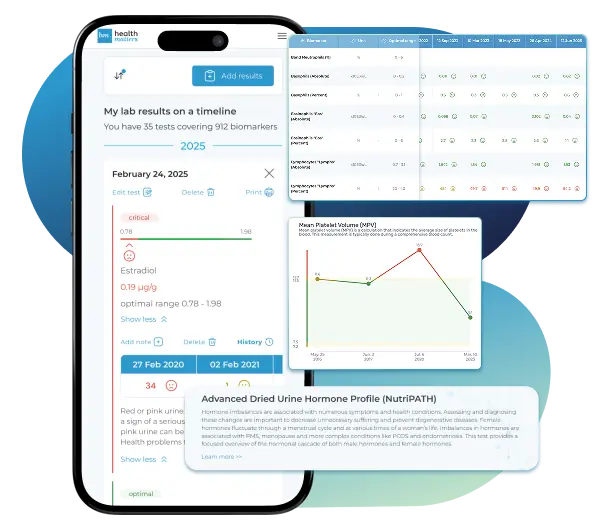
Import lab results from multiple providers, track changes over time, customize your reference ranges, and get clear explanations for each result. Everything is stored securely, exportable in one organized file, and shareable with your doctor—or anyone you choose.
Cancel or upgrade anytime
What does it mean if your Anti-DNA (DS) Ab Qn result is too low?
A low or negative Anti-DNA (DS) Ab Qn result — including results reported as "<1" or "1 IU/mL" — means anti-dsDNA antibodies were not detected at significant levels.
A result of <1 or 1 IU/mL is a normal, reassuring finding. It means the test found no meaningful autoantibody activity against double-stranded DNA. This is the most common result in the general population.
A negative result does not fully exclude lupus. Approximately 15–30% of people with SLE have low or undetectable anti-dsDNA at a given time. Lupus is diagnosed based on the full clinical and laboratory picture, not anti-dsDNA alone. If symptoms persist and clinical suspicion remains, a physician may order additional tests regardless of the anti-dsDNA result.
Related Biomarkers
Article Review & Sources
All our content is backed by peer-reviewed studies, academic research, and trusted medical sources. We're committed to accuracy and transparency — see our editorial policy for details.
Laboratories
Bring All Your Lab Results Together — In One Place
We accept reports from any lab, so you can easily collect and organize all your health information in one secure spot.









Pricing Table
Gather Your Lab History — and Finally Make Sense of It
Finally, Your Lab Results Organized and Clear

Personal plans

$79/ year
Advanced Plan
Access your lab reports, explanations, and tracking tools.
- Import lab results from any provider
- Track all results with visual tools
- Customize your reference ranges
- Export your full lab history anytime
- Share results securely with anyone
- Receive 5 reports entered for you
- Cancel or upgrade anytime
$250/ once
Unlimited Account
Pay once, access everything—no monthly fees, no limits.
- Import lab results from any provider
- Track all results with visual tools
- Customize your reference ranges
- Export your full lab history anytime
- Share results securely with anyone
- Receive 10 reports entered for you
- No subscriptions. No extra fees.
$45/ month
Pro Monthly
Designed for professionals managing their clients' lab reports
- Import lab results from any provider
- Track lab results for multiple clients
- Customize reference ranges per client
- Export lab histories and reports
- Begin with first report entered by us
- Cancel or upgrade anytime
About membership
What's included in a Healthmatters membership
 Import Lab Results from Any Source
 See Your Health Timeline
 Understand What Your Results Mean

 Visualize Your Results

 Data Entry Service for Your Reports
 Securely Share With Anyone You Trust
Let Your Lab Results Tell the Full Story
Once your results are in one place, see the bigger picture — track trends over time, compare data side by side, export your full history, and share securely with anyone you trust.




Bring all your results together to compare, track progress, export your history, and share securely.
What Healthmatters Members Are Saying

I have been using Healthmatters.io since 2021. I travel all over the world and use different doctors and health facilities. This site has allowed me to consolidate all my various test results over 14 years in one place. And every doctor that I show this to has been impressed. Because with any health professional I talk to, I can pull up historical results in seconds. It is invaluable. Even going back to the same doctor, they usually do not have the historical results from their facility in a graph format. That has been very helpful.
Anthony
Unlimited Plan Member since 2021
What fantastic service and great, easy-to-follow layouts! I love your website; it makes it so helpful to see patterns in my health data. It's truly a pleasure to use. I only wish the NHS was as organized and quick as Healthmatters.io. You've set a new standard for health tracking!
Karin
Advanced Plan Member since 2020
As a PRO member and medical practitioner, Healthmatters.io has been an invaluable tool for tracking my clients' data. The layout is intuitive, making it easy to monitor trends and spot patterns over time. The ability to customize reports and charts helps me present information clearly to my clients, improving communication and outcomes. It's streamlined my workflow, saving me time and providing insights at a glance. Highly recommended for any practitioner looking for a comprehensive and user-friendly solution to track patient labs!
Paul
Healthmatters Pro Member since 2024

We implement proven measures to keep your data safe.
At HealthMatters, we're committed to maintaining the security and confidentiality of your personal information. We've put industry-leading security standards in place to help protect against the loss, misuse, or alteration of the information under our control. We use procedural, physical, and electronic security methods designed to prevent unauthorized people from getting access to this information. Our internal code of conduct adds additional privacy protection. All data is backed up multiple times a day and encrypted using SSL certificates. See our Privacy Policy for more details.