
EPA+DPA+DHA (OmegaCheck): Normal Range & What a Low Omega-3 Result Means
Other names: OmegaCheck, EPA+DPA+DHA, EPA + DPA + DHA, OmegaCheck (EPA+DPA+DHA), Omega-3 (EPA+DPA+DHA), Omega-3 Total, OmegaCheck Whole Blood
 Optimal Result:
5.4 - 50 % by wt.
Optimal Result:
5.4 - 50 % by wt.

If your EPA+DPA+DHA result came back low, it means your body doesn't have as much omega-3 available as is considered ideal for long-term cardiovascular health. That's the headline. The rest of this page is about why that happens, what it does and doesn't predict, and how to move it — because this is one of the few blood tests where the number is genuinely in your hands.
The test itself measures the three main long-chain omega-3 fatty acids — eicosapentaenoic acid (EPA), docosapentaenoic acid (DPA), and docosahexaenoic acid (DHA) — added together and reported as a single percentage of your total fatty acids. Many labs report this bundle under the brand name OmegaCheck.
The one idea that explains this whole page: this test tells you what made it into your blood — not what you ate. Anyone can say "I eat salmon twice a week." Only the blood level answers the question that actually matters: did enough omega-3 actually arrive?
Clinical takeaway. Higher is generally better; low is the actionable finding. Low omega-3 status is associated with greater cardiovascular and sudden-cardiac-death risk — an association, not a diagnosis — and it usually responds to diet and supplements within weeks to months.
At a glance
- What it measures: how much omega-3 (EPA + DPA + DHA combined) actually reached your bloodstream, as a percentage by weight.
- Why it's ordered: because intake and blood level aren't the same thing — this checks whether your diet or supplements are actually landing.
- The direction that matters: low. High is generally favorable; a "high" flag is rarely a problem.
- What moves it: oily fish, fish-oil or algal-oil supplements — reflected in your blood over roughly 4–8 weeks.
- What it can't tell you: whether you'll have a cardiac event, the health of your arteries, or your tissue (red-cell) omega-3 stores — that's a related but different test, the Omega-3 Index.
- Best used: tracked over time, re-tested after a dietary or supplement change.
Food on your plate is not the same as omega-3 in your blood
This is the single most useful idea on this page, and it's the reason the test exists at all. What you eat is only the first step in a chain, and things go missing at every link:
| Step | What happens | What can go wrong |
|---|---|---|
| 1. Fish eaten (or capsule taken) | Omega-3 goes in | Portion smaller than assumed; supplement low in actual EPA/DHA; taken inconsistently |
| 2. EPA and DHA absorbed | Fats cross into the body | Taken without food; oxidized or poor-quality oil; individual absorption differences |
| 3. Blood omega-3 level rises | Fatty acids circulate | Takes weeks to build; a single meal barely registers |
| 4. Your EPA+DPA+DHA result | The lab measures what's actually there | This is the only step that gets measured — and the only one that counts |
Your diet is an input. This test is the output. When someone eats fish regularly and still tests low, nothing paradoxical has happened — the chain simply leaked somewhere. That's information you can act on, and it's information no food diary can give you.
Two people, the same fish intake
Person A eats salmon twice a week. Their EPA+DPA+DHA is 2.9% — the high-risk tier.
Person B eats salmon twice a week. Their EPA+DPA+DHA is 6.7% — comfortably optimal.
Same reported diet, opposite results. The gap comes down to portion size, how consistent "twice a week" really is over months, whether a supplement is in play and what's actually in it, absorption, and ordinary individual variation. Person A doesn't need to be told to eat more fish in the abstract — they need to know their current approach isn't landing, which is exactly what the test just told them.
Your result, and what it does not mean
| Your result | Usually means | Does not mean |
|---|---|---|
| Optimal (higher) | Good omega-3 status — the lowest-risk tier; usually reflects regular oily fish or supplements | That more is always better, or that you're protected from heart disease by this alone |
| Moderate / borderline | Middling omega-3 intake — room to improve toward the optimal range | That anything is wrong today; it's a nudge, not an alarm |
| Low | Low omega-3 status — the actionable result; associated with higher cardiovascular risk | That you will have a cardiac event, that your arteries are diseased, or that it can't be fixed |
What counts as low, moderate, or optimal? (OmegaCheck risk tiers)
OmegaCheck reports EPA+DPA+DHA as a percentage by weight and sorts it into relative-risk tiers, drawn from the top and bottom quartiles of a reference population:
| Tier | EPA+DPA+DHA (% by wt) | What it reflects |
|---|---|---|
| Optimal relative risk | ≥ 5.5% | Lowest-risk omega-3 status |
| Moderate relative risk | 3.8 – 5.4% | Intermediate |
| High relative risk | ≤ 3.7% | Highest-risk tier (defined against sudden-cardiac-death risk) |
Read it against your own report. Cutoffs and units are assay-specific, and different labs may present this slightly differently. "Relative risk" here is a population statistic — it describes groups, not your individual fate. Use your own lab's stated range as the reference, and treat the tier as a target to move toward, not a verdict.
What is DPA — and why is it bundled with EPA and DHA?
Most people recognize EPA and DHA but have never heard of DPA (docosapentaenoic acid). It's the "middle" omega-3: your body can convert EPA into DPA and DPA into DHA, so DPA sits between the two better-known fatty acids as an intermediate. It's less studied on its own, but it's biologically active and shows up in the same foods (oily fish), which is why OmegaCheck sums all three into one number rather than reporting DPA separately. In short: DPA is a genuine long-chain omega-3, and including it gives a slightly fuller picture of your omega-3 status than EPA + DHA alone.
EPA+DPA+DHA (OmegaCheck) vs. the Omega-3 Index — what's the difference?
These two tests sound alike and get mixed up constantly, but they measure different things:
| EPA+DPA+DHA (OmegaCheck) | Omega-3 Index | |
|---|---|---|
| What's measured | EPA + DPA + DHA | EPA + DHA only (no DPA) |
| Where | Whole blood / plasma | Red blood cell membranes |
| Reflects | Recent omega-3 status | Longer-term tissue stores |
Both are legitimate ways to gauge omega-3 status; they simply sample different compartments over different timeframes. If you're comparing results from two labs and the numbers don't match, this is often why — you may be looking at two different tests. See Omega-3 Index (confirm slug before linking) for that measure.
What actually raises a low result
- Oily fish — salmon, sardines, mackerel, herring, and anchovies are the richest sources. Two to three servings a week is a common target.
- Fish-oil or algal-oil supplements — a practical route, especially if you don't eat fish. Algal (algae-derived) omega-3 is a vegan option supplying DHA directly (it's where the fish get it) and a reasonable choice for plant-based diets.
- Plant sources (flax, chia, walnuts) supply ALA, a shorter omega-3 the body converts to EPA/DHA only inefficiently — helpful, but rarely enough on their own to move a low result much.
Two clinical caveats, stated plainly. (1) Omega-3's clearest, best-established effect is lowering triglycerides — roughly 7–10% at about 1 g/day of EPA+DHA. (2) Whether omega-3 supplements reduce cardiovascular events is genuinely mixed across large trials, even though low omega-3 status tracks with higher risk. Diet-first is the mainstream recommendation; discuss higher supplement doses with your clinician, particularly if you're on blood thinners.
Why is my EPA+DPA+DHA low even though I take fish oil?
This is one of the most common — and most confusing — versions of this result. It isn't a contradiction; it's the "intake isn't blood level" principle showing up in real life. The usual explanations:
- The dose is too low. Many supplements deliver far less EPA+DHA per capsule than the label's headline "fish oil 1000 mg" suggests — that figure is the oil, not the omega-3 in it. Check the EPA and DHA amounts specifically.
- It's taken inconsistently. A few capsules a week won't build a blood level the way daily use does.
- You re-tested too soon. It takes roughly 4–8 weeks of consistent intake for the change to show up. Testing two weeks in mostly measures where you started.
- The product is weak or oxidized. Quality varies; oil that has gone rancid delivers less than it claims, and old or badly stored capsules are common culprits.
- It's taken without food. These are fats — absorption is generally better with a meal, especially one containing some fat.
- Individual variation. Absorption, metabolism, and baseline diet genuinely differ between people; some simply need more to reach the same level.
The practical move is to check the actual EPA+DHA milligrams you're getting daily, take it consistently with food for a couple of months, and re-test. If the number still hasn't moved, that's a worthwhile conversation to have with your clinician.
The pattern that matters: OmegaCheck read with your triglycerides
One number rarely tells a story; two often do. Triglycerides are the lipid omega-3 most directly affects, so reading these two together is how clinicians actually reason about this result — and it separates "you need more omega-3" from "something else is going on":
| OmegaCheck | Triglycerides | Typical interpretation |
|---|---|---|
| Low | High | Low omega-3 intake plus metabolic dysfunction — the combination that most warrants action |
| Low | Normal | Mainly an omega-3 shortfall, without an obvious metabolic driver |
| High | High | Omega-3 intake is adequate — something else is driving the triglycerides |
| High | Normal | The typical favorable pattern |
None of these is a diagnosis — they're starting points for a conversation, read alongside the rest of your lipid panel and your overall cardiovascular picture. But the logic is worth carrying: a low omega-3 level means something different in someone with normal triglycerides than in someone whose metabolic markers are also drifting.
Can you actually change this result?
Part of why this test is worth paying attention to is that many cardiovascular markers are largely fixed, and this one isn't:
| Marker | Can you change it? |
|---|---|
| ApoE genotype | No — it's your genetics, fixed for life |
| Lp(a) | Largely no — mostly genetically determined and minimally responsive to diet or lifestyle |
| EPA+DPA+DHA (OmegaCheck) | Usually yes — responds to diet and supplements within weeks to months |
That contrast is the point. When a marker you can't move comes back unfavorable, the information is mostly about risk awareness. When this one comes back low, it's an instruction — and one of the few in a lipid workup where the follow-up is genuinely in your control.
The case for tracking it over time
This is one of the few lab values you can deliberately change, which makes a single reading less useful than a trend. But it only moves in response to sustained intake, not recent meals — which is what makes the timing of a re-test matter:
| You changed… | Will the number move? |
|---|---|
| Ate salmon yesterday | Probably not much — one meal barely registers |
| Fish twice weekly for 3 months | Yes — this is the kind of change that shows up |
| Started an omega-3 supplement (adequate dose, taken consistently) | Yes — often the fastest route |
| Skipped fish for one week | Usually little effect — the level reflects months, not days |
| Switched from flax/chia to fish or algal oil | Yes — ALA converts to EPA/DHA poorly |
So: get a low result, change something real, and re-test in about 8–12 weeks. Watching the number climb from the high-risk tier toward optimal tells you whether your approach is working — which is something no single snapshot, and no amount of eating fish and hoping, can answer.
Questions this result answers — and questions it doesn't
This test helps answer:
- Am I getting enough omega-3?
- Is my supplement or diet actually working?
- Has my level moved since I changed something?
- Where do I sit relative to the lower-risk range?
This test cannot answer:
- Do I have heart disease? — it doesn't image plaque or measure heart function.
- Will I have a heart attack? — it's a population risk-marker, not a prediction for you.
- Which fatty acid is low? — the bundled number doesn't break out EPA vs DPA vs DHA.
- What are my long-term tissue stores? — that's the Omega-3 Index (red-cell), a related but separate test.
- Do I absorb fats normally? — a low result is consistent with poor absorption but doesn't demonstrate it.
Common misconceptions
- Eating fish does not guarantee a good level. Intake is the input; this test is the output — and the two often disagree.
- A low result is not a diagnosis. It's a modifiable risk-marker tied to recent omega-3 intake, not evidence of heart disease.
- A low result despite taking fish oil is not a contradiction. It usually means the dose, consistency, product, or timing didn't add up to enough.
- "High" is not bad. For this marker, higher is generally the goal; a high flag usually reflects good fish or supplement intake.
- More is not unlimited-better. Very high supplement doses (>~3 g/day EPA+DHA) can lengthen bleeding time — relevant if you're on blood thinners or facing surgery.
- OmegaCheck is not the Omega-3 Index. Different fatty acids, different blood compartment — don't compare them one-to-one.
- Plant omega-3s (ALA) are not a fast fix. The body converts them to EPA/DHA inefficiently; they rarely move a low OmegaCheck result much on their own.
Clinical pearls
- The test measures what arrived, not what was eaten — dietary history and blood level routinely diverge, which is precisely why the marker is ordered.
- EPA+DPA+DHA is a status marker, not a diagnosis — it reflects intake and tracks risk at the population level.
- The actionable direction is low; a high result is generally favorable.
- Its most robust physiological effect is triglyceride lowering; the CV-event evidence for supplementation is mixed and shouldn't be overstated.
- It's modifiable and worth re-testing after a diet or supplement change — the trend beats the snapshot.
- Distinguish it from the Omega-3 Index (RBC, EPA+DHA only) to avoid comparing unlike tests.
Read together with
- Omega-3 Index (confirm slug) — the red-cell, longer-term companion measure.
- Triglycerides — the lipid most directly moved by omega-3 intake.
- Omega-6 : Omega-3 ratio / AA:EPA ratio (confirm slugs) — context for balance between fatty-acid families.
- Your lipid panel and overall cardiovascular risk — which frame what a low omega-3 result means for you.
In one sentence
EPA+DPA+DHA (OmegaCheck) tells you how much omega-3 actually reached your blood rather than how much you meant to eat — and a low result, while associated with higher cardiovascular risk, is one of the few lab findings you can deliberately fix and then re-test.
The bottom line
This test answers a question your diet can't: did enough omega-3 actually make it in? Higher is generally better; a low result is the one to act on, since low omega-3 status is linked to greater cardiovascular and sudden-cardiac-death risk. It's a risk-marker, not a diagnosis. And if you're already eating fish or taking a supplement and still tested low, that's not a failure — it's the test doing its job, telling you the current approach isn't landing. Adjust, give it a couple of months, and re-test to see the number move.
FAQ about EPA+DPA+DHA
-
What does a low EPA+DPA+DHA (OmegaCheck) result mean?
It means your blood level of long-chain omega-3 fatty acids is below the range linked to the lowest cardiovascular risk. Low omega-3 status is associated with a higher relative risk of cardiovascular events and sudden cardiac death — but a single low number is a risk-marker, not a diagnosis, and it mostly reflects your recent diet. It's very modifiable: more oily fish or an omega-3 supplement usually raises it within a couple of months. -
What is a normal or optimal EPA+DPA+DHA level?
OmegaCheck sorts the result into relative-risk tiers by percentage of total fatty acids: roughly ≥ 5.5% by weight is the optimal (lowest-risk) tier, 3.8–5.4% is moderate, and ≤ 3.7% is the high-risk tier. Cutoffs and units are assay-specific, so read your result against your own lab's stated range, and treat the optimal tier as a target rather than a pass/fail line. -
What is DPA, and why is it grouped with EPA and DHA?
DPA (docosapentaenoic acid) is the "middle" omega-3: the body converts EPA into DPA and DPA into DHA, so it sits between the two better-known fatty acids as an intermediate. It's less studied individually but biologically active and found in the same foods, which is why OmegaCheck bundles all three into a single number instead of reporting DPA on its own. -
What's the difference between OmegaCheck (EPA+DPA+DHA) and the Omega-3 Index?
They measure different things. OmegaCheck sums EPA + DPA + DHA in whole blood and reflects your more recent omega-3 status. The Omega-3 Index measures only EPA + DHA inside red blood cell membranes and reflects longer-term tissue stores. Both are valid, but they aren't interchangeable — if two labs give you different numbers, this is often why. -
How do I raise a low EPA+DPA+DHA level?
Mostly through diet and supplements. Eating more oily fish (salmon, sardines, mackerel, herring), adding a fish-oil or algal-oil (vegan) omega-3 supplement, or both, will typically raise the number over about 4–8 weeks. Plant sources like flax and chia provide ALA, which the body converts to EPA/DHA only inefficiently, so they rarely move a low result much on their own. Re-testing after a change is the best way to confirm it's working. -
Is a high EPA+DPA+DHA level bad?
Usually not — for this marker, higher is generally better and reflects good omega-3 intake. There's no well-defined "too high" cutoff. The main caution is with very high supplement doses (above roughly 3 g/day of EPA+DHA), which can modestly lengthen bleeding time — worth mentioning to your clinician if you take blood thinners or have surgery scheduled. -
Is EPA+DPA+DHA the same thing as OmegaCheck?
Effectively yes — OmegaCheck is the brand name many labs use for the EPA+DPA+DHA measurement, so the two refer to the same result. Your report may show either label, or both together (for example, "OmegaCheck (EPA+DPA+DHA)"). -
How often should I re-test my EPA+DPA+DHA level?
If you're acting on a low result, re-testing in about 8–12 weeks lets your blood level catch up to your dietary or supplement change, so you can see whether it's moving toward the optimal range. Once you're in a comfortable range, occasional checks are enough. Because this value responds to what you eat, the trend over time is far more useful than any single reading. -
Why is my EPA+DPA+DHA low even though I take fish oil?
It's a common result, and not a contradiction — what you take isn't the same as what reaches your blood. The usual reasons are a dose that's lower than it looks (a "1000 mg fish oil" capsule may contain far less actual EPA and DHA), inconsistent use, re-testing before 4–8 weeks have passed, a weak or oxidized product, or taking it without food. Individual absorption also varies. Check the actual EPA+DHA milligrams you're getting daily, take it consistently with a meal, and re-test after a couple of months. -
Does eating fish guarantee a good EPA+DPA+DHA result?
No — and that's exactly why the test is useful. Plenty of people who eat fish regularly still test low, because portion size, consistency over months, and absorption all affect how much omega-3 actually reaches your blood. Your diet is the input; this test is the output. A low result in someone who eats fish isn't a paradox, it's a signal that the current approach isn't adding up to enough.
Lab Results Explained and Tracked
What does it mean if your EPA+DPA+DHA result is too high?
A high EPA+DPA+DHA (OmegaCheck) result is usually good news, not a problem. It generally means you have a strong omega-3 status — typically from eating a lot of oily fish, taking fish-oil or algal supplements, or both. Higher long-chain omega-3 levels are associated with lower cardiovascular and sudden-cardiac-death risk, so a value in or above the optimal range is the direction you want.
There is no well-defined "too high" threshold for this marker in the way there is for many blood tests. The main practical caution is with very high supplement doses: intakes above roughly 3 g/day of EPA+DHA can modestly increase bleeding time, which is worth mentioning to your clinician if you're on blood thinners, have a bleeding disorder, or have surgery coming up. Outside of that, a high result is generally a marker of good omega-3 intake rather than something to correct.
Related Health Conditions

All Your Lab Results.
One Simple Dashboard.
Import, Track, and Share Your Lab Results Easily
Import, Track, and Share Your Lab Results
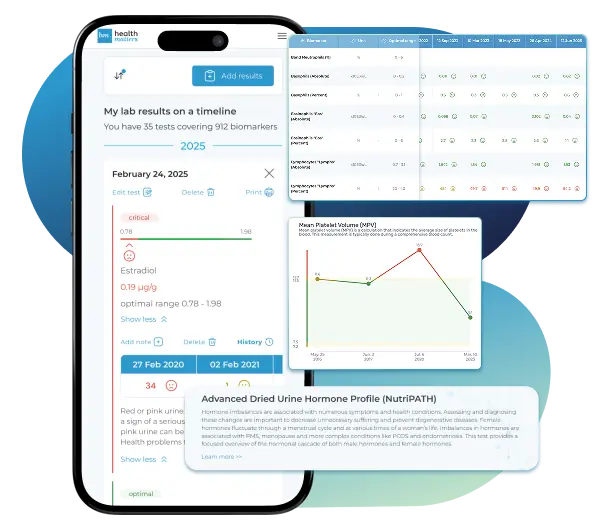
Import lab results from multiple providers, track changes over time, customize your reference ranges, and get clear explanations for each result. Everything is stored securely, exportable in one organized file, and shareable with your doctor—or anyone you choose.
Cancel or upgrade anytime
What does it mean if your EPA+DPA+DHA result is too low?
A low EPA+DPA+DHA (OmegaCheck) result usually means your body doesn't have as much omega-3 available as experts consider ideal for long-term cardiovascular health. Unlike many abnormal blood tests, this one is usually easy to improve — and that's the most useful thing to know about it.
Low omega-3 status is associated with a higher relative risk of cardiovascular events and sudden cardiac death — that association is why the reference tiers exist. What a single low number does not tell you is that you will have a cardiac event, or that anything is wrong right now. It's a risk-marker, not a diagnosis. And it reflects what actually made it into your blood, which isn't always the same as what you ate: plenty of people with a low result are already eating fish or taking a supplement, and the dose, consistency, product, or absorption simply didn't add up to enough.
Most people raise a low result by eating more oily fish (salmon, sardines, mackerel, herring), adding a fish-oil or algal-oil (vegan) omega-3 supplement, or both — and the number typically shifts within a couple of months. Re-testing after that change closes the loop: it tells you whether what you're doing is working. See below for the risk tiers, what moves the number, and why a level can stay low despite fish oil.
Related Biomarkers
Article Review & Sources
All our content is backed by peer-reviewed studies, academic research, and trusted medical sources. We're committed to accuracy and transparency — see our editorial policy for details.
Laboratories
Bring All Your Lab Results Together — In One Place
We accept reports from any lab, so you can easily collect and organize all your health information in one secure spot.











Pricing Table
Gather Your Lab History — and Finally Make Sense of It
Finally, Your Lab Results Organized and Clear

Personal plans

$79/ year
Advanced Plan
Access your lab reports, explanations, and tracking tools.
- Import lab results from any provider
- Track all results with visual tools
- Customize your reference ranges
- Export your full lab history anytime
- Share results securely with anyone
- Receive 5 reports entered for you
- Cancel or upgrade anytime
$250/ once
Unlimited Account
Pay once, access everything—no monthly fees, no limits.
- Import lab results from any provider
- Track all results with visual tools
- Customize your reference ranges
- Export your full lab history anytime
- Share results securely with anyone
- Receive 10 reports entered for you
- No subscriptions. No extra fees.
$45/ month
Pro Monthly
Designed for professionals managing their clients' lab reports
- Import lab results from any provider
- Track lab results for multiple clients
- Customize reference ranges per client
- Export lab histories and reports
- Begin with first report entered by us
- Cancel or upgrade anytime
About membership
What's included in a Healthmatters membership
 Import Lab Results from Any Source
 See Your Health Timeline
 Understand What Your Results Mean

 Visualize Your Results

 Data Entry Service for Your Reports
 Securely Share With Anyone You Trust
Let Your Lab Results Tell the Full Story
Once your results are in one place, see the bigger picture — track trends over time, compare data side by side, export your full history, and share securely with anyone you trust.




Bring all your results together to compare, track progress, export your history, and share securely.
What Healthmatters Members Are Saying

I have been using Healthmatters.io since 2021. I travel all over the world and use different doctors and health facilities. This site has allowed me to consolidate all my various test results over 14 years in one place. And every doctor that I show this to has been impressed. Because with any health professional I talk to, I can pull up historical results in seconds. It is invaluable. Even going back to the same doctor, they usually do not have the historical results from their facility in a graph format. That has been very helpful.
Anthony
Unlimited Plan Member since 2021
What fantastic service and great, easy-to-follow layouts! I love your website; it makes it so helpful to see patterns in my health data. It's truly a pleasure to use. I only wish the NHS was as organized and quick as Healthmatters.io. You've set a new standard for health tracking!
Karin
Advanced Plan Member since 2020
As a PRO member and medical practitioner, Healthmatters.io has been an invaluable tool for tracking my clients' data. The layout is intuitive, making it easy to monitor trends and spot patterns over time. The ability to customize reports and charts helps me present information clearly to my clients, improving communication and outcomes. It's streamlined my workflow, saving me time and providing insights at a glance. Highly recommended for any practitioner looking for a comprehensive and user-friendly solution to track patient labs!
Paul
Healthmatters Pro Member since 2024

We implement proven measures to keep your data safe.
At HealthMatters, we're committed to maintaining the security and confidentiality of your personal information. We've put industry-leading security standards in place to help protect against the loss, misuse, or alteration of the information under our control. We use procedural, physical, and electronic security methods designed to prevent unauthorized people from getting access to this information. Our internal code of conduct adds additional privacy protection. All data is backed up multiple times a day and encrypted using SSL certificates. See our Privacy Policy for more details.