
EBV Ab VCA IgG High, >600 or >750: What Your Result Means
Other names: EBV Viral Capsid Ag (VCA) Ab (IgG), EBV-VCA IgG, VCA IgG, EBV Ab to Viral Capsid Ag IgG, EBV Capsid Ab IgG, EBV AB VCA IgG, EBV Viral Capsid Antigen IgG, EBV VCA IgG EIA, EBV VCA IgG Positive, EBV Ab VCA IgG 600, EBV Ab VCA IgG High
 Optimal Result:
0 - 18 U/mL.
Optimal Result:
0 - 18 U/mL.

A positive or high EBV Ab VCA IgG result — including values reported as ">600 U/mL" or ">750 U/mL" — almost always reflects past EBV infection, not active mononucleosis. More than 90% of adults worldwide have been infected with Epstein-Barr virus at some point, and VCA IgG antibodies remain detectable for life after infection. A high VCA IgG result on its own does not mean you currently have mono or an active EBV infection.
Quick Result Interpreter
| Your result pattern | Most likely meaning |
|---|---|
| VCA IgG positive + EBNA IgG positive | Past EBV infection — most common adult finding |
| VCA IgG positive + VCA IgM positive + EBNA IgG negative | Recent or current primary infection |
| VCA IgG >600 or >750, no current symptoms | Longstanding past infection — clinically routine |
| VCA IgG equivocal (18–21.9 U/mL) | Borderline — repeat testing or full panel needed |
| VCA IgG negative | No prior EBV exposure detected |
| VCA IgG positive + EBNA IgG negative + VCA IgM negative | Infection confirmed, timing uncertain — see note below |
How to interpret your EBV panel
1. Check whether VCA IgG is positive, negative, or equivocal.
2. Check VCA IgM to assess recent infection.
3. Check EBNA IgG to distinguish past infection from recent primary infection.
4. Do not use VCA IgG level alone to diagnose active EBV or reactivation.
AT A GLANCE
-
EBV Ab VCA IgG (also reported as "EBV Viral Capsid Ag (VCA) Ab (IgG)" or "VCA IgG") measures IgG antibodies to the viral capsid antigen of Epstein-Barr virus.
-
A positive result means you have been exposed to EBV at some point in your life — this is extremely common; over 90% of adults are EBV-positive.
-
Values reported as >600 U/mL (LabCorp) or >750 U/mL (Quest) are commonly reported ceiling displays — the test is qualitative only. LabCorp explicitly states the numeric value above the cutoff is not indicative of the amount of antibody present.
-
A high VCA IgG alone does not diagnose active mono — it must be interpreted alongside VCA IgM and EBNA IgG to determine the timing of infection.
-
VCA IgG positive + EBNA IgG positive = past infection (most common pattern in adults).
-
VCA IgG positive + VCA IgM positive + EBNA IgG negative = recent or current infection.
-
The positive threshold is >21.9 U/mL at both LabCorp and Quest — any value above this is positive, whether it reads 22 or 600.
What Is EBV Ab VCA IgG?
EBV stands for Epstein-Barr virus — the virus that causes infectious mononucleosis (mono) and one of the most prevalent viruses in humans. VCA stands for viral capsid antigen, a protein found in the outer shell of the EBV virus particle. IgG is the antibody class that develops weeks to months after initial infection and then persists for life.
The EBV Ab VCA IgG test measures whether your blood contains IgG antibodies against this viral capsid protein. It is part of the standard EBV antibody panel, which typically includes:
-
VCA IgG — present for life after infection; does not distinguish recent from past exposure alone.
-
VCA IgM — appears early in acute infection; declines after 4–8 weeks.
-
EBNA IgG (Epstein-Barr nuclear antigen) — develops 6–12 weeks after primary infection; its presence alongside VCA IgG confirms past rather than recent infection.
-
Early Antigen IgG (EA-D) — appears during active viral replication; may indicate acute infection or reactivation.
How It Appears on Your Lab Report
-
EBV Ab VCA, IgG / EBV Ab VCA IgG
-
EBV Viral Capsid Ag (VCA) Ab (IgG)
-
EBV-VCA IgG / VCA IgG
-
EBV Ab to Viral Capsid Ag, IgG
-
EBV Capsid Ab IgG
Common Exact Phrases From Patient Portals
If your portal shows any of the following, the interpretation is the same as described on this page:
-
WarningHigh EBV Ab VCA, IgG
-
EBV Ab VCA IgG >600 / EBV Ab VCA IgG >600.0 H
-
EBV Viral Capsid Ag (VCA) Ab (IgG) 750
-
EBV Ab VCA, IgG 01 / EBV Ab VCA, IgG 01 High
-
EBV VCA IgG EIA Positive
-
EBV VCA IgG, Qual Positive
-
High EBV Ab VCA IgG
-
EBV Nuclear Antigen Ab, IgG >600
-
EBV Ab VCA IGM <36 (negative IgM)
Reference Ranges: LabCorp and Quest
Both LabCorp and Quest Diagnostics use the same three-tier interpretation for VCA IgG:
| Result | LabCorp (test 096230) | Quest (test 8474) |
|---|---|---|
| Negative | < 18.0 U/mL | < 18.00 U/mL |
| Equivocal | 18.0–21.9 U/mL | 18.00–21.99 U/mL |
| Positive | ≥ 21.9 U/mL | ≥ 21.99 U/mL |
Any value above 21.9 U/mL is positive — whether it reads 25 or is displayed as a ceiling value such as >600 or >750. LabCorp (test code 096230) explicitly states that this test is intended for qualitative determination only — the numeric value above the positive cutoff is not indicative of the amount of antibodies present. A result of >600 U/mL does not represent a more severe infection than a result of 25 U/mL. Both are simply positive.
What Does a High EBV Ab VCA IgG Mean?
A high VCA IgG — including values commonly displayed as >600 U/mL (LabCorp) or >750 U/mL (Quest) — indicates that your immune system has produced IgG antibodies to EBV's viral capsid antigen. This is the expected finding in anyone who has been infected with EBV.
The most important thing to understand about high VCA IgG values: the test does not measure active viral load or current disease activity. IgG antibodies are long-lived immune memory proteins. LabCorp states explicitly that the numeric value above the positive cutoff is not indicative of the amount of antibody present. A VCA IgG of >600 in a healthy adult who had mono at age 16 and recovered completely is clinically identical to the same result in someone recently infected — the VCA IgG number alone cannot distinguish between them.
EBV reactivation cannot be diagnosed from VCA IgG alone — VCA IgG remains elevated regardless of whether the virus is latent or actively replicating. Suspected reactivation typically requires additional clinical evaluation and may include EBV Early Antigen (EA-D) IgG antibodies or EBV DNA PCR testing to assess active viral replication directly.
Interpreting Your VCA IgG in Context of the Full Panel
| VCA IgG | VCA IgM | EBNA IgG | Most likely interpretation |
|---|---|---|---|
| Negative | Negative | Negative | No prior EBV exposure |
| Positive | Positive | Negative | Recent or current primary infection |
| Positive | Negative | Positive | Past infection — most common adult pattern |
| Positive | Negative | Negative | Infection confirmed, timing uncertain* |
| Positive | Positive | Positive | Past infection (IgM may be residual) |
| Negative | Positive | Negative | Very early primary infection |
*Note: EBNA antibodies develop 6–12 weeks after primary infection in most people — however, approximately 5–10% of individuals with prior EBV infection never develop detectable EBNA antibodies. This pattern can represent a recent infection in which EBNA has not yet appeared, a remote past infection in someone who never developed EBNA antibodies, or occasionally, immunocompromised states.
What Does EBV Ab VCA IgG 600 or >600 Mean Specifically?
"EBV Ab VCA IgG 600" or "EBV Ab VCA IgG >600" is the most common high EBV result reported by LabCorp (test code 096230). It means your VCA IgG is at or above the level at which the assay commonly displays a ceiling value. LabCorp states that this test is for qualitative determination only — the numeric value above the positive cutoff does not indicate the amount of antibody present. Your result could reflect a longstanding past infection or a more recent one; the number alone cannot tell you which.
In a healthy adult with no current symptoms of mono (fatigue, fever, sore throat, swollen lymph nodes, enlarged spleen), a VCA IgG >600 almost always reflects normal longstanding past infection. No clinical action is required based on this number alone.
In someone with current symptoms consistent with mono or EBV reactivation, VCA IgG >600 must be interpreted alongside VCA IgM and EBNA IgG — if VCA IgM is also positive and EBNA IgG is negative, this pattern supports a recent primary infection.
EBV Ab VCA IgG vs. EBV Nuclear Antigen (EBNA) IgG: What Is the Difference?
These are two different antibody tests and their combination determines the timing of EBV infection.
VCA IgG rises within 2–4 weeks of initial infection and remains elevated for life. It cannot distinguish between a recent infection from six months ago and one from twenty years ago.
EBNA IgG develops 6–12 weeks after primary infection and also persists for life. Its presence alongside VCA IgG is the key marker of past rather than recent infection. When EBNA IgG is negative and VCA IgG is positive, the infection may be recent — or the patient may be one of the 5–10% who never develop EBNA antibodies.
If your lab report only shows VCA IgG and not EBNA IgG, your result is incomplete for determining the timing of infection. Ask your doctor whether EBNA IgG was also ordered.
What Does a Positive VCA IgG Mean If You Have No Symptoms?
A positive or high VCA IgG in someone with no symptoms of mono or EBV reactivation is almost always an incidental finding reflecting past infection — the same status that over 90% of adults carry. It does not require treatment, does not indicate active infection, and does not predict future illness.
Some patients discover a positive VCA IgG on routine bloodwork or when testing for causes of fatigue. A positive VCA IgG alone is not evidence of chronic active EBV infection, which is a rare and distinct clinical condition requiring additional testing — including PCR for EBV DNA in blood — and specialist evaluation.
Can EBV IgG Stay High for Years?
Yes — VCA IgG antibodies are lifelong. Once you have been infected with EBV, VCA IgG remains detectable indefinitely. A result reported as >600 U/mL or >750 U/mL ten or twenty years after a mono infection is entirely expected and does not indicate ongoing active infection or any health problem.
Does High EBV IgG Cause Fatigue?
VCA IgG itself does not cause fatigue — it is an immune memory antibody, not an active inflammatory marker. Persistent fatigue following EBV infection (sometimes called post-infectious fatigue or post-mononucleosis syndrome) is a distinct clinical condition that is not diagnosed by VCA IgG levels alone. If you have ongoing fatigue after a documented EBV infection, other markers including ferritin, CRP, CBC with differential, and thyroid function are typically evaluated alongside clinical assessment.
Can Stress Reactivate EBV?
EBV reactivation has been studied in the context of psychological stress and immune suppression. Some research suggests that periods of significant psychological stress or immune compromise can be associated with EBV reactivation — detectable through Early Antigen IgG or EBV DNA PCR, not through VCA IgG which remains elevated regardless. A high VCA IgG during a stressful period does not confirm EBV reactivation.
What Does Positive EBNA IgG Mean?
EBNA IgG (Epstein-Barr nuclear antigen antibody) develops 6–12 weeks after primary infection and persists for life. A positive EBNA IgG alongside a positive VCA IgG is the definitive pattern for past — not recent — EBV infection. If EBNA IgG is positive, recent primary infection is effectively ruled out for most patients.
What Is the Normal Range for EBV VCA IgG?
The standard reference range used by both LabCorp (test code 096230) and Quest (test code 8474):
-
Below 18 U/mL: Negative
-
18.0–21.9 U/mL: Equivocal
-
Above 21.9 U/mL: Positive
Any value above 21.9 U/mL is positive — whether it reads 25 or >600. LabCorp states that the numeric value above the positive cutoff does not indicate the amount of antibody present or the severity of infection.
What Does a Negative EBV Ab VCA IgG Mean?
A negative VCA IgG (below 18 U/mL on both LabCorp and Quest reference ranges) means no detectable IgG antibodies to EBV's viral capsid antigen were found. This most commonly means you have never been infected with EBV — making you susceptible to primary infection.
A negative VCA IgG does not mean you are immune or protected. If you have symptoms consistent with mono (fever, sore throat, extreme fatigue, swollen lymph nodes) and a negative VCA IgG, the infection may be in its very early stages before IgG antibodies have developed. Early primary EBV infection is better detected by VCA IgM, which appears earlier than IgG.
In immunocompromised patients, a negative VCA IgG despite prior infection can occasionally occur due to reduced antibody production.
What Does an Equivocal EBV Ab VCA IgG Mean?
An equivocal EBV Ab VCA IgG result — between 18.0 and 21.9 U/mL at LabCorp or 18.00 and 21.99 U/mL at Quest — means the antibody signal is borderline and cannot be clearly interpreted as negative or positive. This is a genuinely uncertain result, not a mildly positive one.
Equivocal VCA IgG results can occur in several situations: very early in a primary infection before IgG levels have fully risen; in someone with a weak or atypical antibody response; or because of low-level nonspecific assay reactivity unrelated to EBV.
What to do with an equivocal result: interpret alongside VCA IgM and EBNA IgG. If VCA IgM is also positive, this supports early primary infection and the equivocal IgG likely represents a rising response. If VCA IgM is negative and EBNA IgG is negative, the result is genuinely indeterminate. If EBV infection is clinically suspected based on symptoms, repeat testing in 1–2 weeks may clarify whether antibodies are rising toward a clearly positive result.
The Complete EBV Antibody Panel: What Each Test Tells You
| Test | Appears | Persists | Significance |
|---|---|---|---|
| VCA IgM | 1–2 weeks post-infection | Declines after 4–8 weeks | Acute/recent primary infection |
| VCA IgG (this test) | 2–4 weeks post-infection | Lifelong | Past or current exposure |
| EBNA IgG | 6–12 weeks post-infection | Lifelong | Confirms past (not recent) infection |
| Early Antigen IgG (EA-D) | During active replication | Variable — may decline | Active viral replication (acute or reactivation) |
LabCorp EBV Ab VCA IgG: test code 096230
Quest Diagnostics EBV VCA Ab IgG: test code 8474
FAQ about EBV Ab VCA, IgG
-
What is the normal range for EBV VCA IgG?
The standard reference range for EBV VCA IgG used by both LabCorp and Quest Diagnostics is: Negative: below 18 U/mL Equivocal: 18.0–21.9 U/mL Positive: above 21.9 U/mL A positive result means IgG antibodies to Epstein-Barr virus were detected, usually indicating past EBV infection. Values reported as >600 U/mL or >750 U/mL are still interpreted simply as positive and do not indicate infection severity or active viral replication. -
What does "EBV Ab VCA IgG High" mean on my lab report?
It means you have elevated IgG antibodies to the Epstein-Barr virus capsid antigen. In most adults, a high VCA IgG reflects past EBV infection — which more than 90% of adults have had. It does not mean you currently have mono or an active EBV infection. -
What does EBV Ab VCA IgG >600 mean?
Less than 600 U/mL is a commonly reported ceiling display on LabCorp VCA IgG results (test 096230). LabCorp states explicitly that this test is for qualitative determination only — the numeric value above the positive cutoff does not indicate the amount of antibody present. A result of >600 U/mL is clinically equivalent to a result of 22 U/mL: both are positive. In a healthy adult without current mono symptoms, this reflects longstanding past infection. Interpret alongside VCA IgM and EBNA IgG to determine timing. -
What does EBV Ab VCA IgG >750 mean?
Less than 750 U/mL is a commonly reported ceiling display on Quest Diagnostics VCA IgG results (test 8474). Clinically equivalent to LabCorp's ">600" — the numeric value above the positive cutoff does not indicate severity or viral activity. Interpret alongside VCA IgM and EBNA IgG. -
What is the difference between VCA IgG and VCA IgM?
VCA IgG develops 2–4 weeks after infection and persists for life — it confirms past or current exposure but cannot determine timing alone. VCA IgM appears earlier (within 1–2 weeks) and declines after acute infection resolves — its presence alongside VCA IgG suggests recent or ongoing primary infection. Both LabCorp and Quest use a negative threshold of less than 18 U/mL for VCA IgG, with an equivocal range of 18–21.9 U/mL. -
Can a high VCA IgG mean cancer?
EBV is associated with certain cancers including Burkitt lymphoma, Hodgkin lymphoma, and nasopharyngeal carcinoma, but a high VCA IgG alone is not a cancer screening result. The association involves specific patterns of EBV reactivation, not a standalone elevated VCA IgG in an otherwise healthy person. If you have concerns, discuss with your doctor alongside clinical examination and appropriate evaluation. -
Why is my EBV IgG so high if I feel fine?
Because VCA IgG reflects immune memory, not active disease. Once infected with EBV, your immune system maintains lifelong antibody levels — often at or above reported ceiling values. Feeling well is the expected state for most EBV-positive adults. A high VCA IgG in an asymptomatic person typically requires no action. -
What does "WarningHigh EBV Ab VCA IgG" mean on my portal?
WarningHigh is an automated portal flag indicating your result is above the reference range. For VCA IgG, this is the expected finding in any EBV-positive person — which includes the majority of adults. The flag is technically correct but clinically unremarkable in isolation for asymptomatic individuals. -
What does EBV Ab VCA IgM <36 mean?
Less than 36 U/mL is the lower reporting limit of the VCA IgM assay at LabCorp — any value below 36 is reported as "<36" and is interpreted as negative. A negative VCA IgM alongside a positive VCA IgG typically indicates past rather than recent infection. -
What does EBV Ab VCA IgG equivocal mean?
An equivocal EBV Ab VCA IgG result means the antibody signal is borderline and cannot be clearly classified as negative or positive. At both LabCorp and Quest Diagnostics, the equivocal range is approximately 18.0–21.9 U/mL. This can occur very early in an EBV infection before IgG antibodies have fully developed, in someone with a weak antibody response, or because of low-level nonspecific assay reactivity. Interpreting the result alongside VCA IgM and EBNA IgG is important. If infection is suspected, repeat testing in 1–2 weeks may help clarify whether the antibody level is rising toward a clearly positive result.
Lab Results Explained and Tracked
What does it mean if your EBV Ab VCA, IgG result is too high?
A positive or high EBV Ab VCA IgG result — including values commonly reported as ">600 U/mL" or ">750 U/mL" — almost always reflects past EBV infection, not active mononucleosis. VCA IgG antibodies develop 2–4 weeks after initial infection and remain elevated for life. More than 90% of adults worldwide carry detectable VCA IgG.
LabCorp (test code 096230) states that this test is intended for qualitative determination only — the numeric value above the positive cutoff is not indicative of the amount of antibodies present. A result of >600 U/mL carries no additional clinical significance beyond confirming past or current EBV exposure compared to a result of 25 U/mL. Both are simply positive.
To interpret what your positive VCA IgG means, you need the full panel:
VCA IgG positive + EBNA IgG positive — past infection. The most common adult pattern. VCA IgG positive + VCA IgM positive + EBNA IgG negative — recent or current primary infection. VCA IgG positive + VCA IgM negative + EBNA IgG negative — infection confirmed, timing uncertain; approximately 5–10% of people with prior EBV never develop EBNA antibodies.
A high VCA IgG in an asymptomatic person typically requires no clinical action.
Related Health Conditions

All Your Lab Results.
One Simple Dashboard.
Import, Track, and Share Your Lab Results Easily
Import, Track, and Share Your Lab Results
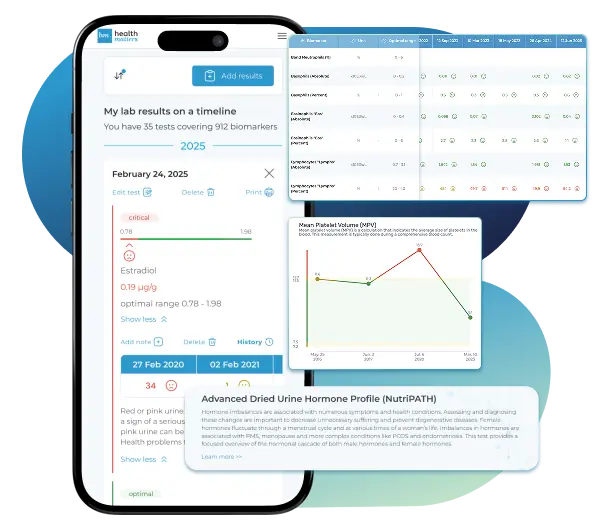
Import lab results from multiple providers, track changes over time, customize your reference ranges, and get clear explanations for each result. Everything is stored securely, exportable in one organized file, and shareable with your doctor—or anyone you choose.
Cancel or upgrade anytime
Related Biomarkers
Article Review & Sources
All our content is backed by peer-reviewed studies, academic research, and trusted medical sources. We're committed to accuracy and transparency — see our editorial policy for details.
Laboratories
Bring All Your Lab Results Together — In One Place
We accept reports from any lab, so you can easily collect and organize all your health information in one secure spot.











Pricing Table
Gather Your Lab History — and Finally Make Sense of It
Finally, Your Lab Results Organized and Clear

Personal plans

$79/ year
Advanced Plan
Access your lab reports, explanations, and tracking tools.
- Import lab results from any provider
- Track all results with visual tools
- Customize your reference ranges
- Export your full lab history anytime
- Share results securely with anyone
- Receive 5 reports entered for you
- Cancel or upgrade anytime
$250/ once
Unlimited Account
Pay once, access everything—no monthly fees, no limits.
- Import lab results from any provider
- Track all results with visual tools
- Customize your reference ranges
- Export your full lab history anytime
- Share results securely with anyone
- Receive 10 reports entered for you
- No subscriptions. No extra fees.
$45/ month
Pro Monthly
Designed for professionals managing their clients' lab reports
- Import lab results from any provider
- Track lab results for multiple clients
- Customize reference ranges per client
- Export lab histories and reports
- Begin with first report entered by us
- Cancel or upgrade anytime
About membership
What's included in a Healthmatters membership
 Import Lab Results from Any Source
 See Your Health Timeline
 Understand What Your Results Mean

 Visualize Your Results

 Data Entry Service for Your Reports
 Securely Share With Anyone You Trust
Let Your Lab Results Tell the Full Story
Once your results are in one place, see the bigger picture — track trends over time, compare data side by side, export your full history, and share securely with anyone you trust.




Bring all your results together to compare, track progress, export your history, and share securely.
What Healthmatters Members Are Saying

I have been using Healthmatters.io since 2021. I travel all over the world and use different doctors and health facilities. This site has allowed me to consolidate all my various test results over 14 years in one place. And every doctor that I show this to has been impressed. Because with any health professional I talk to, I can pull up historical results in seconds. It is invaluable. Even going back to the same doctor, they usually do not have the historical results from their facility in a graph format. That has been very helpful.
Anthony
Unlimited Plan Member since 2021
What fantastic service and great, easy-to-follow layouts! I love your website; it makes it so helpful to see patterns in my health data. It's truly a pleasure to use. I only wish the NHS was as organized and quick as Healthmatters.io. You've set a new standard for health tracking!
Karin
Advanced Plan Member since 2020
As a PRO member and medical practitioner, Healthmatters.io has been an invaluable tool for tracking my clients' data. The layout is intuitive, making it easy to monitor trends and spot patterns over time. The ability to customize reports and charts helps me present information clearly to my clients, improving communication and outcomes. It's streamlined my workflow, saving me time and providing insights at a glance. Highly recommended for any practitioner looking for a comprehensive and user-friendly solution to track patient labs!
Paul
Healthmatters Pro Member since 2024

We implement proven measures to keep your data safe.
At HealthMatters, we're committed to maintaining the security and confidentiality of your personal information. We've put industry-leading security standards in place to help protect against the loss, misuse, or alteration of the information under our control. We use procedural, physical, and electronic security methods designed to prevent unauthorized people from getting access to this information. Our internal code of conduct adds additional privacy protection. All data is backed up multiple times a day and encrypted using SSL certificates. See our Privacy Policy for more details.