
Band Neutrophils High or Low: What Your CBC Result Means
Other names: Band Cells, Band Forms, Bands, Stab Cells, Band Neutrophil, Band Form Neutrophils, Bands Manual, Band % Manual Count, Banded Neutrophils, Band Neutrophils Absolute, Neutrophil Band Form, Band Man, Bands CBC, Band WBC, Rod Cells, Band Count CBC
 Optimal Result:
0 - 6 %.
Optimal Result:
0 - 6 %.

Band neutrophils are immature white blood cells released by the bone marrow when the immune system needs to respond quickly to infection or inflammation. Normal range: 0–6% of white blood cells. A result of 0% is normal and common in healthy adults. Elevated band neutrophils are part of what clinicians call a "left shift" — a pattern that reflects increased immune demand and most often indicates bacterial infection or significant inflammation.
At a Glance
- Band neutrophils are immature versions of segmented neutrophils — the body's frontline infection-fighting cells
- Normal range: 0–6%; a result of 0% is completely normal and the most common finding in healthy adults
- Elevated bands indicate the bone marrow is releasing immature cells faster than usual — a pattern called a "left shift" that can occur even when total WBC is normal
- Many modern labs do not routinely report band neutrophils separately and may include them within the total neutrophil count unless a manual differential is performed
- Tracking CBC trends over time — rather than a single result — provides the most useful insight into immune activity
What are band neutrophils?
Neutrophils are the most abundant white blood cell and the immune system's primary defence against bacterial infection. They are produced in the bone marrow through a series of maturation stages — from myelocytes to metamyelocytes, then to band neutrophils, and finally to fully mature segmented neutrophils.
The key difference between a band and a segmented neutrophil is nuclear shape. A mature segmented neutrophil has a nucleus divided into distinct lobes. A band neutrophil has a nucleus that is curved or horseshoe-shaped — like a band or rod — not yet divided into separate lobes. Small numbers of band neutrophils may circulate in healthy individuals, but a result of 0% is also very common and completely normal.
When the body faces significant immune demand — particularly acute bacterial infection — the bone marrow releases band neutrophils early into circulation before they have fully matured. This reflects the urgency of the immune response and is the biological basis of the "left shift" pattern.
Important technical note: Band counts are less standardised than other CBC components and can vary significantly depending on whether a manual or automated differential was used. Many modern laboratories do not routinely report band neutrophils separately — they may be included within the total neutrophil count unless a manual differential is specifically performed.
On your lab report, band neutrophils may appear as: Band Neutrophils (%), Bands, Band Cells, Band Form, Bands Manual, Band % Manual Count, Stab Cells, Segs + Bands, or Neutrophils Segmented and Band Form (band neutrophils CBC meaning may vary by lab system).
Band neutrophils normal range
| Result type | Normal range |
|---|---|
| Band neutrophils (%) | 0 – 6% |
| Band neutrophils (absolute) | 0 – 0.7 × 10³/µL (cut-offs vary between laboratories) |
Note: Reference ranges vary between laboratories. Some labs report bands as part of a combined "Segs + Bands" value. Always compare your result to the range on your own report.
A result of 0% or 0.00 means no immature neutrophils were detected in the sample. This is normal, requires no action, and is the most common finding in healthy adults.
What does a high band neutrophil result mean?
Elevated band neutrophils — also described as high bands on a blood test — indicate the bone marrow is releasing immature neutrophils into circulation before they have fully matured. This is called bandemia and reflects increased immune demand.
Common causes include:
Infection
- Acute bacterial infection — the most common cause; bacteria trigger rapid neutrophil production and early release of bands
- Sepsis — band counts around or above 10% are often used clinically as a marker of serious bacterial illness in some settings; a cut-off of 8.5% or above has been associated with sepsis in certain clinical studies
- Localised infections — pneumonia, urinary tract infection, appendicitis, cellulitis, abscess
Inflammation and physiological stress
- Surgery or significant trauma
- Burns
- Heart attack (myocardial infarction)
- Haemorrhage or blood loss
- Tissue necrosis
Chronic and systemic conditions
- Inflammatory bowel disease
- Rheumatoid arthritis and other inflammatory conditions
- Systemic inflammatory response syndrome (SIRS)
Medications and treatments
- Corticosteroids — mobilise bone marrow stores and can release bands into circulation
- Granulocyte colony-stimulating factor (G-CSF) — directly stimulates the bone marrow to produce and release neutrophils including bands
- Epinephrine — causes rapid release of stored neutrophils
Bone marrow and haematological conditions
- Chronic myelogenous leukaemia (CML) — can produce very high band and immature neutrophil counts
- Other myeloproliferative disorders
Important: An elevated band count is a non-specific finding. High bands on a blood test indicate immune activation but do not diagnose a specific condition on their own. The result must always be interpreted alongside total WBC, the rest of the CBC differential, and clinical symptoms.
What is a "left shift" on a CBC blood test?
A left shift refers to an increase in immature white blood cells — particularly band neutrophils — in the circulation. The term comes from older laboratory practice where cell types were arranged from immature (left) to mature (right) on a differential count chart.
A left shift means the bone marrow is releasing cells before they have fully matured, reflecting high immune demand. A left shift can occur even when the total white blood cell count is normal — making band neutrophil reporting clinically valuable as an independent finding.
Degrees of left shift:
Mild left shift — bands 6–10%, total WBC mildly elevated or normal. Often reflects early or localised infection, physiological stress, or medication effect.
Moderate left shift — bands 10–20%, often with elevated total WBC. Suggests significant bacterial infection or systemic inflammation. Further clinical evaluation is typically warranted.
Severe (degenerative) left shift — bands or earlier immature forms present in high numbers, sometimes with a normal or low total WBC. When bands outnumber segmented neutrophils, this suggests the bone marrow is struggling to keep up with demand. Associated with severe infection or significant physiological stress, and may be seen in sepsis or overwhelming infection. This pattern requires urgent clinical evaluation.
A left shift blood test finding is most meaningful when interpreted alongside total WBC, clinical symptoms, CRP, and other inflammatory markers.
Band neutrophils vs segmented neutrophils
| Feature | Band neutrophils | Segmented neutrophils |
|---|---|---|
| Maturity | Immature | Fully mature |
| Nucleus shape | Horseshoe / rod-shaped | Divided into lobes |
| Normal in circulation | Rarely / 0% common | Yes — primary circulating form |
| Normal range (%) | 0 – 6% | 40 – 70% |
| Clinical significance of elevation | Suggests immune demand / infection | Suggests infection / inflammation / stress |
Both belong to the same cell lineage. When labs report "Neutrophils (Segs + Bands)" as a combined value, this represents the total neutrophil count including both mature and immature forms.
Specific band neutrophil percentage guidance
0% bands Normal. The most common finding in healthy adults. No action required.
1–5% bands Within the normal range. Usually not clinically significant in isolation.
6–10% bands (mild elevation) May reflect early infection, physiological stress, medication effect, or post-surgical state. Interpret alongside total WBC, symptoms, and clinical context.
10–20% bands (bandemia) Associated with significant bacterial infection or systemic inflammation. Band counts around or above 10% are often used as a marker of serious bacterial illness in some clinical settings. Further evaluation is typically warranted.
Above 20% bands Associated with severe infection or significant physiological stress, and may be seen in sepsis or major bone marrow stimulation. Urgent clinical evaluation warranted.
When to speak to your doctor
A mildly elevated band neutrophil result in the context of a recent illness, minor infection, or recent surgery is usually expected and often resolves with treatment of the underlying cause.
Speak to your doctor if:
- Band neutrophils are consistently elevated across multiple tests without a clear cause
- Bands are elevated above 10%
- Your CBC shows a left shift alongside a low or normal total WBC
- You have symptoms of infection: fever, chills, rapid heart rate, confusion, or significant pain
- You have a known immune condition or are on immunosuppressive therapy
Seek urgent medical care if you feel severely unwell or have symptoms suggesting serious infection such as very high fever, difficulty breathing, or confusion.
FAQ about Band Neutrophils (%)
-
What are band neutrophils?
Band neutrophils are immature white blood cells produced in the bone marrow — the final maturation stage before becoming fully mature segmented neutrophils. They are normally stored in the bone marrow and released into the bloodstream only when the immune system faces significant demand, most commonly acute bacterial infection. -
What does high band neutrophils mean?
High band neutrophils (above 6%) on a blood test indicate the bone marrow is releasing immature neutrophils early — most often in response to bacterial infection, inflammation, surgery, trauma, or certain medications. Band counts around or above 10% are often used as a marker of serious bacterial illness in some clinical settings. Elevated bands are a non-specific finding and should be interpreted alongside the full CBC and symptoms. -
What does a band neutrophil result of 0 or 0.00 mean?
A result of 0 or 0.00 is completely normal and the most common finding in healthy adults. The absence of band neutrophils means the bone marrow is not under pressure to release immature cells. -
What is the normal range for band neutrophils?
The normal range is 0–6% of white blood cells. A result of 0% is completely normal. -
What are bands called on a CBC?
Bands may appear on your report as: Band Neutrophils, Bands, Band Cells, Band Form, Bands Manual, Band % Manual Count, Stab Cells, or as part of a combined Segs + Bands value. Band neutrophils CBC meaning is the same regardless of the label used. -
What is another name for bands in a CBC?
Band neutrophils are also called band cells, stab cells, rod cells, or band forms. All refer to the same cell — an immature neutrophil that has not yet fully segmented its nucleus. -
What does left shift mean on a CBC blood test?
A left shift on a blood test means there are increased immature white blood cells — particularly band neutrophils — in the bloodstream. It indicates the bone marrow is releasing cells before they fully mature, reflecting high immune demand. A left shift can occur even when the total WBC is normal. It most commonly indicates bacterial infection but can also occur with severe inflammation, trauma, or bone marrow stimulation. -
What is bandemia?
Bandemia refers to an elevated percentage of band neutrophils — typically defined as greater than 10% of total white blood cells. It is associated with serious bacterial infection and sepsis and is used clinically alongside other markers to assess infection severity. -
Are bands the same as neutrophils?
Band neutrophils are a type of neutrophil — specifically an immature one. Segmented neutrophils are fully mature. Together they make up the total neutrophil count. When a lab reports combined "Segs + Bands," this represents both mature and immature neutrophils. -
What is the difference between bands and segmented neutrophils?
Segmented neutrophils are fully mature with a nucleus divided into distinct lobes. Band neutrophils are immature with a horseshoe-shaped nucleus not yet divided. Bands are only released from the bone marrow when immune demand is high. -
Can band neutrophils be high without infection?
Yes. Bands can be elevated due to corticosteroids, G-CSF therapy, surgery, trauma, burns, heart attack, inflammatory conditions, and bone marrow disorders without bacterial infection being the cause. Elevated bands are a non-specific finding requiring clinical interpretation. -
What does bands absolute high mean?
Bands absolute refers to the actual number of band neutrophils per microlitre of blood rather than the percentage. A high absolute band count — typically above 0.7 × 10³/µL, though cut-offs vary between laboratories — carries the same clinical significance as a high percentage and warrants interpretation alongside the full CBC. -
What does bands manual mean on a blood test?
Bands manual or band % manual count means the band percentage was determined by a laboratory technician manually examining the blood smear under a microscope rather than by an automated analyser. Manual counting is more accurate for band differentiation. Many automated analysers do not reliably separate bands from segmented neutrophils and may include both within the total neutrophil count. -
Why do some CBC reports not show bands?
Many modern labs do not routinely report band neutrophils separately. Automated analysers have difficulty reliably distinguishing bands from segmented neutrophils, so bands may be included in the total neutrophil count unless a manual differential is specifically performed. If bands are clinically relevant — for example when infection or sepsis is suspected — a manual differential can be ordered.
Lab Results Explained and Tracked
What does it mean if your Band Neutrophils (%) result is too high?
High band neutrophils mean the bone marrow is releasing immature white blood cells earlier than usual — most often in response to bacterial infection, significant inflammation, trauma, surgery, or certain medications including corticosteroids and G-CSF.
Common causes include acute bacterial infections such as pneumonia, UTI, appendicitis, and sepsis; inflammatory conditions; post-surgical state; and bone marrow stimulation. Band counts around or above 10% are often used clinically as a marker of serious bacterial illness.
A mildly elevated result in the context of recent illness or surgery is usually expected and often resolves with treatment of the underlying cause. If your band neutrophils are consistently elevated above 10%, or if you have symptoms of serious infection — high fever, chills, rapid heart rate, or confusion — seek clinical evaluation.
Related Health Conditions

All Your Lab Results.
One Simple Dashboard.
Import, Track, and Share Your Lab Results Easily
Import, Track, and Share Your Lab Results
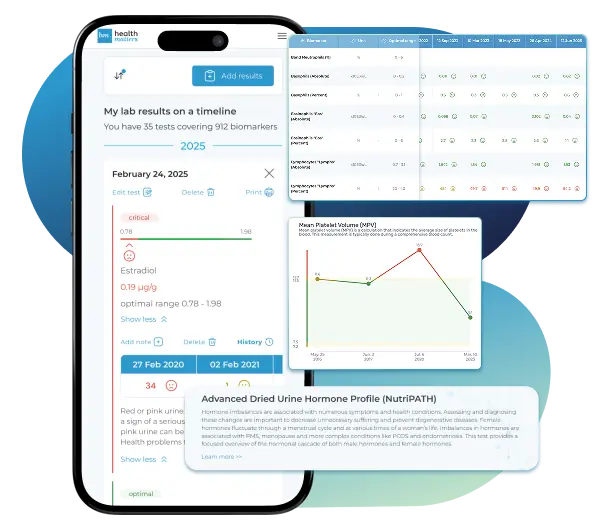
Import lab results from multiple providers, track changes over time, customize your reference ranges, and get clear explanations for each result. Everything is stored securely, exportable in one organized file, and shareable with your doctor—or anyone you choose.
Cancel or upgrade anytime
Related Biomarkers
Article Review & Sources
All our content is backed by peer-reviewed studies, academic research, and trusted medical sources. We're committed to accuracy and transparency — see our editorial policy for details.
Laboratories
Bring All Your Lab Results Together — In One Place
We accept reports from any lab, so you can easily collect and organize all your health information in one secure spot.











Pricing Table
Gather Your Lab History — and Finally Make Sense of It
Finally, Your Lab Results Organized and Clear

Personal plans

$79/ year
Advanced Plan
Access your lab reports, explanations, and tracking tools.
- Import lab results from any provider
- Track all results with visual tools
- Customize your reference ranges
- Export your full lab history anytime
- Share results securely with anyone
- Receive 5 reports entered for you
- Cancel or upgrade anytime
$250/ once
Unlimited Account
Pay once, access everything—no monthly fees, no limits.
- Import lab results from any provider
- Track all results with visual tools
- Customize your reference ranges
- Export your full lab history anytime
- Share results securely with anyone
- Receive 10 reports entered for you
- No subscriptions. No extra fees.
$45/ month
Pro Monthly
Designed for professionals managing their clients' lab reports
- Import lab results from any provider
- Track lab results for multiple clients
- Customize reference ranges per client
- Export lab histories and reports
- Begin with first report entered by us
- Cancel or upgrade anytime
About membership
What's included in a Healthmatters membership
 Import Lab Results from Any Source
 See Your Health Timeline
 Understand What Your Results Mean

 Visualize Your Results

 Data Entry Service for Your Reports
 Securely Share With Anyone You Trust
Let Your Lab Results Tell the Full Story
Once your results are in one place, see the bigger picture — track trends over time, compare data side by side, export your full history, and share securely with anyone you trust.




Bring all your results together to compare, track progress, export your history, and share securely.
What Healthmatters Members Are Saying

I have been using Healthmatters.io since 2021. I travel all over the world and use different doctors and health facilities. This site has allowed me to consolidate all my various test results over 14 years in one place. And every doctor that I show this to has been impressed. Because with any health professional I talk to, I can pull up historical results in seconds. It is invaluable. Even going back to the same doctor, they usually do not have the historical results from their facility in a graph format. That has been very helpful.
Anthony
Unlimited Plan Member since 2021
What fantastic service and great, easy-to-follow layouts! I love your website; it makes it so helpful to see patterns in my health data. It's truly a pleasure to use. I only wish the NHS was as organized and quick as Healthmatters.io. You've set a new standard for health tracking!
Karin
Advanced Plan Member since 2020
As a PRO member and medical practitioner, Healthmatters.io has been an invaluable tool for tracking my clients' data. The layout is intuitive, making it easy to monitor trends and spot patterns over time. The ability to customize reports and charts helps me present information clearly to my clients, improving communication and outcomes. It's streamlined my workflow, saving me time and providing insights at a glance. Highly recommended for any practitioner looking for a comprehensive and user-friendly solution to track patient labs!
Paul
Healthmatters Pro Member since 2024

We implement proven measures to keep your data safe.
At HealthMatters, we're committed to maintaining the security and confidentiality of your personal information. We've put industry-leading security standards in place to help protect against the loss, misuse, or alteration of the information under our control. We use procedural, physical, and electronic security methods designed to prevent unauthorized people from getting access to this information. Our internal code of conduct adds additional privacy protection. All data is backed up multiple times a day and encrypted using SSL certificates. See our Privacy Policy for more details.