
Speckled Pattern High or Positive ANA: What It Means
Other names: Speckled Pattern ANA, ANA Speckled, ANA Pattern Speckled, Nuclear Speckled, Speckled ANA Pattern, ANA Nuclear Speckled, Speckled ANA, Fine Speckled Pattern, Coarse Speckled Pattern, Dense Fine Speckled Pattern, DFS Pattern, AC-4, AC-5, Anti-Nuclear Ab by IFA Speckled Pattern, FANA Speckled Pattern, ANA IFA Speckled, Speckled Pattern High, High Speckled Pattern, Positive ANA Speckled Pattern, ANA 12 Plus Profile Speckled Pattern, Nuclear Speckled ANA Pattern, Speckled Pattern Blood Test, Warning High Speckled Pattern
 Reference range:

A "speckled pattern" on an ANA (antinuclear antibody) test means antinuclear antibodies were detected and produced a dotted or speckled staining pattern in the cell nucleus under immunofluorescence. If your report says "speckled pattern high," "positive speckled pattern," or "anti-nuclear ab by IFA (RDL) positive speckled pattern," the result should be interpreted together with the ANA titer, your symptoms, and any follow-up antibody testing.
Some reports describe this as a "nuclear speckled" ANA pattern, which refers to the same general staining location in the cell nucleus. On a blood test, a speckled ANA pattern means the laboratory detected antinuclear antibodies that create a dotted or speckled staining appearance under immunofluorescence. It is a screening finding that may be seen in autoimmune disease, but also in some healthy people — especially at low titers.
At a Glance
- A speckled ANA pattern means antinuclear antibodies targeting extractable nuclear antigens (ENAs) were detected in your blood
- The result is always reported with a titer (e.g. 1:80, 1:160, 1:320) — the higher the titer, the more clinically significant the result
- The speckled pattern is one of the most common ANA patterns — including in healthy people
- A positive speckled pattern is a screening result, not a diagnosis — it requires interpretation alongside symptoms and further testing
- Associated conditions include SLE, Sjögren's syndrome, mixed connective tissue disease (MCTD), systemic sclerosis, dermatomyositis, and polymyositis
Speckled Pattern High Meaning
A "speckled pattern high" result means the ANA test was positive — antinuclear antibodies were detected — and the pattern of staining was speckled. "High" in this context means the result was above the laboratory's reference range, typically indicating a positive ANA rather than a numerical elevation like a blood count.
What does a high speckled pattern mean? It means your immune system is producing antibodies that target proteins inside the cell nucleus, and those antibodies were present at a level the lab considers above normal. The speckled pattern identifies the type of staining, while the titer tells you how strong the antibody signal is. Together, they guide the next steps.
A high speckled pattern is not a diagnosis on its own. It is one piece of information that your doctor will interpret alongside your symptoms, other blood test results, and clinical history.
What does "ANA 12 Plus Profile Speckled Pattern High" mean?
This is one of the most commonly reported results people search for, and the wording is specific to LabCorp's ANA 12 Plus Profile panel — a commonly ordered autoimmune screening test. Here is what each part means:
ANA 12 Plus Profile is a LabCorp panel that tests for antinuclear antibodies using indirect immunofluorescence (IFA) on HEp-2 cells. The "12 Plus" refers to the combination of ANA screening with reflex testing for specific antibodies.
Speckled pattern means the antibodies detected produced a speckled staining appearance in the cell nucleus — indicating they target extractable nuclear antigens (ENAs).
High means the result was flagged above the reference range — in other words, the ANA test was positive.
The result also appears in these formats on LabCorp and similar portals:
Anti-Nuclear Ab by IFA (RDL) Positive Speckled Pattern HighAnti-Nuclear Ab by IFA (RDL) Speckled PatternANA 12 Plus Profile (RDL) Speckled Pattern HighANA by IFA RFX Titer/Pattern Positive Speckled Pattern
In all cases, the interpretation is the same: the ANA test is positive, the pattern is speckled, and the titer reported alongside it determines how clinically significant the finding is. "RDL" refers to Research Development Laboratories, a LabCorp testing division.
Why does my portal say "warning high speckled pattern" or "highspeckled pattern"?
Some patient portals compress the result flag and the pattern name together, producing combined strings like "warning high speckled pattern," "highspeckled pattern," or "nuclear, speckled abnormal." This is a display artefact — the portal is combining the abnormal/high flag with the pattern name. It does not change the clinical meaning. The result still means a positive ANA with a speckled pattern, and the titer reported alongside it is what matters most for interpretation.
Understanding the titer with a speckled pattern
The titer tells you how diluted your blood sample can be and still show a positive result. Higher numbers mean more antibodies are present. The approximate prevalence figures below come from population studies — exact rates vary by laboratory and age group.
| Titer | General interpretation |
|---|---|
| 1:40 | Very common in healthy individuals — up to around one-third of healthy adults may be positive at this level in some studies. Usually not clinically significant on its own |
| 1:80 | Still common in healthy people — roughly 1 in 10 adults in some populations. May be reported as borderline or low positive depending on the lab |
| 1:160 | Less common in healthy individuals. Many laboratories treat this as a threshold where results are more likely to be clinically meaningful, especially if symptoms are present |
| 1:320 | More strongly associated with autoimmune disease than lower titers. Usually warrants further investigation |
| 1:640 | High titer — more strongly associated with connective tissue disease, especially when symptoms are present |
| 1:1280 and above | Very high titer — significantly associated with systemic autoimmune rheumatic disease; ENA antibody testing is strongly indicated |
Important: Titer interpretation always depends on clinical context. Higher titers are more likely to be seen in autoimmune connective tissue diseases, but even high titers can occur without a defined autoimmune diagnosis.
What does ANA titer 1:80 speckled pattern mean? A low-level positive result found in roughly 1 in 10 adults in some populations. Often non-specific and may be reported as borderline depending on the lab. May warrant investigation if accompanied by symptoms such as joint pain, fatigue, dry eyes, or skin rashes.
What does ANA titer 1:160 speckled pattern mean? The level at which many laboratories consider results more likely to be clinically meaningful. ENA antibody follow-up testing and clinical review are usually recommended, especially if symptoms are present.
What does ANA titer 1:320 speckled pattern mean? A moderately high positive result, more strongly associated with systemic autoimmune rheumatic disease than lower titers. Typically warrants comprehensive ENA testing and rheumatology referral, particularly if symptoms are present.
What does ANA titer 1:640 speckled pattern mean? A high level of antinuclear antibodies, more strongly associated with connective tissue disease than lower titers. Comprehensive specialist evaluation is usually recommended when symptoms are also present.
What does ANA titer 1:1280 speckled pattern mean? A very high titer strongly associated with systemic autoimmune rheumatic disease. ENA antibody testing and specialist review are strongly indicated regardless of whether symptoms are currently prominent.
What conditions are associated with a speckled ANA pattern?
| Condition | Key associated antibodies |
|---|---|
| Systemic lupus erythematosus (SLE) | Anti-Sm, anti-dsDNA, anti-SSA/Ro, anti-SSB/La |
| Sjögren's syndrome | Anti-SSA/Ro, anti-SSB/La |
| Mixed connective tissue disease (MCTD) | Anti-U1-RNP |
| Systemic sclerosis (scleroderma) | Anti-Scl-70 (topoisomerase I) |
| Dermatomyositis / Polymyositis | Anti-Jo-1 and other myositis-specific antibodies |
| Undifferentiated connective tissue disease (UCTD) | Various ENAs at lower titers |
A speckled pattern can also appear in other inflammatory conditions, with certain medications, and in healthy individuals — particularly at low titers.
Common symptoms associated with a positive speckled ANA
A positive speckled ANA is not itself a symptom, but it is often found in people experiencing signs of an underlying autoimmune condition. Symptoms that commonly appear alongside a positive result and should be discussed with your doctor include:
- Joint pain or stiffness, particularly in the hands, wrists, or knees
- Persistent fatigue
- Dry eyes or dry mouth
- Skin rashes, including a butterfly rash across the cheeks, or photosensitivity
- Muscle weakness or aching
- Raynaud's phenomenon — fingers or toes turning white or blue in the cold
Having one or more of these symptoms alongside a positive ANA result — especially at a titer of 1:160 or higher — is a stronger signal for further evaluation than a positive result in isolation.
Speckled pattern subtypes
Fine speckled (AC-4) Small, evenly distributed dots. Associated with anti-SSA/Ro and anti-SSB/La antibodies. Seen in Sjögren's syndrome and various forms of lupus including cutaneous lupus erythematosus.
Coarse speckled (AC-5) Larger, irregular clumps. Associated with anti-Sm and anti-U1-RNP antibodies. Linked to SLE and MCTD.
Dense fine speckled (DFS / AC-2) An intense, dense pattern of very fine speckles. Usually caused by anti-DFS70/LEDGF antibodies. An isolated DFS pattern — without other ENA antibodies and without clinical features of autoimmune disease — is strongly associated with healthy individuals and may help exclude systemic autoimmune rheumatic disease. Specific anti-DFS70 testing can confirm this.
Nuclear speckled / mixed patterns "Nuclear speckled" specifies the staining is in the nucleus rather than cytoplasm or nucleolus, and is clinically equivalent to a standard speckled result. Mixed patterns occur when multiple antibody types are present simultaneously.
What happens after a positive speckled ANA result?
Step 1: Review symptoms Consider whether you have joint pain, fatigue, dry eyes, skin rashes, or Raynaud's phenomenon. The clinical picture is essential — a high titer without symptoms is interpreted differently from the same result in someone with significant complaints.
Step 2: Check the titer Results at 1:160 and above are more likely to be clinically meaningful. Results at 1:40–1:80 with no symptoms are often monitored rather than acted on immediately.
Step 3: ENA panel testing The standard follow-up is an ENA panel testing for anti-Sm, anti-U1-RNP, anti-SSA/Ro, anti-SSB/La, anti-Scl-70, and anti-Jo-1. A specific ENA result alongside the speckled pattern is far more diagnostically useful than the pattern alone.
Step 4: Rheumatology referral Often considered when the titer is 1:160 or higher and/or symptoms suggestive of connective tissue disease are present. If a dense fine speckled pattern is reported, anti-DFS70 testing may be ordered first.
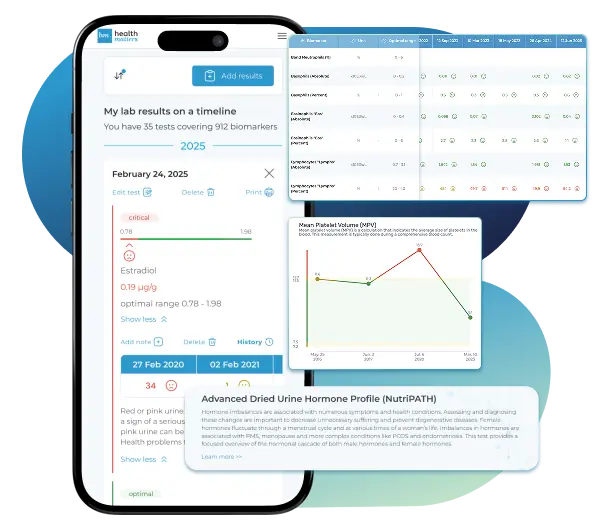
Tracking your ANA result and related biomarkers over time in HealthMatters can help you and your clinician monitor trends, organise follow-up results in one place, and bring a clear record to specialist appointments.
FAQ about Speckled Pattern
-
What does "speckled pattern high" mean?
"Speckled pattern high" on a lab report means the ANA test was positive with a speckled staining pattern, flagged above the laboratory's reference range. The titer reported alongside it — such as 1:80, 1:160, or 1:320 — tells you how strong the antibody signal is and guides whether follow-up testing is needed. -
What does "high speckled pattern" mean?
The same as "speckled pattern high" — a positive ANA result with a speckled pattern. The word "high" indicates the result was above the reference range, not a specific numerical value. -
What does a speckled ANA pattern mean?
It means your blood contains antinuclear antibodies that target extractable nuclear antigens (ENAs) — proteins in the cell nucleus. It is one of the most common ANA patterns, seen in autoimmune conditions and in healthy individuals at low titers. It is a screening result, not a diagnosis. -
What does "ANA 12 Plus Profile speckled pattern high" mean?
This is LabCorp report wording. The ANA 12 Plus Profile is a LabCorp autoimmune screening panel. "Speckled pattern high" means the test was positive with a speckled staining pattern. The titer alongside this result determines how clinically significant the finding is. -
What does "anti-nuclear ab by IFA (RDL) positive speckled pattern high" mean?
This LabCorp wording means the ANA test was performed by indirect immunofluorescence, was positive, showed a speckled pattern, and was flagged as high. "RDL" is a LabCorp testing division. The titer must be read alongside this result to understand its significance. -
What does "speckled pattern" mean on a blood test?
On a blood test, a speckled ANA pattern means the laboratory detected antinuclear antibodies that create a dotted staining appearance in the cell nucleus under immunofluorescence. It is a screening finding that may be seen in autoimmune disease but also in some healthy people at low titers. -
Why does my portal say "warning high speckled pattern" or "highspeckled pattern"?
Some patient portals compress the abnormal/high flag and the pattern name together. It means the ANA result was flagged positive with a speckled pattern. The clinical meaning is the same as any positive speckled ANA — interpret it with the titer and discuss with your doctor. -
What does "nuclear speckled ANA pattern" mean?
"Nuclear speckled" specifies the staining is in the nucleus rather than the cytoplasm or nucleolus. It is clinically equivalent to a standard speckled ANA result. -
What does ANA titer 1:160 speckled pattern mean?
The level at which many labs consider a result more likely to be clinically meaningful. ENA follow-up testing and clinical review are usually recommended, especially if symptoms are present. -
What does ANA titer 1:320 speckled pattern mean?
A moderately high positive result more strongly associated with autoimmune disease. Usually warrants ENA testing and rheumatology referral if symptoms are also present. -
Is a speckled ANA pattern always serious?
No. A low-titer speckled pattern (1:40 or 1:80) is common in healthy people and often non-specific. Even high titers are not a diagnosis on their own. Many people with a positive speckled ANA result are found not to have an autoimmune disease after full evaluation. -
Can you have a speckled ANA and not have lupus?
Yes — most people with a positive speckled ANA do not have lupus. The pattern is associated with several different conditions and is common in healthy individuals at low titers. A lupus diagnosis requires multiple criteria beyond a positive ANA result. -
What diseases cause a positive ANA speckled pattern?
The speckled pattern is associated with SLE, Sjögren's syndrome, MCTD, systemic sclerosis, dermatomyositis, and polymyositis. It can also appear in other inflammatory conditions, with certain medications, and in healthy individuals at low titers. -
What does dense fine speckled (DFS) ANA pattern mean?
A DFS pattern (AC-2) is typically caused by anti-DFS70/LEDGF antibodies. In isolation — without other ENA antibodies and without clinical features of autoimmune disease — it is strongly associated with healthy individuals and may help exclude systemic autoimmune rheumatic disease.
Lab Results Explained and Tracked
Related Health Conditions

All Your Lab Results.
One Simple Dashboard.
Import, Track, and Share Your Lab Results Easily
Import, Track, and Share Your Lab Results
Import lab results from multiple providers, track changes over time, customize your reference ranges, and get clear explanations for each result. Everything is stored securely, exportable in one organized file, and shareable with your doctor—or anyone you choose.
Cancel or upgrade anytime
Related Biomarkers
Article Review & Sources
All our content is backed by peer-reviewed studies, academic research, and trusted medical sources. We're committed to accuracy and transparency — see our editorial policy for details.
Laboratories
Bring All Your Lab Results Together — In One Place
We accept reports from any lab, so you can easily collect and organize all your health information in one secure spot.











Pricing Table
Gather Your Lab History — and Finally Make Sense of It
Finally, Your Lab Results Organized and Clear

Personal plans

$79/ year
Advanced Plan
Access your lab reports, explanations, and tracking tools.
- Import lab results from any provider
- Track all results with visual tools
- Customize your reference ranges
- Export your full lab history anytime
- Share results securely with anyone
- Receive 5 reports entered for you
- Cancel or upgrade anytime
$250/ once
Unlimited Account
Pay once, access everything—no monthly fees, no limits.
- Import lab results from any provider
- Track all results with visual tools
- Customize your reference ranges
- Export your full lab history anytime
- Share results securely with anyone
- Receive 10 reports entered for you
- No subscriptions. No extra fees.
$45/ month
Pro Monthly
Designed for professionals managing their clients' lab reports
- Import lab results from any provider
- Track lab results for multiple clients
- Customize reference ranges per client
- Export lab histories and reports
- Begin with first report entered by us
- Cancel or upgrade anytime
About membership
What's included in a Healthmatters membership
 Import Lab Results from Any Source
 See Your Health Timeline
 Understand What Your Results Mean

 Visualize Your Results

 Data Entry Service for Your Reports
 Securely Share With Anyone You Trust
Let Your Lab Results Tell the Full Story
Once your results are in one place, see the bigger picture — track trends over time, compare data side by side, export your full history, and share securely with anyone you trust.




Bring all your results together to compare, track progress, export your history, and share securely.
What Healthmatters Members Are Saying

I have been using Healthmatters.io since 2021. I travel all over the world and use different doctors and health facilities. This site has allowed me to consolidate all my various test results over 14 years in one place. And every doctor that I show this to has been impressed. Because with any health professional I talk to, I can pull up historical results in seconds. It is invaluable. Even going back to the same doctor, they usually do not have the historical results from their facility in a graph format. That has been very helpful.
Anthony
Unlimited Plan Member since 2021
What fantastic service and great, easy-to-follow layouts! I love your website; it makes it so helpful to see patterns in my health data. It's truly a pleasure to use. I only wish the NHS was as organized and quick as Healthmatters.io. You've set a new standard for health tracking!
Karin
Advanced Plan Member since 2020
As a PRO member and medical practitioner, Healthmatters.io has been an invaluable tool for tracking my clients' data. The layout is intuitive, making it easy to monitor trends and spot patterns over time. The ability to customize reports and charts helps me present information clearly to my clients, improving communication and outcomes. It's streamlined my workflow, saving me time and providing insights at a glance. Highly recommended for any practitioner looking for a comprehensive and user-friendly solution to track patient labs!
Paul
Healthmatters Pro Member since 2024

We implement proven measures to keep your data safe.
At HealthMatters, we're committed to maintaining the security and confidentiality of your personal information. We've put industry-leading security standards in place to help protect against the loss, misuse, or alteration of the information under our control. We use procedural, physical, and electronic security methods designed to prevent unauthorized people from getting access to this information. Our internal code of conduct adds additional privacy protection. All data is backed up multiple times a day and encrypted using SSL certificates. See our Privacy Policy for more details.