
MAG AB (IGM), WESTERN BLOT
 Reference range:

MAG, Western Blot with reflexes is useful in detecting antibodies associated with autoimmune peripheral neuropathy.
MAG stands for Myelin Associated Glycoprotein.
This is a stand-alone test for autoimmune neuropathies. The test by itself is not diagnostic and should be used in conjunction with other clinical parameters to confirm disease.
A normal concentration generally rules out an anti-MAG antibody-associated peripheral neuropathy.
--------------------
What is Anti-MAG peripheral neuropathy?
Anti-MAG peripheral neuropathy is a very rare disease, constituting perhaps 5% of CIDP-like (=Chronic Inflammatory Demyelinating Polyneuropathy) disorders. Anti-MAG occurs when the body’s own immune system develops antibodies against a key glycoprotein (myelin-associated glycoprotein, or MAG). MAG is essential to maintaining a healthy peripheral nervous system. The disorder is predominantly characterized by distal sensory loss in the extremities (hands and feet), a tingling sensation in the affected limbs, a mild to moderate tremor, and poor balance which can lead to difficulty walking. As the disease progresses, individuals develop some muscle weakness as well. Ninety percent of patients are male, and most of them are in their 50s or 60s.
Anti-MAG differs from CIDP in that it is not an inflammatory disease, and therefore typical CIDP treatments are usually only transiently effective in these patients.
What causes Anti-MAG?
Myelin is an important part of the peripheral nervous system. It wraps around the nerve axon (the long, wire-like part of a nerve cell) much like insulation around an electrical wire. The nerves extend from the spinal cord to the rest of the body, stimulating muscle contraction and transmitting sensory information back to the nervous system receptors in the skin and joints. This insulation (myelin) allows electrical impulses to efficiently travel along the nerve axon. When myelin is damaged or removed, these electrical impulses are slowed or lost, and messages transmitted from the brain are disrupted and may never make it to their final destination.
MAG is a special type of glycoprotein that is found within the myelin sheath and in Schwann cells, which are the cells that are responsible for creating and maintaining myelin sheaths on nerve axons. It is thought that MAG plays a role in a signaling cascade that “turns on” the Schwann cells, leading to normal myelin production and healthy peripheral nerve activity.
In anti-MAG peripheral neuropathy, the body produces serum IgM antibodies that bind to MAG, preventing MAG from signaling the Schwann cells and myelin to do their job. This results in the loss of the nerves’ normal function, leading to problems in both sensory and motor function.
It is still unclear what causes the body to create anti-MAG antibodies in the first place. In about 98% of cases, the anti-MAG antibodies are the result of an abnormal expansion (increase in numbers) of a single antibody-producing cell. This condition is called monoclonal gammopathy.
What is monoclonal gammopathy?
Monoclonal gammopathies are the irregular proteins produced by these cells. These proteins are called immunoglobulins and there are different types:
Immunoglobulin G (IgG),
- IgA,
- IgM,
- IgD
- and IgE.
In anti-MAG neuropathy the monoclonal gammopathy is IgM. Most monoclonal gammopathies are not associated with neuropathies or any other disease but occasionally they can be malignant. Your neurologist may refer you to a hematologist to rule out other diseases.
How is Anti-MAG diagnosed?
Detecting anti-MAG neuropathy starts with identifying the symptoms of the patient:
- Sensory loss starting in toes in fingers
- Loss of vibration senses
- Unsteady gait
- Tremors in hands and legs
Diagnosis proceeds with a neurological examination. If the examination indicates that the patient has a peripheral neuropathy then testing for an IgM monoclonal gammopathy and electrodiagnostic testing is done. If the blood work and/or the EMG are appropriately abnormal then blood testing for anti-MAG neuropathy is done. Other blood work will be done to exclude another cause for the patient’s condition. Some patients will have an elevated protein in their cerebral-spinal fluid, which can be obtained through a spinal tap.
How is Anti-MAG treated?
There are many therapeutic treatments that have been used for anti-MAG neuropathy. Most of these treatments are thought to reduce the levels of anti-MAG antibodies. Please discuss treatment options with your medical professional.
Living with Anti-MAG:
The progression of anti-MAG is slower and less severe than CIDP, and many patients continue living relatively normal lives while managing their symptoms with simple exercises or drug therapies. Usually, only 10 percent of patients become severely disabled and wheelchair-bound.
Lab Results Explained and Tracked

All Your Lab Results.
One Simple Dashboard.
Import, Track, and Share Your Lab Results Easily
Import, Track, and Share Your Lab Results
Import lab results from multiple providers, track changes over time, customize your reference ranges, and get clear explanations for each result. Everything is stored securely, exportable in one organized file, and shareable with your doctor—or anyone you choose.
Cancel or upgrade anytime
Article Review & Sources
All our content is backed by peer-reviewed studies, academic research, and trusted medical sources. We're committed to accuracy and transparency — see our editorial policy for details.
Laboratories
Bring All Your Lab Results Together — In One Place
We accept reports from any lab, so you can easily collect and organize all your health information in one secure spot.











Pricing Table
Gather Your Lab History — and Finally Make Sense of It
Finally, Your Lab Results Organized and Clear

Personal plans

$79/ year
Advanced Plan
Access your lab reports, explanations, and tracking tools.
- Import lab results from any provider
- Track all results with visual tools
- Customize your reference ranges
- Export your full lab history anytime
- Share results securely with anyone
- Receive 5 reports entered for you
- Cancel or upgrade anytime
$250/ once
Unlimited Account
Pay once, access everything—no monthly fees, no limits.
- Import lab results from any provider
- Track all results with visual tools
- Customize your reference ranges
- Export your full lab history anytime
- Share results securely with anyone
- Receive 10 reports entered for you
- No subscriptions. No extra fees.
$45/ month
Pro Monthly
Designed for professionals managing their clients' lab reports
- Import lab results from any provider
- Track lab results for multiple clients
- Customize reference ranges per client
- Export lab histories and reports
- Begin with first report entered by us
- Cancel or upgrade anytime
About membership
What's included in a Healthmatters membership
 Import Lab Results from Any Source
 See Your Health Timeline
 Understand What Your Results Mean

 Visualize Your Results

 Data Entry Service for Your Reports
 Securely Share With Anyone You Trust
Let Your Lab Results Tell the Full Story
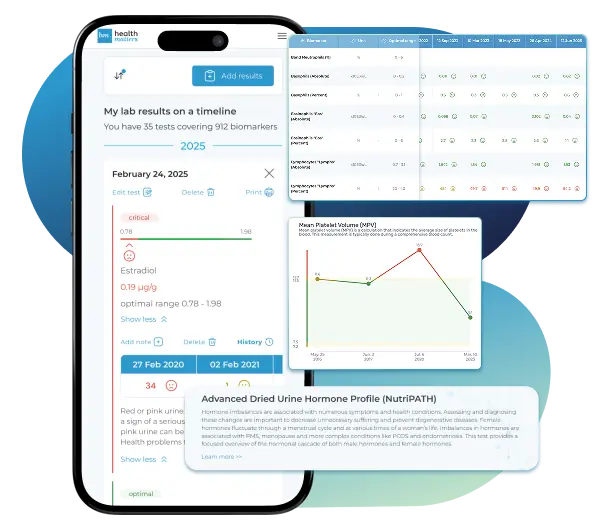
Once your results are in one place, see the bigger picture — track trends over time, compare data side by side, export your full history, and share securely with anyone you trust.




Bring all your results together to compare, track progress, export your history, and share securely.
What Healthmatters Members Are Saying

I have been using Healthmatters.io since 2021. I travel all over the world and use different doctors and health facilities. This site has allowed me to consolidate all my various test results over 14 years in one place. And every doctor that I show this to has been impressed. Because with any health professional I talk to, I can pull up historical results in seconds. It is invaluable. Even going back to the same doctor, they usually do not have the historical results from their facility in a graph format. That has been very helpful.
Anthony
Unlimited Plan Member since 2021
What fantastic service and great, easy-to-follow layouts! I love your website; it makes it so helpful to see patterns in my health data. It's truly a pleasure to use. I only wish the NHS was as organized and quick as Healthmatters.io. You've set a new standard for health tracking!
Karin
Advanced Plan Member since 2020
As a PRO member and medical practitioner, Healthmatters.io has been an invaluable tool for tracking my clients' data. The layout is intuitive, making it easy to monitor trends and spot patterns over time. The ability to customize reports and charts helps me present information clearly to my clients, improving communication and outcomes. It's streamlined my workflow, saving me time and providing insights at a glance. Highly recommended for any practitioner looking for a comprehensive and user-friendly solution to track patient labs!
Paul
Healthmatters Pro Member since 2024

We implement proven measures to keep your data safe.
At HealthMatters, we're committed to maintaining the security and confidentiality of your personal information. We've put industry-leading security standards in place to help protect against the loss, misuse, or alteration of the information under our control. We use procedural, physical, and electronic security methods designed to prevent unauthorized people from getting access to this information. Our internal code of conduct adds additional privacy protection. All data is backed up multiple times a day and encrypted using SSL certificates. See our Privacy Policy for more details.