
 Optimal Result:
35 - 60 %.
Optimal Result:
35 - 60 %.

The "CAR (Cortisol Awakening Response) Rise Response" is a physiological phenomenon observed in the hypothalamic-pituitary-adrenal (HPA) axis, reflecting the body's reaction to stress and its regulatory mechanisms of stress hormones, primarily cortisol.
Upon awakening, a marked increase in cortisol levels is typically observed, peaking within the first 30 to 45 minutes after waking. This response is thought to be an adaptive mechanism that prepares the body for the anticipated demands of the day, enhancing alertness and mobilizing energy resources. The magnitude and pattern of the CAR can be influenced by various factors, including sleep quality, psychosocial stressors, and underlying health conditions. Scientific studies have utilized the CAR as a biomarker for assessing HPA axis function and its dysregulation in stress-related disorders, such as chronic fatigue syndrome, depression, and post-traumatic stress disorder (PTSD).
Furthermore, the CAR has been investigated for its predictive value in health outcomes, including cardiovascular disease and metabolic syndrome, underlining its significance as a critical indicator of physiological stress responses and overall health status. The quantification and analysis of the CAR involve precise measurement of salivary cortisol levels at specific intervals upon waking, requiring standardized collection protocols to ensure accuracy and reliability of the data.
Lab Results Explained and Tracked

All Your Lab Results.
One Simple Dashboard.
Import, Track, and Share Your Lab Results Easily
Import, Track, and Share Your Lab Results
Import lab results from multiple providers, track changes over time, customize your reference ranges, and get clear explanations for each result. Everything is stored securely, exportable in one organized file, and shareable with your doctor—or anyone you choose.
Cancel or upgrade anytime
What does it mean if your CAR Rise Response result is too low?
The Cortisol Awakening Response (CAR) measures how much your cortisol levels rise within the first 30–45 minutes after waking.
This natural surge is part of your body’s circadian rhythm and helps you transition from sleep to alertness, mobilize energy, and prepare to handle the physical and mental demands of the day.
A healthy CAR is characterized by a significant increase in cortisol shortly after waking, followed by a gradual decline throughout the day.
What Does It Mean If the CAR Rise Response Is Low?
A low CAR Rise Response means that your cortisol levels do not rise adequately after waking, or that the increase from your baseline (at waking) to the 30-minute post-waking measurement is blunted.
This pattern suggests that your adrenal glands — which produce cortisol — are not responding strongly to the body’s normal morning activation signal.
Clinically, a low CAR is often interpreted as a sign of:
-
Adrenal fatigue or insufficiency
-
HPA axis dysregulation (impaired communication between the brain and adrenal glands)
-
Reduced physiological readiness or resilience to stress
Possible Causes of a Low CAR Rise Response
Several physiological and lifestyle factors can blunt the normal morning cortisol rise:
1. Chronic stress and burnout
-
Prolonged emotional or physical stress can exhaust adrenal responsiveness.
-
Over time, the stress response becomes “down-regulated,” producing less cortisol when needed.
2. Sleep disruption
-
Poor-quality sleep, insomnia, or irregular sleep–wake patterns can reduce the morning cortisol peak.
-
Shift work or jet lag can also flatten the CAR.
3. Adrenal or HPA axis insufficiency
-
Chronic overstimulation of the stress system leads to low cortisol output upon waking.
-
Often accompanied by fatigue, low blood pressure, and reduced stress tolerance.
4. Depression or chronic fatigue
-
Research shows that individuals with chronic fatigue syndrome, depressive disorders, or post-viral fatigue may have a lower CAR.
5. Nutrient depletion
-
Inadequate intake of vitamin C, B vitamins, and magnesium — key nutrients for adrenal hormone synthesis — can impair cortisol production.
6. Underlying illness or inflammation
-
Chronic infections or autoimmune conditions can suppress adrenal function and blunt cortisol output.
Symptoms Associated with a Low CAR
When the morning cortisol rise is insufficient, individuals may experience:
-
Difficulty waking up or getting going in the morning
-
Persistent fatigue or low energy despite adequate sleep
-
Brain fog or slow mental clarity after waking
-
Low motivation or mood disturbances
-
Increased stress sensitivity or burnout
-
Low blood pressure or dizziness on standing
Health Implications
Cortisol is essential for:
-
Regulating blood sugar and blood pressure
-
Supporting immune balance
-
Modulating inflammation
-
Managing energy and focus
A consistently low CAR suggests that your body may be struggling to adapt to daily stressors, and over time, this can contribute to chronic fatigue, immune imbalance, and reduced resilience.
How to Support a Healthy CAR Rise
Improving a low CAR often requires a combination of lifestyle, nutritional, and behavioral strategies to support adrenal and circadian function:
1. Prioritize restorative sleep
-
Keep a consistent bedtime and waking schedule.
-
Avoid screens and bright light before bed; expose yourself to natural light shortly after waking.
2. Manage stress effectively
-
Practice mindfulness, deep breathing, yoga, or progressive relaxation daily.
-
Take regular breaks from chronic psychological or work-related stressors.
3. Support adrenal nutrition
-
Ensure adequate vitamin C, B5 (pantothenic acid), B6, and magnesium intake.
-
Maintain stable blood sugar through balanced meals and regular protein intake.
4. Moderate exercise
-
Engage in light-to-moderate activity, such as walking or cycling.
-
Avoid overtraining, which can further suppress cortisol output.
5. Evaluate for underlying causes
-
If fatigue is persistent, your clinician may test DHEAS, thyroid hormones, or 24-hour cortisol to assess broader endocrine function.
-
In some cases, adaptogenic herbs (such as ashwagandha or rhodiola) may help normalize the cortisol rhythm under professional guidance.
Key Takeaway
A low CAR Rise Response means that your morning cortisol surge is blunted, suggesting adrenal insufficiency, chronic stress adaptation, or reduced stress resilience.
This pattern is often reversible with restorative sleep, stress management, balanced nutrition, and adrenal support — helping restore energy, focus, and a healthy daily rhythm.
Article Review & Sources
All our content is backed by peer-reviewed studies, academic research, and trusted medical sources. We're committed to accuracy and transparency — see our editorial policy for details.
Laboratories
Bring All Your Lab Results Together — In One Place
We accept reports from any lab, so you can easily collect and organize all your health information in one secure spot.











Pricing Table
Gather Your Lab History — and Finally Make Sense of It
Finally, Your Lab Results Organized and Clear

Personal plans

$79/ year
Advanced Plan
Access your lab reports, explanations, and tracking tools.
- Import lab results from any provider
- Track all results with visual tools
- Customize your reference ranges
- Export your full lab history anytime
- Share results securely with anyone
- Receive 5 reports entered for you
- Cancel or upgrade anytime
$250/ once
Unlimited Account
Pay once, access everything—no monthly fees, no limits.
- Import lab results from any provider
- Track all results with visual tools
- Customize your reference ranges
- Export your full lab history anytime
- Share results securely with anyone
- Receive 10 reports entered for you
- No subscriptions. No extra fees.
$45/ month
Pro Monthly
Designed for professionals managing their clients' lab reports
- Import lab results from any provider
- Track lab results for multiple clients
- Customize reference ranges per client
- Export lab histories and reports
- Begin with first report entered by us
- Cancel or upgrade anytime
About membership
What's included in a Healthmatters membership
 Import Lab Results from Any Source
 See Your Health Timeline
 Understand What Your Results Mean

 Visualize Your Results

 Data Entry Service for Your Reports
 Securely Share With Anyone You Trust
Let Your Lab Results Tell the Full Story
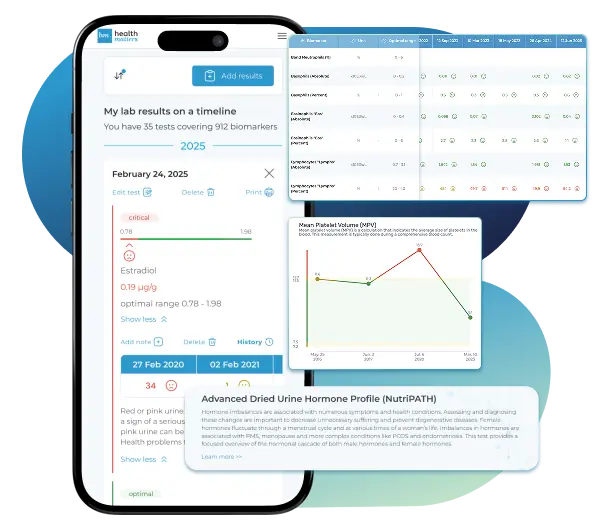
Once your results are in one place, see the bigger picture — track trends over time, compare data side by side, export your full history, and share securely with anyone you trust.




Bring all your results together to compare, track progress, export your history, and share securely.
What Healthmatters Members Are Saying

I have been using Healthmatters.io since 2021. I travel all over the world and use different doctors and health facilities. This site has allowed me to consolidate all my various test results over 14 years in one place. And every doctor that I show this to has been impressed. Because with any health professional I talk to, I can pull up historical results in seconds. It is invaluable. Even going back to the same doctor, they usually do not have the historical results from their facility in a graph format. That has been very helpful.
Anthony
Unlimited Plan Member since 2021
What fantastic service and great, easy-to-follow layouts! I love your website; it makes it so helpful to see patterns in my health data. It's truly a pleasure to use. I only wish the NHS was as organized and quick as Healthmatters.io. You've set a new standard for health tracking!
Karin
Advanced Plan Member since 2020
As a PRO member and medical practitioner, Healthmatters.io has been an invaluable tool for tracking my clients' data. The layout is intuitive, making it easy to monitor trends and spot patterns over time. The ability to customize reports and charts helps me present information clearly to my clients, improving communication and outcomes. It's streamlined my workflow, saving me time and providing insights at a glance. Highly recommended for any practitioner looking for a comprehensive and user-friendly solution to track patient labs!
Paul
Healthmatters Pro Member since 2024

We implement proven measures to keep your data safe.
At HealthMatters, we're committed to maintaining the security and confidentiality of your personal information. We've put industry-leading security standards in place to help protect against the loss, misuse, or alteration of the information under our control. We use procedural, physical, and electronic security methods designed to prevent unauthorized people from getting access to this information. Our internal code of conduct adds additional privacy protection. All data is backed up multiple times a day and encrypted using SSL certificates. See our Privacy Policy for more details.