
Vanillylmandelic acid (VMA)
 Optimal Result:
2411.2 - 5047.8 mcg/g.
Optimal Result:
2411.2 - 5047.8 mcg/g.

Vanilmandelate (also known as VMA) is the primary metabolite of norepinephrine and epinephrine (adrenaline). Epinephrine is also called adrenaline, and norepinephrine is also called noradrenaline. They are responsible for the “fight or flight” sensations we experience during periods of stress and anxiety. They are produced in by the nervous system and the adrenal medulla.
Epinephrine and norepinephrine are broken down to VMA (vanilmandelate) by the enzymes MAO and COMT. Vanilmandelate is then excreted in the urine. It can be used as an indirect measure of epinephrine/norepinephrine levels. The adrenal gland makes cortisol and DHEA as well as norepinephrine and epinephrine. When adrenal hormone output is generally low, VMA levels may be low.
Norepinephrine/Epinephrine are made in the brain and in the adrenal medulla.
- Stored in pre-synaptic vesicles to be released immediately on need
- There is no negative feedback loop
- Norepinephrine/Epinephrine cannot cross into or out of the brain
Primary action in the brain or the peripheral tissues is to prepare for fight/flight.
- Brain: alertness, attention, anxiety, vigilance, restlessness
- Periphery: higher blood pressure and heart rate, increases glucose release (via glycogenolysis), diverts blood flow from GI tract to skeletal muscles
It’s lowest levels are in the night and highest levels in the morning unless stimulated.
Norepinephrine/Epinephrine Metabolite, can also reflect genetic mutations and nutrition, neurotransmitter and adrenal problems.
-----------------------------
Vanillylmandelic acid (VMA) can be used to detect neuroblastoma and other tumors of neural crest origin.
References:
- https://www.ncbi.nlm.nih.gov/pubmed/3998066
- https://www.ncbi.nlm.nih.gov/pubmed/15125800
- https://www.ncbi.nlm.nih.gov/pubmed/12834431
- https://www.ncbi.nlm.nih.gov/pubmed/12909458
- https://www.ncbi.nlm.nih.gov/pmc/articles/PMC2903966/
- https://www.ncbi.nlm.nih.gov/pmc/articles/PMC4821201/
- https://www.ncbi.nlm.nih.gov/pmc/articles/PMC1728136/
- https://www.ncbi.nlm.nih.gov/pubmed/24094641
- https://www.ncbi.nlm.nih.gov/pubmed/16142213
- https://www.ncbi.nlm.nih.gov/pubmed/28757337
- https://www.ncbi.nlm.nih.gov/pmc/articles/PMC2824171/
- https://www.ncbi.nlm.nih.gov/pubmed/12827641
- https://www.ncbi.nlm.nih.gov/pubmed/6723203
- https://www.ncbi.nlm.nih.gov/pmc/articles/PMC3277743/
- https://www.ncbi.nlm.nih.gov/pubmed/11903030
- https://www.ncbi.nlm.nih.gov/pubmed/4925832
- https://www.ncbi.nlm.nih.gov/pubmed/15666839
- https://link.springer.com/chapter/10.1007/978-1-4471-6539-2_5
- https://www.ncbi.nlm.nih.gov/pubmed/15018454
- https://www.ncbi.nlm.nih.gov/pmc/articles/PMC1459119/
Lab Results Explained and Tracked
What does it mean if your Vanillylmandelic acid (VMA) result is too high?
Conditions associated with elevations in urinary vanillylmandelic acid (VMA) include the following:
- Severe anxiety/stress
- Neuroblastoma (a disease in which malignant (cancer) cells form in neuroblasts (immature nerve tissue) in the adrenal glands, neck, chest, or spinal cord.)
- Pheochromocytoma (a rare, usually noncancerous (benign) tumor that develops in an adrenal gland.)
- Other neural crest tumors (eg, ganglioblastoma, ganglioneuroma)
Elevated metabolic by-products of catecholamines—dihydroxyphenylalanine (DOPA), dopamine, norepinephrine, and epinephrine—can be detected in the urine of patients with neuroblastoma and other tumors of neural crest origin. DOPA and dopamine are metabolized into their final product, homovanillic acid (HVA), while norepinephrine and epinephrine are metabolized into vanillylmandelic acid (VMA).
The biochemical pathway is as follows:
- DOPA
- Dopamine
- Norepinephrine → Normetanephrine → VMA and 3-methoxyphenylethyleneglcol (MHPG)
- Epinephrine → Metanephrine → VMA and 3-methoxyphenylethyleneglcol (MHPG)
Ninety percent of neuroblastoma tumors secrete these by-products. Children with dedifferentiated tumors tend to excrete higher levels of HVA than vanillylmandelic acid because these tumors have lost the final enzymatic pathway that converts HVA to vanillylmandelic acid. A low ratio of vanillylmandelic acid to HVA is consistent with a poorly differentiated tumor and indicates a poor prognosis.
In the evaluation of pheochromocytoma, vanillylmandelic acid is now considered the least-specific test for catecholamine metabolites, with a false-positive rate greater than 15%. Measurement of metanephrine, an intermediate metabolite between epinephrine and vanillylmandelic acid, is now considered the most sensitive and specific test for pheochromocytoma. Besides plasma free metanephrines and urine metanephrines, urine or plasma catecholamine tests are also preferred over vanillylmandelic acid testing.
Considerations:
Foods that can increase urinary catecholamines include the following:
Coffee, Tea, Bananas, Chocolate, Cocoa, Citrus fruits, Vanilla
Drugs that can increase urinary vanillylmandelic acid include the following:
Appetite suppressants, Caffeine, Histamine, Imipramine, Insulin, Epinephrine, Levodopa, Lithium, Morphine, Nitroglycerin, Rauwolfia alkaloids, Isoproterenol, Methocarbamol, Sulfonamide, Chlorpromazine
---------------------
If Homovanillate (HVA) is low at the same time:
In this case, checking the adrenal glands would be a good idea. Is the HPA axis overactive? Are cortisol levels too high, pushing epinephrine levels up? (and therefore increasing VMA levels)
Other potential causes:
Are you on stimulant medications?
- Amphetamines
- Amphetamine-like meds
- Appetite suppressants like phentermine
- Caffeine (pills or drinks)
- Ephedrine (Sudafed)
- ADHD meds
Are you on dopamine reuptake inhibitors? (risperidone)
Possible tumor of the adrenal medulla? (Pheochromocytoma)
Higher risk for myocardial injury/ dysfunction with elevated cardiac troponin I (Consider age and CVD risk).
If Homovanillate (HVA) is high at the same time:
Possible reasons for a high HVA and high VMA include:
- COMT or MAO mutations that increase dopamine, epinephrine, or norepinephrine levels.
- High levels of or taking Tyrosine, DLPA, Dopamine and/or Macuna supplements (= dopamine precursors)
- Non-selective alpha-blockers for blood pressure (phenoxybenzamine) can increase norepinephrine levels.
- SNRI Medication (Wellbutrin), Tricyclic Antidepressants (amitriptyline)
- Amphetamines/Amphetamine-like medications or drugs, Appetite suppressants (Phentermine), Caffeine (pills or drinks), Ephedrine (ie. Sudafed)
- Parkinson’s medications (Levodopa, carbidopa) will increase dopamine, epinephrine and norepinephrine synthesis.
- Opioids (VMA may be normal)
- Alcohol consumption (increases dopamine, epinephrine, and norepinephrine levels.
- Elevated adrenal output (i.e. cortisol) address the stress
- Inflammation - inflammatory cytokines increase sympathetic output
- Neuroblastic Tumor
- Pheochromocytoma (very high levels of VMA, maybe HVA). Usually also linked to high blood pressure and excessive sweating.
- Neuroblastoma (cancer of the nervous system, often occurs in the adrenal glands).
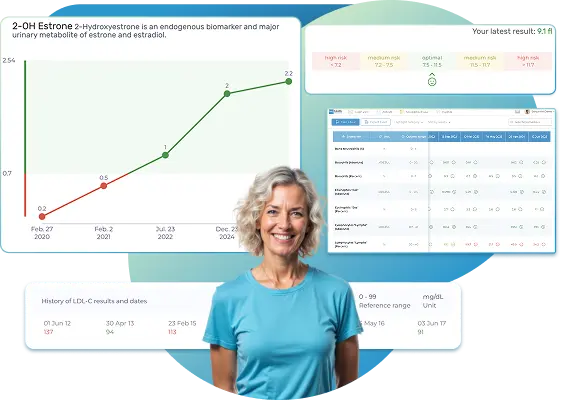
All Your Lab Results.
One Simple Dashboard.
Import, Track, and Share Your Lab Results Easily
Import, Track, and Share Your Lab Results
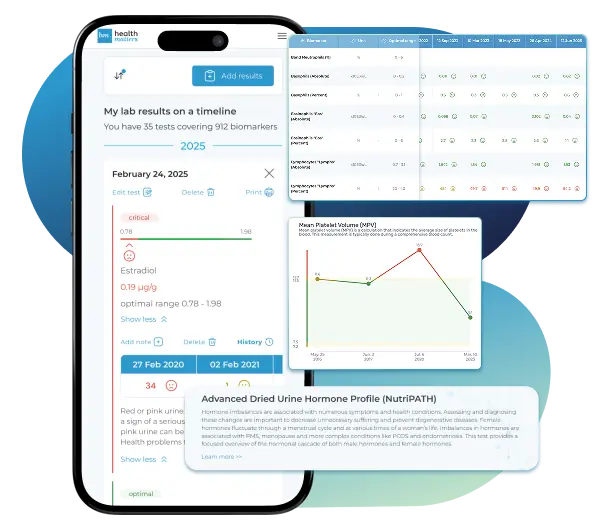
Import lab results from multiple providers, track changes over time, customize your reference ranges, and get clear explanations for each result. Everything is stored securely, exportable in one organized file, and shareable with your doctor—or anyone you choose.
Cancel or upgrade anytime
What does it mean if your Vanillylmandelic acid (VMA) result is too low?
Low levels of norepinephrine and epinephrine may be associated with addictions, cravings, fatigue, low blood pressure, low muscle tone, intolerance to exercise, depression, loss of alertness.
The enzymes COMT (methylation) and MAOA are needed to make VMA from norepinephrine. If these enzymes are not working properly, VMA may be low when circulating norepinephrine and/or epinephrine are not low.
If Homovanillate (HVA) is low at the same time:
This suggests that dopamine, norepinephrine, and epinephrine levels are low.
It’s important to look at the cofactors for all of the involved reactions. Could they be low?
- Iron / BH4 / Vitamin B6 / Vitamin B2 / Magnesium / SAMe / Niacin (NAD) / Copper / Vitamin C
- Could there be MAO or COMT mutations that slow down these pathways?
- Low Tyrosine (ie. low protein diet or poor protein absorption)?
- Are your cortisol levels too low? Is your HPA axis “fatigued”?
- Oxidative stress (pushing PEA down other pathways)?
- Fungal/candida infections inhibit Tyrosinase activity (cannot make L-Dopa)
- Glyphosate blocking the Shikamate pathway and depleting/binding co-nutrients (ie. Tyrosine and Tryptophan)?
- Tetrahydrocannabinol (THC) long term use? Possibly suppressive?
If Homovanillate (HVA) is high at the same time:
If dopamine is HIGH and epinephrine/norepinephrine are low or normal, there may be an issue in the conversion of dopamine to norepinephrine.
Cofactors required for the conversion of dopamine to norepinephrine:
- Copper
- Vitamin C
Low copper or vitamin C so DBH enzyme can’t move forward (VMA usually quite low)
- Clostridia difficile (inhibits DBH enzyme so cannlt make VMA)
- Bananas (contain high levels dopamine that doesn’t cross BBB – VMA likely normal)
- Quercetin supplements/foods – turn into HVA in the gut and can show up as artificial high HVA and normal VMA
- Check adrenals – low levels of cortisol too? Then VMA is usually low.
- Tetrahydrocannabinol (THC) use – short term use raises dopamine (VMA may be normal)
- Opioids (VMA may be normal)
- DBH enzyme deficiency (VMA very low) = orthostatic hypotension, exercise intolerance, ptosis of eyelid, psychological/behavior disorders
- Neuroblastic tumor (if HVA are at very high levels)
- Eating a diet super rich in polyphenols (tomatoes, onions, tea) could raise HVA levels in some people.
- Did you eat velvet beans recently? They contain L-dopa and can raise dopamine levels.
Article Review & Sources
All our content is backed by peer-reviewed studies, academic research, and trusted medical sources. We're committed to accuracy and transparency — see our editorial policy for details.
Laboratories
Bring All Your Lab Results Together — In One Place
We accept reports from any lab, so you can easily collect and organize all your health information in one secure spot.









Pricing Table
Gather Your Lab History — and Finally Make Sense of It
Finally, Your Lab Results Organized and Clear

Personal plans

$79/ year
Advanced Plan
Access your lab reports, explanations, and tracking tools.
- Import lab results from any provider
- Track all results with visual tools
- Customize your reference ranges
- Export your full lab history anytime
- Share results securely with anyone
- Receive 5 reports entered for you
- Cancel or upgrade anytime
$250/ once
Unlimited Account
Pay once, access everything—no monthly fees, no limits.
- Import lab results from any provider
- Track all results with visual tools
- Customize your reference ranges
- Export your full lab history anytime
- Share results securely with anyone
- Receive 10 reports entered for you
- No subscriptions. No extra fees.
$45/ month
Pro Monthly
Designed for professionals managing their clients' lab reports
- Import lab results from any provider
- Track lab results for multiple clients
- Customize reference ranges per client
- Export lab histories and reports
- Begin with first report entered by us
- Cancel or upgrade anytime
About membership
What's included in a Healthmatters membership
 Import Lab Results from Any Source
 See Your Health Timeline
 Understand What Your Results Mean

 Visualize Your Results

 Data Entry Service for Your Reports
 Securely Share With Anyone You Trust
Let Your Lab Results Tell the Full Story
Once your results are in one place, see the bigger picture — track trends over time, compare data side by side, export your full history, and share securely with anyone you trust.




Bring all your results together to compare, track progress, export your history, and share securely.
What Healthmatters Members Are Saying

I have been using Healthmatters.io since 2021. I travel all over the world and use different doctors and health facilities. This site has allowed me to consolidate all my various test results over 14 years in one place. And every doctor that I show this to has been impressed. Because with any health professional I talk to, I can pull up historical results in seconds. It is invaluable. Even going back to the same doctor, they usually do not have the historical results from their facility in a graph format. That has been very helpful.
Anthony
Unlimited Plan Member since 2021
What fantastic service and great, easy-to-follow layouts! I love your website; it makes it so helpful to see patterns in my health data. It's truly a pleasure to use. I only wish the NHS was as organized and quick as Healthmatters.io. You've set a new standard for health tracking!
Karin
Advanced Plan Member since 2020
As a PRO member and medical practitioner, Healthmatters.io has been an invaluable tool for tracking my clients' data. The layout is intuitive, making it easy to monitor trends and spot patterns over time. The ability to customize reports and charts helps me present information clearly to my clients, improving communication and outcomes. It's streamlined my workflow, saving me time and providing insights at a glance. Highly recommended for any practitioner looking for a comprehensive and user-friendly solution to track patient labs!
Paul
Healthmatters Pro Member since 2024

We implement proven measures to keep your data safe.
At HealthMatters, we're committed to maintaining the security and confidentiality of your personal information. We've put industry-leading security standards in place to help protect against the loss, misuse, or alteration of the information under our control. We use procedural, physical, and electronic security methods designed to prevent unauthorized people from getting access to this information. Our internal code of conduct adds additional privacy protection. All data is backed up multiple times a day and encrypted using SSL certificates. See our Privacy Policy for more details.