
Thyroid Peroxidase IgG
 Optimal Result:
0 - 100 WHO units.
Optimal Result:
0 - 100 WHO units.

Function:
Thyroid peroxidase (TPO) is an enzyme expressed mainly in the thyroid that frees iodine for its addition onto thyroglobulin tyrosine residues for the production of thyroxine (T4) or triiodothyronine (T3), thyroid hormones. Some TPO antibodies may lyse thyroid cells or inhibit TPO enzyme activity, in vitro [2, 7] but in general it is considered an antibody response to thyroid damage inflicted by T-Cells.
Antibodies Appear:
Autoimmune Thyroid Disease [1, 3, 5, 6]
Graves’ Disease (an immune system disorder that results in the overproduction of thyroid hormones) [3]
Hashimoto’s Thyroiditis (can cause your thyroid to not make enough thyroid hormone.)[2]
Vitiligo [a chronic (long-lasting) autoimmune disorder that causes patches of skin to lose pigment or color.] [3, 4]
Known Cross-Reactions:
- Thyroglobulin, [9]
- gliadin, [10]
- Helicobacter pylori, [11]
- heat shock protein [12]
Clinical Significance:
Autoimmunity occurs when antibodies against TPO cause gradual destruction of follicles in the thyroid gland, and decrease assimilation of thyroid hormones into the cells. [5, 6, 8]
Elevated antibodies to TPO are often associated with a hypothyroid condition called Hashimoto’s Disease.
It is important to note that TPO antibodies can be detected in circulation long before the change of thyroid function can be observed by changes in the TSH levels. [1]
Additionally, Vitiligo often precedes thyroid dysfunction, [3] and thus Vitiligo patients should be screened for thyroid disorders. Researchers have shown that there is an increased risk of autoimmune and/or endocrine disorders in first and second degree relatives of vitiligo patients with positive organ-specific antibodies. [4]
References:
1. Bjøro, et al. Prevalence of thyroid disease, thyroid dysfunction and thyroid peroxidase antibodies in a large, unselected population. The study on health Nord-Trøndelag (HUNT). Eur J Endocrinol, 2000; 143:639-647.
2. Chiovato, et al. Antibodies producing complement-mediated thyroid cytotoxicity in patients with atrophic or goitrous autoimmune thyroiditis. J Clin Endocrinol Metab, 1993; 77(6):1700-1705.
3. Daneshpazhooh, et al. Anti-thyroid peroxidase antibody and vitiligo: a controlled study. BMC Dermatol, 2006; 6(3):1-5.
4. Grimes, et al. Autoantibodies and their clinical significance in a black vitiligo population. Arch Dermatol, 1983; 119:300-303.
5. Guo, et al. Search for the Autoantibody Immunodominant Region on Thyroid Peroxidase: Epitopic Footprinting with a Human Monoclonal Autoantibody Locates a Facet on the Native Antigen Containing a Highly Conformational Epitope. J Immunol, 2001; 166:1327-1333.
6. Kaczur, et al. Effect of anti-thyroid peroxidase (TPO) antibodies on TPO activity measured by chemiluminescence assay. Clin Chem, 1997; 43(8):1392-1396.
7. Kohno, et al. Anti-thyroid peroxidase antibodies in sera from healthy subjects and from patients with chronic thyroiditis: differences in the ability to inhibit thyroid peroxidase activities. Clin Exp Immunol, 1991; 85(3):459-463.
8. Roddiger, et al. Detection of thyroid peroxidase mRNA in peripheral blood of patients with malignant and benign thyroid diseases. J Molec Endocrinol, 2002; 29:287-295.
9. Thrasyvoulides and Lymberi. Antibodies cross-reacting with thyroglobulin and thyroid peroxidase are induced by immunization of rabbits with an immunogenic thyroglobulin 20mer peptide. Clin Exp Immuno, 2004; 138(3):423-429
10. Vojdani and Tarash. Cross-reaction between gliadin and different food and tissue antigens, Food Nutri Sci, 2013; 4:20-32.
11. Ko, et al. Monoclonal antibodies against Helicobacter pylori cross-react with human tissue. Helicobacter, 1997; 2(4):210-215.
12. Gammazza, et al. Elevated blood Hsp60, its structural similarities and cross-reactivity with thyroid molecules, and its presence on the plasma membrane of oncocytes point to the chaperonin as an immunopathogenic factor in Hashimoto’s thyroiditis. Cell Stress Chaperones, 2014; 19(3):343-353.
Lab Results Explained and Tracked
What does it mean if your Thyroid Peroxidase IgG result is too high?
Autoimmunity occurs when antibodies against TPO cause gradual destruction of follicles in the thyroid gland, and decrease assimilation of thyroid hormones into the cells. [5, 6, 8]
Elevated antibodies to TPO are often associated with a hypothyroid condition called Hashimoto’s Disease.
It is important to note that TPO antibodies can be detected in circulation long before the change of thyroid function can be observed by changes in the TSH levels. [1]
Additionally, Vitiligo often precedes thyroid dysfunction, [3] and thus Vitiligo patients should be screened for thyroid disorders. Researchers have shown that there is an increased risk of autoimmune and/or endocrine disorders in first and second degree relatives of vitiligo patients with positive organ-specific antibodies. [4]
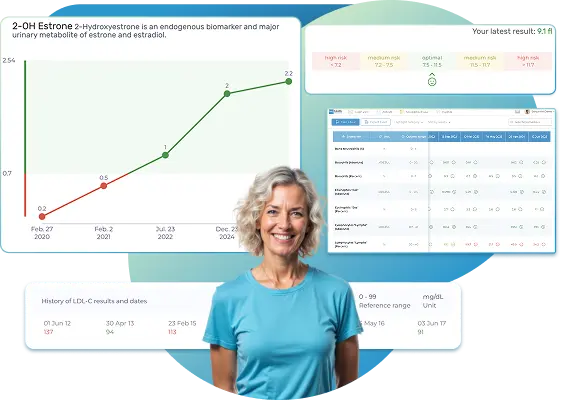
All Your Lab Results.
One Simple Dashboard.
Import, Track, and Share Your Lab Results Easily
Import, Track, and Share Your Lab Results
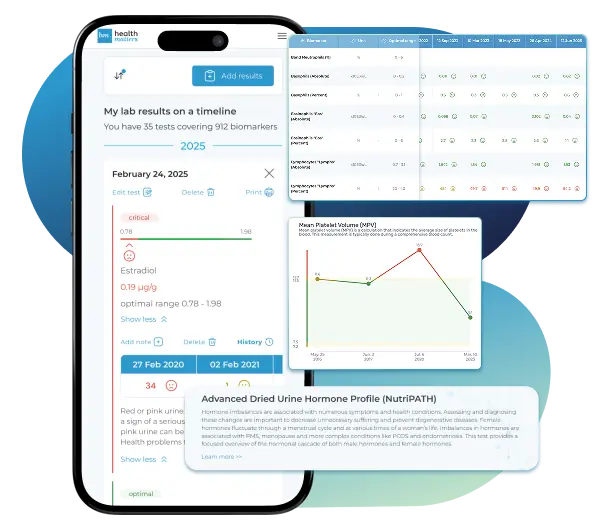
Import lab results from multiple providers, track changes over time, customize your reference ranges, and get clear explanations for each result. Everything is stored securely, exportable in one organized file, and shareable with your doctor—or anyone you choose.
Cancel or upgrade anytime
Article Review & Sources
All our content is backed by peer-reviewed studies, academic research, and trusted medical sources. We're committed to accuracy and transparency — see our editorial policy for details.
Laboratories
Bring All Your Lab Results Together — In One Place
We accept reports from any lab, so you can easily collect and organize all your health information in one secure spot.











Pricing Table
Gather Your Lab History — and Finally Make Sense of It
Finally, Your Lab Results Organized and Clear

Personal plans

$79/ year
Advanced Plan
Access your lab reports, explanations, and tracking tools.
- Import lab results from any provider
- Track all results with visual tools
- Customize your reference ranges
- Export your full lab history anytime
- Share results securely with anyone
- Receive 5 reports entered for you
- Cancel or upgrade anytime
$250/ once
Unlimited Account
Pay once, access everything—no monthly fees, no limits.
- Import lab results from any provider
- Track all results with visual tools
- Customize your reference ranges
- Export your full lab history anytime
- Share results securely with anyone
- Receive 10 reports entered for you
- No subscriptions. No extra fees.
$45/ month
Pro Monthly
Designed for professionals managing their clients' lab reports
- Import lab results from any provider
- Track lab results for multiple clients
- Customize reference ranges per client
- Export lab histories and reports
- Begin with first report entered by us
- Cancel or upgrade anytime
About membership
What's included in a Healthmatters membership
 Import Lab Results from Any Source
 See Your Health Timeline
 Understand What Your Results Mean

 Visualize Your Results

 Data Entry Service for Your Reports
 Securely Share With Anyone You Trust
Let Your Lab Results Tell the Full Story
Once your results are in one place, see the bigger picture — track trends over time, compare data side by side, export your full history, and share securely with anyone you trust.




Bring all your results together to compare, track progress, export your history, and share securely.
What Healthmatters Members Are Saying

I have been using Healthmatters.io since 2021. I travel all over the world and use different doctors and health facilities. This site has allowed me to consolidate all my various test results over 14 years in one place. And every doctor that I show this to has been impressed. Because with any health professional I talk to, I can pull up historical results in seconds. It is invaluable. Even going back to the same doctor, they usually do not have the historical results from their facility in a graph format. That has been very helpful.
Anthony
Unlimited Plan Member since 2021
What fantastic service and great, easy-to-follow layouts! I love your website; it makes it so helpful to see patterns in my health data. It's truly a pleasure to use. I only wish the NHS was as organized and quick as Healthmatters.io. You've set a new standard for health tracking!
Karin
Advanced Plan Member since 2020
As a PRO member and medical practitioner, Healthmatters.io has been an invaluable tool for tracking my clients' data. The layout is intuitive, making it easy to monitor trends and spot patterns over time. The ability to customize reports and charts helps me present information clearly to my clients, improving communication and outcomes. It's streamlined my workflow, saving me time and providing insights at a glance. Highly recommended for any practitioner looking for a comprehensive and user-friendly solution to track patient labs!
Paul
Healthmatters Pro Member since 2024

We implement proven measures to keep your data safe.
At HealthMatters, we're committed to maintaining the security and confidentiality of your personal information. We've put industry-leading security standards in place to help protect against the loss, misuse, or alteration of the information under our control. We use procedural, physical, and electronic security methods designed to prevent unauthorized people from getting access to this information. Our internal code of conduct adds additional privacy protection. All data is backed up multiple times a day and encrypted using SSL certificates. See our Privacy Policy for more details.