
RPR, Rfx Qn RPR/Confirm TP: What Your LabCorp Syphilis Test Results Mean (Non-Reactive, Reactive, Confirm TP Explained)
Other names: RPR Rfx Qn RPR Confirm TP, RPR, Rfx Qn RPR/Confirm TP, RPR RFX QN RPR/Confirm TP, RPR Rfx Qn RPR/Confirm TP-PA, RPR Rfx Qn RPR/Confirm TP-012005, RPR Rfx, RFX QN RPR/Confirm TP, RPR Confirm TP, Confirm TP, Confirm TP Blood Test, Confirm TP Meaning, RPR/Confirm TP, RPR Rfx Qn RPR, RPR Rfx Qn, RFX Test, RFX Blood Test, RFX QN, What Is RFX Blood Test, RPR (Dx) W/Refl Titer and Confirmatory Testing, RPR With Reflex to Titer and Confirmatory Testing, RPR With TP-PA Confirmation, RPR Screen W/Rfx Titer and TP-PA, RPR Reflex to Titer, RPR Qualitative with Reflex Titer, Syphilis RPR with Reflex, Rapid Plasma Reagin With Reflex, RPR Non Reactive, RPR Reactive, RPR Non-Reactive Meaning, RPR Reactive Meaning, RPR Qn, RPR Quantitative, Treponema Pallidum Confirmatory, TP-PA Test, TP-PA Syphilis, Syphilis Screening TP, LabCorp 012005, RPR LC, RPR (Dx) W/Refl Titer, RPR W/Rfx TP-PA, RPR W/Titer and Conf Rfx, Syphilis Serology TP, RPR Rfx Qn RPR/Confirm TP No Reactivo (Spanish), Examen RPR (Spanish), RPR Que Significa (Spanish)
 Reference range:

QUICK ANSWER
RPR, Rfx Qn RPR/Confirm TP is a syphilis screening panel that combines an initial RPR screen with automatic reflex to a quantitative titer and confirmatory treponemal antibody test if the screen is reactive.
What each part of the test name means:
| Abbreviation | Full meaning |
|---|---|
| RPR | Rapid Plasma Reagin — the initial syphilis antibody screen |
| Rfx | Reflex — the lab automatically runs the next test if the prior result is reactive |
| Qn | Quantitative — a titer (dilution measurement) of antibody level |
| Confirm TP | Confirmatory Treponema pallidum test — a specific treponemal antibody test (TP-PA or FTA-ABS) to confirm true syphilis vs. false positive |
Most common result — Non-Reactive:
| Result | Meaning |
|---|---|
| Non-Reactive | No syphilis antibodies detected — normal result, syphilis unlikely |
| Reactive | Syphilis antibodies detected — reflex tests are performed to confirm |
Key takeaway: A non-reactive result on RPR, Rfx Qn RPR/Confirm TP means syphilis is very unlikely. Most people seeing this result on their LabCorp report have nothing to be concerned about.
Quick result lookup:
| Your result | What it usually means |
|---|---|
| Non-Reactive | No syphilis antibodies detected — normal result |
| Reactive + Confirm TP Reactive | Consistent with current or previous syphilis infection (clinical evaluation needed) |
| Reactive + Confirm TP Non-Reactive | Biological false positive more likely — syphilis unlikely |
| Reactive + Confirm TP not yet resulted | Reflex testing in progress |
WHAT DOES NON-REACTIVE MEAN ON THIS TEST?
Non-reactive is the normal, expected result. It means the RPR screen did not detect reagin antibodies — the antibodies that appear in response to syphilis infection. A non-reactive result indicates:
- No current syphilis infection is detected
- No significant reagin antibody response is present
- No reflex testing (quantitative titer or Confirm TP) was performed — because it was not triggered
A non-reactive result effectively ends the testing cascade. No further interpretation is needed.
Important nuance: RPR can occasionally be negative (non-reactive) very early in syphilis infection — within the first few weeks before antibodies have developed. If there is genuine concern about very recent exposure, retesting in 2–4 weeks may be recommended by your clinician.
WHAT DOES REACTIVE MEAN — AND WHAT HAPPENS NEXT?
A reactive RPR screen means the test detected reagin antibodies. This triggers the reflex cascade — the lab automatically performs additional tests to determine whether the reactive result represents:
- True syphilis infection (current or past)
- Biological false positive — a reactive RPR not caused by syphilis
The reflex cascade:
| Step | Test | Triggered by |
|---|---|---|
| 1 | RPR screen (qualitative) | Always performed |
| 2 | RPR Qn (quantitative titer, e.g., 1:2, 1:4, 1:8) | RPR screen reactive |
| 3 | Confirm TP (TP-PA or FTA-ABS) | RPR screen reactive |
Interpreting the reflex results:
| RPR screen | RPR Qn | Confirm TP | Interpretation |
|---|---|---|---|
| Non-reactive | Not performed | Not performed | No syphilis antibodies — normal |
| Reactive | ≥ 1:1 | Non-reactive | RPR positive but TP negative — biological false positive; syphilis unlikely |
| Reactive | ≥ 1:1 | Reactive | Both positive — consistent with current or past syphilis infection |
WHAT IS "CONFIRM TP"?
Confirm TP refers to a confirmatory treponemal antibody test — the second line of testing triggered when the RPR screen is reactive.
While the RPR measures non-treponemal antibodies (reagin), the Confirm TP measures antibodies that are specific to Treponema pallidum — the bacterium that causes syphilis. This distinction matters because:
- RPR can be falsely reactive in many conditions unrelated to syphilis (biological false positives)
- Confirm TP tests are far more specific — a positive Confirm TP with a positive RPR strongly confirms syphilis exposure
Common Confirm TP tests:
- TP-PA (Treponema pallidum Particle Agglutination) — the most commonly used confirmatory test on the LabCorp RPR, Rfx Qn RPR/Confirm TP panel
- FTA-ABS (Fluorescent Treponemal Antibody Absorption) — older gold standard, now less commonly used
- EIA/CIA (Enzyme or Chemiluminescent Immunoassay for T. pallidum IgG/IgM) — used in reverse screening algorithms
Importantly: Treponemal antibody tests (Confirm TP) typically remain positive for life after syphilis infection, even after successful treatment. A reactive Confirm TP in someone who has been treated for syphilis in the past is expected and does not indicate reinfection.
WHAT IS "RFX" ON A LAB REPORT?
Rfx stands for "reflex" — a laboratory instruction meaning the test will automatically cascade to the next step if the prior result meets a predefined threshold.
On this panel:
- If RPR screen = Non-Reactive → no reflex occurs → report shows only the non-reactive result
- If RPR screen = Reactive → reflex occurs → lab automatically adds RPR Qn (titer) and Confirm TP
You did not separately order the quantitative titer or the confirmatory test — the lab performed them automatically based on the reactive screen result. This is standard syphilis testing protocol.
WHAT ARE BIOLOGICAL FALSE POSITIVES?
A biological false positive RPR is a reactive RPR screen result that is not caused by syphilis. The RPR is a non-specific test and can be triggered by various conditions:
- Pregnancy — one of the most common causes of low-titer biological false positives
- Autoimmune diseases — particularly systemic lupus erythematosus (SLE) and antiphospholipid syndrome
- Viral infections — EBV (mononucleosis), hepatitis, HIV
- IV drug use
- Advanced age
- Other spirochetal infections (Lyme disease, leptospirosis, yaws)
The confirmatory TP test (Confirm TP) distinguishes biological false positives from true syphilis. If RPR is reactive but Confirm TP is non-reactive → biological false positive is the likely explanation, and true syphilis is unlikely.
WHAT IS THE RPR TITER AND WHY DOES IT MATTER?
When the RPR screen is reactive, the quantitative titer (Qn) measures the level of antibody as a dilution ratio — expressed as 1:1, 1:2, 1:4, 1:8, 1:16, 1:32, etc.
What titer levels indicate:
| RPR titer | General interpretation |
|---|---|
| 1:1 | Borderline reactive — may indicate biological false positive or very early/late infection |
| 1:2–1:4 | Low titer — early, late latent, or treated syphilis; also seen in biological false positives |
| 1:8–1:16 | Moderate titer — active infection more likely |
| 1:32 or higher | High titer — consistent with active or recent syphilis infection |
Titer is used to monitor treatment response: After successful treatment, RPR titers should decline 4-fold (e.g., from 1:16 to 1:4) within 6–12 months. A rising titer suggests reinfection or treatment failure. A persistently low titer after treatment ("serofast") is common and does not necessarily indicate treatment failure.
WHEN TO FOLLOW UP
Discuss your result with a clinician if:
- RPR screen is reactive — regardless of Confirm TP result, clinical follow-up is needed
- Both RPR and Confirm TP are reactive — evaluation for treatment and partner notification is needed
- RPR is reactive but Confirm TP is non-reactive — biological false positive workup may be recommended, particularly if autoimmune disease or pregnancy is present
- You are pregnant and have a reactive RPR — urgent evaluation is required regardless of titer level
BOTTOM LINE
Bottom line: RPR, Rfx Qn RPR/Confirm TP (LabCorp 012005) is a syphilis screening panel. Non-reactive means no syphilis detected — the normal result. Reactive triggers automatic reflex testing: a quantitative titer and a confirmatory treponemal antibody test (Confirm TP). If both the RPR and Confirm TP are reactive, current or past syphilis is likely. If only the RPR is reactive with a non-reactive Confirm TP, a biological false positive is the probable explanation.
FAQ about RPR, Rfx Qn RPR/Confirm TP
-
Can RPR be non-reactive if I have syphilis?
Yes. During the first few weeks after syphilis infection, the RPR may be non-reactive because the body has not yet produced detectable antibody levels. This is known as the window period and typically lasts 1–4 weeks after exposure. If you had a potential recent exposure and your result is non-reactive, your clinician may recommend repeat testing in 2–4 weeks to confirm. A non-reactive result on a test done well after potential exposure is more reassuring. -
Is syphilis curable?
Yes. Syphilis is generally curable with appropriate antibiotic treatment, most commonly penicillin G. Early-stage syphilis (primary and secondary) responds very well to treatment. Even latent and tertiary syphilis can be treated, though damage already caused to organs cannot be reversed. After treatment, follow-up RPR titer testing is used to confirm treatment response — a declining titer indicates successful treatment. -
What does non-reactive mean on RPR, Rfx Qn RPR/Confirm TP?
Non-reactive is the normal result — it means no syphilis antibodies were detected. No reflex testing was triggered. Syphilis is very unlikely. If you had a potential exposure very recently (within 2–4 weeks), antibodies may not yet have developed, and your clinician may recommend repeat testing. -
What does "Rfx" mean on a lab report?
Rfx stands for "reflex" — it means the lab automatically performs additional tests if the initial result meets a threshold. On this panel, if the RPR screen is reactive, the lab automatically adds a quantitative RPR titer (Qn) and a confirmatory Treponema pallidum test (Confirm TP). You did not need to separately order these — they are triggered automatically. -
What does "Confirm TP" mean?
Confirm TP refers to a confirmatory Treponema pallidum antibody test — typically TP-PA (Treponema pallidum Particle Agglutination). It is performed automatically when the RPR screen is reactive to distinguish true syphilis infection from a biological false positive. A reactive Confirm TP alongside a reactive RPR indicates syphilis exposure; a non-reactive Confirm TP with a reactive RPR suggests a biological false positive rather than true syphilis. -
What does "Qn" mean in this test?
Qn stands for "quantitative" — referring to the RPR titer, a dilution-based measurement of antibody level (e.g., 1:2, 1:4, 1:8). It is performed automatically when the RPR screen is reactive and helps assess the severity of infection and monitor treatment response. A rising titer suggests active or worsening infection; a falling titer after treatment confirms response. -
What is a biological false positive RPR?
A biological false positive occurs when the RPR screen is reactive but the result is not caused by syphilis. The RPR is a non-specific test that can be triggered by pregnancy, autoimmune diseases (particularly lupus), viral infections (EBV, HIV, hepatitis), IV drug use, and advanced age. The Confirm TP test distinguishes biological false positives from true syphilis — if the Confirm TP is non-reactive, syphilis is unlikely despite the reactive RPR screen. -
I was treated for syphilis — why is my Confirm TP still reactive?
Treponemal antibody tests (including TP-PA and FTA-ABS) typically remain positive for life after syphilis infection, even after successful treatment. A persistently reactive Confirm TP after treatment is expected and does not mean treatment failed or that you are currently infected. RPR titers (Qn) are used to monitor treatment response — they should decline after successful treatment, while the Confirm TP may remain positive indefinitely. -
What is LabCorp test 012005?
LabCorp test code 012005 is the catalog identifier for the RPR, Rfx Qn RPR/Confirm TP panel — the full name for this syphilis screening test. It is also sometimes labeled "RPR, Rfx Qn RPR/Confirm TP-PA" on reports, with TP-PA specifying that the Treponema pallidum Particle Agglutination assay is used for confirmatory testing. -
What does RPR stand for?
RPR stands for Rapid Plasma Reagin — a non-specific screening test for syphilis that detects reagin antibodies (a mixture of IgG and IgM antibodies) produced by the body in response to syphilis infection. It is used as an initial screen because it is fast and inexpensive; reactive results are followed up with more specific confirmatory tests.
Lab Results Explained and Tracked
What does it mean if your RPR, Rfx Qn RPR/Confirm TP result is too high?
A reactive RPR on the RPR, Rfx Qn RPR/Confirm TP panel means the initial syphilis screen detected reagin antibodies, triggering reflex to a quantitative titer and confirmatory TP test. If both the RPR and Confirm TP are reactive, the result is consistent with current or past syphilis infection requiring clinical evaluation and treatment. If the RPR is reactive but the Confirm TP is non-reactive, a biological false positive is likely — common in pregnancy, autoimmune disease, and certain viral infections.
Related Health Conditions

All Your Lab Results.
One Simple Dashboard.
Import, Track, and Share Your Lab Results Easily
Import, Track, and Share Your Lab Results
Import lab results from multiple providers, track changes over time, customize your reference ranges, and get clear explanations for each result. Everything is stored securely, exportable in one organized file, and shareable with your doctor—or anyone you choose.
Cancel or upgrade anytime
What does it mean if your RPR, Rfx Qn RPR/Confirm TP result is too low?
A non-reactive RPR, Rfx Qn RPR/Confirm TP result means no syphilis antibodies were detected and no reflex testing was triggered. This is the normal expected result. Non-reactive does not mean the test "failed" — it means syphilis is very unlikely. In rare cases of very recent exposure (within 2–4 weeks), antibodies may not yet have developed, and repeat testing may be recommended.
Related Biomarkers
Article Review & Sources
All our content is backed by peer-reviewed studies, academic research, and trusted medical sources. We're committed to accuracy and transparency — see our editorial policy for details.
Laboratories
Bring All Your Lab Results Together — In One Place
We accept reports from any lab, so you can easily collect and organize all your health information in one secure spot.











Pricing Table
Gather Your Lab History — and Finally Make Sense of It
Finally, Your Lab Results Organized and Clear

Personal plans

$79/ year
Advanced Plan
Access your lab reports, explanations, and tracking tools.
- Import lab results from any provider
- Track all results with visual tools
- Customize your reference ranges
- Export your full lab history anytime
- Share results securely with anyone
- Receive 5 reports entered for you
- Cancel or upgrade anytime
$250/ once
Unlimited Account
Pay once, access everything—no monthly fees, no limits.
- Import lab results from any provider
- Track all results with visual tools
- Customize your reference ranges
- Export your full lab history anytime
- Share results securely with anyone
- Receive 10 reports entered for you
- No subscriptions. No extra fees.
$45/ month
Pro Monthly
Designed for professionals managing their clients' lab reports
- Import lab results from any provider
- Track lab results for multiple clients
- Customize reference ranges per client
- Export lab histories and reports
- Begin with first report entered by us
- Cancel or upgrade anytime
About membership
What's included in a Healthmatters membership
 Import Lab Results from Any Source
 See Your Health Timeline
 Understand What Your Results Mean

 Visualize Your Results

 Data Entry Service for Your Reports
 Securely Share With Anyone You Trust
Let Your Lab Results Tell the Full Story
Once your results are in one place, see the bigger picture — track trends over time, compare data side by side, export your full history, and share securely with anyone you trust.




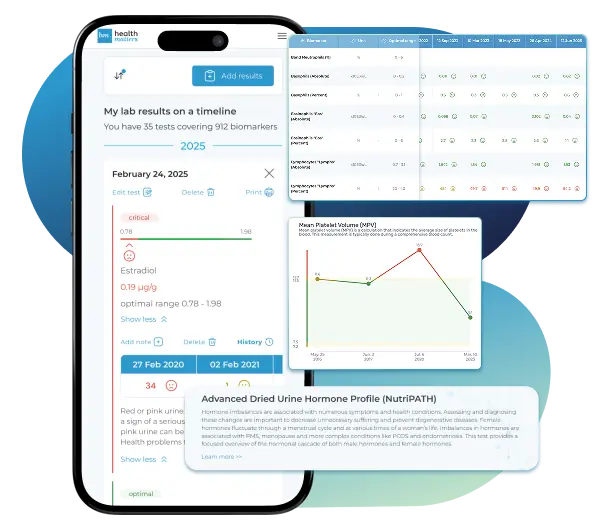
Bring all your results together to compare, track progress, export your history, and share securely.
What Healthmatters Members Are Saying

I have been using Healthmatters.io since 2021. I travel all over the world and use different doctors and health facilities. This site has allowed me to consolidate all my various test results over 14 years in one place. And every doctor that I show this to has been impressed. Because with any health professional I talk to, I can pull up historical results in seconds. It is invaluable. Even going back to the same doctor, they usually do not have the historical results from their facility in a graph format. That has been very helpful.
Anthony
Unlimited Plan Member since 2021
What fantastic service and great, easy-to-follow layouts! I love your website; it makes it so helpful to see patterns in my health data. It's truly a pleasure to use. I only wish the NHS was as organized and quick as Healthmatters.io. You've set a new standard for health tracking!
Karin
Advanced Plan Member since 2020
As a PRO member and medical practitioner, Healthmatters.io has been an invaluable tool for tracking my clients' data. The layout is intuitive, making it easy to monitor trends and spot patterns over time. The ability to customize reports and charts helps me present information clearly to my clients, improving communication and outcomes. It's streamlined my workflow, saving me time and providing insights at a glance. Highly recommended for any practitioner looking for a comprehensive and user-friendly solution to track patient labs!
Paul
Healthmatters Pro Member since 2024

We implement proven measures to keep your data safe.
At HealthMatters, we're committed to maintaining the security and confidentiality of your personal information. We've put industry-leading security standards in place to help protect against the loss, misuse, or alteration of the information under our control. We use procedural, physical, and electronic security methods designed to prevent unauthorized people from getting access to this information. Our internal code of conduct adds additional privacy protection. All data is backed up multiple times a day and encrypted using SSL certificates. See our Privacy Policy for more details.