
P-tau181 Blood Test: Normal Range, High Results, and What It Means for Alzheimer's Risk
Other names: P-tau181, Phosphorylated Tau 181, P-Tau 181, p-tau 181, ptau181, ptau 181, P-Tau181 Blood Test, P-Tau181 Normal Range, P-Tau181 High, Phospho-Tau 181, Phospho-Tau 181P, Phospho-Tau (181P), Phosphorylated Tau 181 (ptau-181) Plasma, T -- P-Tau181, T--P-Tau181, T-P-Tau181, T P Tau181, Quest P-Tau181, Quest AD-Detect P-Tau181, AD-Detect Tau181, AD-Detect Phosphorylated Tau181 Plasma, Plasma P-Tau181, Plasma Phospho-Tau 181, P-Tau 181 Blood Test Results, P-Tau181 Blood Test Results, P-Tau 181 High Range, CSF P-Tau181, P-Tau181 Alzheimer's, Tau 181, Tau181, P-Tau181 vs P-Tau217, Phosphorylated Tau (P-Tau), P-Tau Normal Range, Tau 181 Test
 Optimal Result:
0 - 0.95 pg/mL.
Optimal Result:
0 - 0.95 pg/mL.

QUICK ANSWER
P-tau181 (phosphorylated tau at threonine 181) is a blood or CSF biomarker that reflects Alzheimer's disease-related brain changes — specifically the accumulation of amyloid plaques and tau tangles.
Reference ranges vary significantly by assay and platform:
| Platform | Commonly reported negative threshold | Commonly reported positive threshold |
|---|---|---|
| Lumipulse (Fujirebio) | ≤ ~0.95 pg/mL | ≥ ~1.3–1.5 pg/mL |
| Simoa (ALZpath / Quanterix) | ≤ ~2.0–2.25 pg/mL | ≥ ~2.5–3.0 pg/mL |
| Quest AD-Detect (T -- P-Tau181) | Consult report cutoff | Consult report cutoff |
These numbers are approximations from published validation studies. Always use the reference range and cutoff printed on your own lab report — platforms are not interchangeable.
Key takeaway: A high p-tau181 increases the likelihood of Alzheimer's-type pathology. A normal p-tau181 makes it less likely. Like all AD blood biomarkers, it is a diagnostic aid — not a standalone diagnosis.
WHAT IS P-TAU181?
Tau is a protein that stabilizes structures inside brain cells. In Alzheimer's disease, tau becomes abnormally phosphorylated — chemically modified at specific sites — causing it to detach from its normal function, aggregate into tangles, and damage neurons.
Phosphorylated tau-181 refers to tau that has been modified specifically at threonine 181, one of the earliest and most studied phosphorylation sites in Alzheimer's disease. As this process occurs in the brain, p-tau181 leaks into the bloodstream and cerebrospinal fluid (CSF), where it can be measured.
P-tau181 in plasma vs CSF:
- Plasma (blood) p-tau181 is a newer, less invasive measurement. It requires only a blood draw and is increasingly available through commercial labs including Quest Diagnostics (AD-Detect panel) and labs using Lumipulse or Simoa platforms.
- CSF p-tau181 has a longer research history and is measured during a lumbar puncture. It remains a gold-standard confirmatory test but requires a more invasive procedure.
WHAT DOES HIGH P-TAU181 MEAN?
High p-tau181 (above the positive cutoff on your report) means Alzheimer's-related amyloid and tau pathology is likely present in the brain. The higher the value above the threshold, the stronger the signal.
Clinically, a high result:
- Supports — but does not confirm — a clinical diagnosis of Alzheimer's disease
- May prompt your clinician to order confirmatory testing (amyloid PET scan or CSF biomarkers)
- May support eligibility evaluation for Alzheimer's disease-modifying treatments
- Helps differentiate Alzheimer's disease from other forms of dementia when the diagnosis is unclear
What a high result does not mean:
- It is not a standalone diagnosis of Alzheimer's disease
- It does not predict the rate of cognitive decline
- It does not mean dementia is imminent — pathology may be present years before significant symptoms
WHAT DOES LOW P-TAU181 MEAN?
Low p-tau181 (below the negative cutoff) makes Alzheimer's-type pathology less likely at the time of testing. This is a reassuring finding in a patient being evaluated for possible Alzheimer's disease.
A negative result may redirect evaluation toward other causes of cognitive symptoms — vascular dementia, Lewy body dementia, depression, metabolic conditions, or medication effects.
A negative result does not completely exclude Alzheimer's disease, particularly in early-stage or atypical presentations.
HOW TO READ YOUR RESULT: SPECIFIC NUMBERS
If your result is from the Lumipulse platform (typical range ~0.3–3.0 pg/mL):
| P-tau181 result (pg/mL) | Typical interpretation |
|---|---|
| Under 0.8 | Clearly negative — AD pathology unlikely |
| 0.8–1.0 | Near the negative threshold — typically negative |
| 1.0–1.3 | Indeterminate / borderline — further evaluation often recommended |
| 1.3–1.5 | Near the positive threshold — borderline positive |
| Above 1.5 | Clearly elevated — AD pathology likely |
If your result is from the Simoa platform (ALZpath, Quanterix; typical range ~0.5–10+ pg/mL):
| P-tau181 result (pg/mL) | Typical interpretation |
|---|---|
| Under 1.8 | Typically negative |
| 1.8–2.5 | Borderline / indeterminate |
| Above 2.5 | Elevated — consistent with AD pathology |
If your report says "T -- P-Tau181" or "T--P-Tau181": This is the Quest AD-Detect report format for plasma p-tau181. Use the reference range printed on your Quest report — Quest uses their own validated cutoffs which may differ from the approximations above.
P-TAU181 VS P-TAU217: WHAT IS THE DIFFERENCE?
These are two different phosphorylation sites on the same tau protein. Both reflect Alzheimer's disease pathology, but they differ in important ways:
| Feature | P-tau181 | P-tau217 |
|---|---|---|
| Phosphorylation site | Threonine 181 | Threonine 217 |
| Clinical availability | Widely available — Quest, LabCorp, Lumipulse labs | Growing availability — Lumipulse (FDA-cleared), specialty labs |
| Diagnostic accuracy | High (AUC ~0.85–0.92) | Generally higher (AUC ~0.90–0.96) |
| Research history | Longer — more published validation data | Newer — but rapidly accumulating evidence |
| FDA clearance | Not cleared as a standalone test | Lumipulse p-tau217/Aβ42 ratio cleared May 16, 2025 |
| Report format | Often pg/mL (absolute) | Often pg/mL (absolute) or ratio |
The practical difference: P-tau217 tends to rise earlier and more steeply in Alzheimer's disease and generally shows higher diagnostic accuracy in head-to-head comparisons. However, p-tau181 is more widely available, has a longer validation history, and remains clinically useful — particularly when p-tau217 is not available or when used as part of a multimarker panel (e.g., with Aβ42/40 ratio).
WHAT IS THE QUEST AD-DETECT P-TAU181 TEST?
Quest Diagnostics offers plasma p-tau181 as part of its AD-Detect panel. On Quest reports, plasma p-tau181 appears as "T -- P-Tau181" or similar formatting. The test uses a Simoa-based immunoassay and reports in pg/mL.
The AD-Detect panel typically includes:
- Plasma p-tau181 (T -- P-Tau181)
- Plasma Aβ42/40 ratio
- Sometimes additional tau or amyloid markers (some panel versions may include p-tau217)
Quest provides its own reference ranges and cutoffs on the report. Do not apply cutoffs from Lumipulse or ALZpath validation studies to Quest AD-Detect results.
CAN P-TAU181 BE ELEVATED BEFORE SYMPTOMS APPEAR?
Yes. Like p-tau217, plasma p-tau181 can become elevated years before cognitive symptoms become obvious. The biomarker reflects the underlying biological process — amyloid accumulation and tau phosphorylation — not the current severity of memory loss.
This means a person with elevated p-tau181 may currently have:
- Mild cognitive impairment (MCI)
- Subjective memory concerns without objective deficits
- No obvious symptoms at all
An elevated result in the absence of clear dementia symptoms does not mean dementia is imminent. It indicates the pathological process is underway and warrants clinical follow-up.
WHEN TO FOLLOW UP
Discuss your p-tau181 result with a clinician if:
- Your result is above the positive cutoff on your report — confirmatory testing (amyloid PET or CSF) may be recommended
- Your result is borderline — repeat testing, additional biomarkers (Aβ42/40 ratio, p-tau217), or imaging may be ordered
- Your result is negative but symptoms are progressing — other causes of cognitive change need investigation
- You are considering or already on Alzheimer's disease-modifying therapy
BOTTOM LINE
Bottom line: P-tau181 is an established blood and CSF biomarker for Alzheimer's-type pathology. Reference ranges vary significantly by platform — Lumipulse, Simoa, and Quest AD-Detect all use different cutoffs that cannot be compared directly. P-tau217 generally shows higher diagnostic accuracy but p-tau181 remains widely useful, especially where p-tau217 is unavailable. A high result increases the likelihood of AD pathology; a normal result makes it less likely. Neither is a standalone diagnosis.
FAQ about p-tau181
-
Can kidney disease affect p-tau181 levels?
Yes. Reduced kidney function may increase circulating levels of Alzheimer's-related blood biomarkers including p-tau181 and p-tau217. This appears to occur because the kidneys normally help clear these proteins from the bloodstream — impaired clearance leads to accumulation that can falsely elevate results. Results should be interpreted alongside kidney function markers such as creatinine, cystatin C, and eGFR, particularly in patients with chronic kidney disease. Your clinician should be aware of any kidney conditions when interpreting plasma tau biomarker results. -
What if my p-tau181 is high but my p-tau217 is intermediate?
This pattern can occur in early Alzheimer's disease or when different biomarkers are changing at different stages of the pathological process. P-tau181 and p-tau217 measure different phosphorylation sites on the tau protein and do not always become abnormal at exactly the same time. An elevated p-tau181 with an intermediate p-tau217 should be interpreted alongside amyloid PET imaging, cognitive testing, symptoms, and other biomarkers such as the Aβ42/40 ratio. No single Alzheimer's biomarker should be interpreted in isolation — the overall pattern across markers and the clinical picture together determine the significance. -
What is the normal range for p-tau181?
Reference ranges are assay-specific. On the Lumipulse platform, published studies place the negative threshold at approximately ≤ 0.95 pg/mL and the positive threshold at ≥ 1.3–1.5 pg/mL. On Simoa-based platforms (ALZpath, Quanterix, Quest AD-Detect), the scale is different — the positive cutoff is typically around 2.0–2.25 pg/mL. Never compare a result from one platform against cutoffs from another. -
What does it mean when my result says "T -- P-Tau181"?
"T -- P-Tau181" or "T--P-Tau181" is how Quest Diagnostics labels plasma p-tau181 on its AD-Detect report. It refers to the same biomarker — phosphorylated tau protein at threonine 181, measured in blood plasma. Use the reference range and cutoffs printed on your Quest report to interpret the number. -
What does high p-tau181 mean?
A high p-tau181 (above the positive cutoff on your report) indicates that Alzheimer's-related amyloid and tau brain changes are likely present. It supports a diagnosis of Alzheimer's disease when combined with clinical symptoms and cognitive testing, but does not confirm it alone. Your clinician may recommend amyloid PET imaging or CSF testing for confirmation. -
How does p-tau181 compare to p-tau217?
P-tau217 generally shows higher diagnostic accuracy than p-tau181 in head-to-head comparisons and rises earlier in Alzheimer's disease. However, p-tau181 is more widely available, has a longer research history, and is still highly useful clinically. The Lumipulse p-tau217/Aβ42 ratio received FDA clearance in May 2025, which may shift clinical preference toward p-tau217 over time. -
Can p-tau181 be elevated without symptoms?
Yes. P-tau181 reflects the underlying biological process of Alzheimer's disease rather than the current severity of memory loss. Elevated levels can appear years before cognitive symptoms become apparent. An elevated result in the absence of obvious dementia does not mean dementia is imminent — it means the pathological process is underway and warrants clinical follow-up. -
Do I still need a PET scan or lumbar puncture after a p-tau181 result?
Sometimes. P-tau181 can reduce the need for invasive confirmatory testing for many patients. However, amyloid PET or CSF biomarkers may still be recommended when results are borderline, when the clinical picture is atypical, or when confirming pathology would directly change treatment decisions — particularly for eligibility for disease-modifying therapies. -
Is p-tau181 the same as total tau?
No. Total tau measures the overall level of tau protein in blood or CSF, regardless of phosphorylation status. P-tau181 specifically measures tau that has been phosphorylated at threonine 181, which is more specific to Alzheimer's disease pathology. Elevated total tau can reflect general neuronal injury from many causes; elevated p-tau181 is more specifically associated with Alzheimer's-type changes.
Lab Results Explained and Tracked
What does it mean if your p-tau181 result is too high?
High p-tau181 means Alzheimer's-related amyloid and tau pathology is likely present in the brain. The result supports — but does not confirm — Alzheimer's disease, and must be interpreted alongside cognitive testing, symptoms, and clinical history. Your clinician may recommend confirmatory amyloid PET imaging or CSF testing. Reference ranges differ significantly between the Lumipulse, Simoa/ALZpath, and Quest AD-Detect platforms — always use the cutoffs on your own report.
Related Health Conditions

All Your Lab Results.
One Simple Dashboard.
Import, Track, and Share Your Lab Results Easily
Import, Track, and Share Your Lab Results
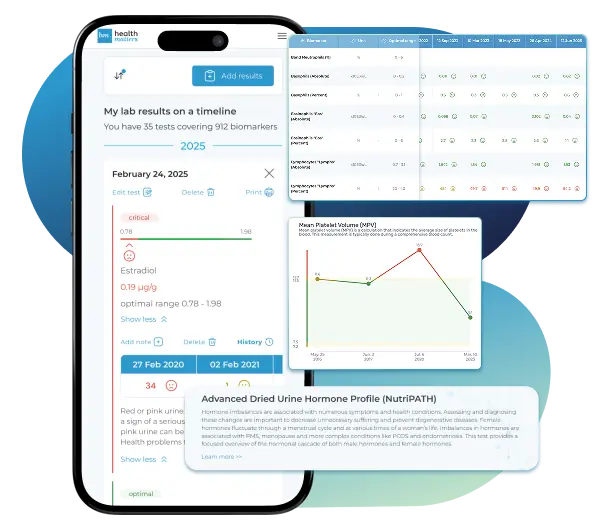
Import lab results from multiple providers, track changes over time, customize your reference ranges, and get clear explanations for each result. Everything is stored securely, exportable in one organized file, and shareable with your doctor—or anyone you choose.
Cancel or upgrade anytime
What does it mean if your p-tau181 result is too low?
Low p-tau181 makes Alzheimer's-type pathology less likely at the time of testing. This is a reassuring finding in a patient being evaluated for possible Alzheimer's disease, and may redirect investigation toward other causes of cognitive symptoms. A negative result should still be interpreted alongside clinical assessment — it does not completely exclude early or atypical Alzheimer's disease.
Related Biomarkers
Article Review & Sources
All our content is backed by peer-reviewed studies, academic research, and trusted medical sources. We're committed to accuracy and transparency — see our editorial policy for details.
Laboratories
Bring All Your Lab Results Together — In One Place
We accept reports from any lab, so you can easily collect and organize all your health information in one secure spot.











Pricing Table
Gather Your Lab History — and Finally Make Sense of It
Finally, Your Lab Results Organized and Clear

Personal plans

$79/ year
Advanced Plan
Access your lab reports, explanations, and tracking tools.
- Import lab results from any provider
- Track all results with visual tools
- Customize your reference ranges
- Export your full lab history anytime
- Share results securely with anyone
- Receive 5 reports entered for you
- Cancel or upgrade anytime
$250/ once
Unlimited Account
Pay once, access everything—no monthly fees, no limits.
- Import lab results from any provider
- Track all results with visual tools
- Customize your reference ranges
- Export your full lab history anytime
- Share results securely with anyone
- Receive 10 reports entered for you
- No subscriptions. No extra fees.
$45/ month
Pro Monthly
Designed for professionals managing their clients' lab reports
- Import lab results from any provider
- Track lab results for multiple clients
- Customize reference ranges per client
- Export lab histories and reports
- Begin with first report entered by us
- Cancel or upgrade anytime
About membership
What's included in a Healthmatters membership
 Import Lab Results from Any Source
 See Your Health Timeline
 Understand What Your Results Mean

 Visualize Your Results

 Data Entry Service for Your Reports
 Securely Share With Anyone You Trust
Let Your Lab Results Tell the Full Story
Once your results are in one place, see the bigger picture — track trends over time, compare data side by side, export your full history, and share securely with anyone you trust.




Bring all your results together to compare, track progress, export your history, and share securely.
What Healthmatters Members Are Saying

I have been using Healthmatters.io since 2021. I travel all over the world and use different doctors and health facilities. This site has allowed me to consolidate all my various test results over 14 years in one place. And every doctor that I show this to has been impressed. Because with any health professional I talk to, I can pull up historical results in seconds. It is invaluable. Even going back to the same doctor, they usually do not have the historical results from their facility in a graph format. That has been very helpful.
Anthony
Unlimited Plan Member since 2021
What fantastic service and great, easy-to-follow layouts! I love your website; it makes it so helpful to see patterns in my health data. It's truly a pleasure to use. I only wish the NHS was as organized and quick as Healthmatters.io. You've set a new standard for health tracking!
Karin
Advanced Plan Member since 2020
As a PRO member and medical practitioner, Healthmatters.io has been an invaluable tool for tracking my clients' data. The layout is intuitive, making it easy to monitor trends and spot patterns over time. The ability to customize reports and charts helps me present information clearly to my clients, improving communication and outcomes. It's streamlined my workflow, saving me time and providing insights at a glance. Highly recommended for any practitioner looking for a comprehensive and user-friendly solution to track patient labs!
Paul
Healthmatters Pro Member since 2024

We implement proven measures to keep your data safe.
At HealthMatters, we're committed to maintaining the security and confidentiality of your personal information. We've put industry-leading security standards in place to help protect against the loss, misuse, or alteration of the information under our control. We use procedural, physical, and electronic security methods designed to prevent unauthorized people from getting access to this information. Our internal code of conduct adds additional privacy protection. All data is backed up multiple times a day and encrypted using SSL certificates. See our Privacy Policy for more details.