
Oxidized LDL
 Optimal Result:
10 - 170 ng/mL.
Optimal Result:
10 - 170 ng/mL.

Metabolic syndrome (MetS) represents a cluster of risk factors for cardiovascular disease (CVD), defined by the presence of ≥3 of the following 5 physiological risk factors:
- increased waist circumference,
- elevated blood pressure,
- low HDL cholesterol,
- elevated triglycerides,
- and elevated glucose.
Despite established diagnostic and treatment guidelines for MetS, the clinical evidence guiding the use of markers to predict MetS onset is still evolving.
One potential marker of MetS risk is oxidized LDL (oxLDL), which is formed when oxidative stress leads to modification of the apoB subunit on LDL cholesterol (LDL). Conversion of LDL to oxLDL appears to be an important event that helps initiate and accelerate the development of early atherosclerotic lesions, or fatty streaks. Cardiovascular sequelae of elevated oxLDL include coronary artery disease, acute myocardial infarction, stable and unstable angina, and untreated overt hypothyroidism. In a cross-sectional study of 3,987 non-diabetic individuals without symptoms of atherosclerosis, elevated oxLDL was strongly associated with prevalent MetS: odds ratios for the highest quartile ranged from 2.57 (95% CI 1.66-4.04) to 3.36 (95% CI 2.33-4.91), depending on which variables were adjusted for.
Measurement of oxLDL can also help in assessing the risk of MetS. A prospective, longitudinal study looked at oxLDL levels in 1,367 initially healthy adults in Finland. Individuals with elevated baseline oxLDL levels were more likely to develop MetS at 6-year follow-up, after adjusting for age, sex, smoking status, insulin resistance, body mass index, and C-reactive protein; however, the trend was not significant after also adjusting for apoB.
Similar findings were reported in another prospective, longitudinal study of 1,889 initially healthy adults in the United States. At 5-year follow-up, individuals in the highest quintile of oxLDL at baseline had 3.5 times the risk of developing MetS compared to those in the lowest quintile; individuals in the fourth quintile were at moderate risk (OR=2.8) for MetS.
Reference:
- Holvoet et al. JAMA. 2008; 299: 2287-2293 [L]
- Moore JX, Chaudhary N, Akinyemiju T. Metabolic syndrome prevalence by race/ethnicity and sex in the United States, National Health and Nutrition Examination Survey, 1988-2012. Prev Chronic Dis. 2017;14:4-5.
- Grundy SM, Stone NJ, Bailey AL, et al. 2018 AHA/ACC/AACVPR/AAPA/ABC/ACPM/ADA/AGS/APhA/ASPC/NLA/PCNA guideline on the management of blood cholesterol. A Report of the American College of Cardiology/American Heart Association Task Force on Clinical Practice Guidelines. 2018:25709.
- Srikanthan K, Feyh A, Visweshwar H, et al. Systematic review of metabolic syndrome biomarkers: a panel for early detection, management, and risk stratification in the West Virginian population. Int J Med Sci. 2016;13:25-38.
- Gruzdeva O, Uchasova E, Dyleva Y, et al. Multivessel coronary artery disease, free fatty acids, oxidized LDL and its antibody in myocardial infarction. Lipids Health Dis. 2014;13:111.
- Salvayre R, Negre-Salvayre A, Camaré C. Oxidative theory of atherosclerosis and antioxidants. Biochimie. 2016;125:281-296.
- Steinberg D. Low density lipoprotein oxidation and its pathobiological significance. J Biol Chem. 1997;272:20963-20966.
- Oge A, Sozmen E, Karaoglu AO. Effect of thyroid function on LDL oxidation in hypothyroidism and hyperthyroidism. Endocr Res. 2004;30:481-489.
- Hurtado-Roca Y, Bueno H, Fernandez-Ortiz A, et al. Oxidized LDL is associated with metabolic syndrome traits independently of central obesity and insulin resistance. Diabetes. 2017;66:474-482.
- Koskinen J, Magnussen CG, Würtz P, et al. Apolipoprotein B, oxidized low-density lipoprotein, and LDL particle size in predicting the incidence of metabolic syndrome: the Cardiovascular Risk in Young Finns study. Eur J Prev Cardiol. 2012;19:1296-1303.
- Holvoet P, Lee DH, Steffes M, et al. Association between circulating oxidized low-density lipoprotein and incidence of the metabolic syndrome. JAMA. 2008;299:2287-2293.
- Harmon ME, Campen MJ, Miller C, et al. Associations of circulating oxidized LDL and conventional biomarkers of cardiovascular disease in a cross-sectional study of the Navajo population. PLoS One. 2016;11:e0143102.
Lab Results Explained and Tracked
What does it mean if your Oxidized LDL result is too high?
Researchers have found that individuals with high levels of oxidized LDL are 4x more likely to develop metabolic syndrome up to five years following testing. In particular, increased oxidized LDL levels were associated with abdominal obesity and high triglyceride levels, as well as high blood glucose. The oxidized LDL test can also help your medical provider decide if you may be at a higher risk for heart attack or heart disease than by looking at traditional risk factors alone. Oxidized LDL may be twice as good at helping your medical provider know your risk for heart disease as any one of the traditional risk factors.
What can you do to help lower your oxidized LDL levels?
- Lifestyle changes are the best option to help lower your oxidized LDL levels.
- If you smoke, ask your medical provider to help you quit. It is not easy but there are programs and strategies (including over-thecounter and prescription medications) that can improve your chance of success.
- Adjust your diet to include foods low in saturated fat and those with zero trans-fat. Fruits and vegetables are also great options as they contain anti-oxidants.
- Talk with your medical provider about over-thecounter supplements containing anti-oxidants.
- Increase your amount of physical activity as approved by your medical provider.
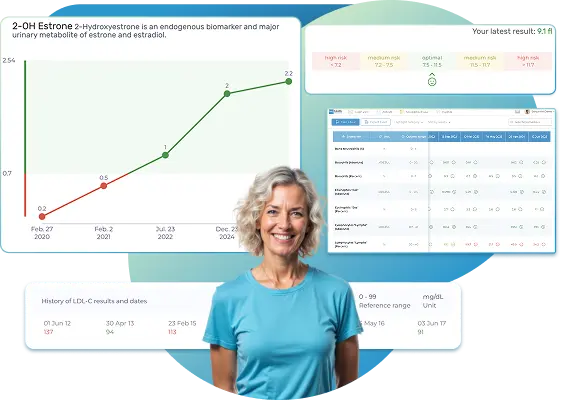
All Your Lab Results.
One Simple Dashboard.
Import, Track, and Share Your Lab Results Easily
Import, Track, and Share Your Lab Results
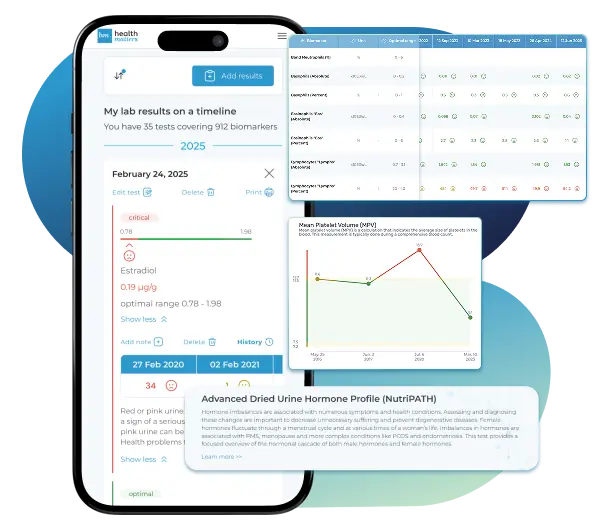
Import lab results from multiple providers, track changes over time, customize your reference ranges, and get clear explanations for each result. Everything is stored securely, exportable in one organized file, and shareable with your doctor—or anyone you choose.
Cancel or upgrade anytime
Article Review & Sources
All our content is backed by peer-reviewed studies, academic research, and trusted medical sources. We're committed to accuracy and transparency — see our editorial policy for details.
Laboratories
Bring All Your Lab Results Together — In One Place
We accept reports from any lab, so you can easily collect and organize all your health information in one secure spot.











Pricing Table
Gather Your Lab History — and Finally Make Sense of It
Finally, Your Lab Results Organized and Clear

Personal plans

$79/ year
Advanced Plan
Access your lab reports, explanations, and tracking tools.
- Import lab results from any provider
- Track all results with visual tools
- Customize your reference ranges
- Export your full lab history anytime
- Share results securely with anyone
- Receive 5 reports entered for you
- Cancel or upgrade anytime
$250/ once
Unlimited Account
Pay once, access everything—no monthly fees, no limits.
- Import lab results from any provider
- Track all results with visual tools
- Customize your reference ranges
- Export your full lab history anytime
- Share results securely with anyone
- Receive 10 reports entered for you
- No subscriptions. No extra fees.
$45/ month
Pro Monthly
Designed for professionals managing their clients' lab reports
- Import lab results from any provider
- Track lab results for multiple clients
- Customize reference ranges per client
- Export lab histories and reports
- Begin with first report entered by us
- Cancel or upgrade anytime
About membership
What's included in a Healthmatters membership
 Import Lab Results from Any Source
 See Your Health Timeline
 Understand What Your Results Mean

 Visualize Your Results

 Data Entry Service for Your Reports
 Securely Share With Anyone You Trust
Let Your Lab Results Tell the Full Story
Once your results are in one place, see the bigger picture — track trends over time, compare data side by side, export your full history, and share securely with anyone you trust.




Bring all your results together to compare, track progress, export your history, and share securely.
What Healthmatters Members Are Saying

I have been using Healthmatters.io since 2021. I travel all over the world and use different doctors and health facilities. This site has allowed me to consolidate all my various test results over 14 years in one place. And every doctor that I show this to has been impressed. Because with any health professional I talk to, I can pull up historical results in seconds. It is invaluable. Even going back to the same doctor, they usually do not have the historical results from their facility in a graph format. That has been very helpful.
Anthony
Unlimited Plan Member since 2021
What fantastic service and great, easy-to-follow layouts! I love your website; it makes it so helpful to see patterns in my health data. It's truly a pleasure to use. I only wish the NHS was as organized and quick as Healthmatters.io. You've set a new standard for health tracking!
Karin
Advanced Plan Member since 2020
As a PRO member and medical practitioner, Healthmatters.io has been an invaluable tool for tracking my clients' data. The layout is intuitive, making it easy to monitor trends and spot patterns over time. The ability to customize reports and charts helps me present information clearly to my clients, improving communication and outcomes. It's streamlined my workflow, saving me time and providing insights at a glance. Highly recommended for any practitioner looking for a comprehensive and user-friendly solution to track patient labs!
Paul
Healthmatters Pro Member since 2024

We implement proven measures to keep your data safe.
At HealthMatters, we're committed to maintaining the security and confidentiality of your personal information. We've put industry-leading security standards in place to help protect against the loss, misuse, or alteration of the information under our control. We use procedural, physical, and electronic security methods designed to prevent unauthorized people from getting access to this information. Our internal code of conduct adds additional privacy protection. All data is backed up multiple times a day and encrypted using SSL certificates. See our Privacy Policy for more details.