
LDL Pattern A and B: What Your Result Means for Heart Disease Risk
Other names: LDL Pattern, LDL Pattern A, LDL Pattern B, LDL Pattern A vs B, LDL Phenotype, LDL Phenotype A, LDL Phenotype B, LDL Particle Size, LDL Particle Size Pattern, LDL Type A, LDL Type B, LDL Type A vs B, LDL Density Pattern, Pattern A Cholesterol, Pattern B Cholesterol, LDL A, LDL B, LDL-A, LDL-B, Two Types of LDL Cholesterol, Types of LDL Cholesterol, Small Dense LDL, Large Buoyant LDL, LDL Subclasses, LDL Subfractions, LDL Peak Size, LDL Peak Particle Size, Advanced Lipid Panel, Advanced Lipid Profile, LDL Pattern A and B Test, LDL Pattern Test, LDL Particle Size Test, LDL A and B, Fluffy LDL, Fluffy Cholesterol, LDL Pattern A But High LDL, LDL Pattern B Treatment, LDL Pattern B Diet, LDL Subclass Test, NMR Lipoprotein Analysis, Ion Mobility LDL Pattern, LDL Muster B (German), LDL Phänotyp A (German), LDL Pattern A คือ (Thai), Lipoproteïne A/B (Dutch)
 Reference range:

QUICK ANSWER
LDL Pattern refers to the size of your LDL cholesterol particles — not just the amount.
| Result | What it means |
|---|---|
| Pattern A | Large, buoyant LDL particles — generally favorable cardiovascular risk profile |
| Pattern B | Small, dense LDL particles — associated with increased cardiovascular risk |
| Intermediate | Mix of particle sizes — some labs report this between A and B |
Is Pattern A good?
Yes. Pattern A means your LDL cholesterol particles are predominantly large and buoyant. Large LDL particles are less likely to penetrate arterial walls and less prone to oxidation. Pattern A is the favorable result.
Is Pattern B bad?
Pattern B indicates predominantly small, dense LDL particles. Small, dense LDL particles are more atherogenic — they penetrate arterial walls more easily and oxidize more readily, contributing to plaque formation. Pattern B is associated with a 3–5× increased risk of heart attack compared to Pattern A, even when total LDL cholesterol levels are similar.
Where does LDL Pattern fit in modern lipid testing? LDL Pattern describes the size of your LDL particles, while ApoB and LDL-P measure how many atherogenic particles are present. Modern lipidology generally considers ApoB and LDL-P stronger overall risk predictors; LDL Pattern provides important context about particle quality.
WHAT IS LDL PATTERN A VS PATTERN B?
LDL (low-density lipoprotein) is not a single uniform particle. LDL cholesterol particles vary in size — from large and buoyant (like a beach ball) to small and dense (like a BB pellet). This variation is what LDL Pattern measures.
Pattern A — large, buoyant LDL:
- Particles are larger in diameter (typically above 25.5 nm or 255 Angstroms depending on the method)
- Float more easily in blood
- Less likely to squeeze between endothelial cells into arterial walls
- Less susceptible to oxidation
- Associated with normal or near-normal triglycerides and healthy HDL levels
- Generally a favorable cardiovascular risk profile
Pattern B — small, dense LDL:
- Particles are smaller and denser (below 25.5 nm or 255 Angstroms depending on the method)
- Penetrate arterial endothelium more easily
- More susceptible to oxidation — and oxidized LDL is a key driver of plaque formation
- Frequently associated with elevated triglycerides, low HDL, and insulin resistance
- Associated with accelerated atherosclerosis
- Associated with 3–5× increased heart attack risk
Side-by-side comparison:
| Feature | Pattern A | Pattern B |
|---|---|---|
| Particle size | Large and buoyant | Small and dense |
| Cardiovascular risk | Lower | Higher |
| Penetrates artery walls | Less easily | More easily |
| Oxidation susceptibility | Lower | Higher |
| Associated triglycerides | Usually normal | Usually elevated |
| Associated HDL | Usually normal to high | Often low |
| Associated with insulin resistance | Less common | More common |
| Genetics | Primarily inherited | Primarily inherited but lifestyle-modifiable |
WHY DOES LDL PATTERN MATTER — EVEN WITH NORMAL LDL?
This is one of the most clinically important insights in modern lipidology.
Two people can have the same LDL cholesterol level but very different cardiovascular risk based on particle size.
Example: A person with LDL cholesterol of 130 mg/dL and Pattern A carries significantly lower cardiovascular risk than a person with LDL 130 mg/dL and Pattern B. The standard lipid panel does not distinguish between these two scenarios.
This is why Pattern B is considered especially important in people with:
- Normal or borderline LDL cholesterol (not clearly elevated)
- Low HDL and elevated triglycerides (classic "atherogenic dyslipidemia" pattern)
- Family history of heart disease despite seemingly normal lipid panels
- Metabolic syndrome or insulin resistance
Pattern B can be the explanation for coronary artery disease in someone with a "normal" standard lipid panel.
Key point: Pattern B can exist even when LDL cholesterol appears normal or borderline on a standard lipid panel. A standard lipid test measures cholesterol mass, not particle size or count. This is the core reason advanced lipid testing — which includes Pattern, LDL-P, and ApoB — was developed.
WHAT DOES "LDL PATTERN ABNORMAL" MEAN?
On many lab reports, Pattern B will appear with the flag "Abnormal" while Pattern A appears as "Normal." This is simply the lab's way of indicating whether the result is the more or less favorable pattern.
- Pattern A — Normal or Negative: Large particle predominance; favorable
- Pattern B — Abnormal or Positive: Small particle predominance; less favorable; warrants clinical discussion
The word "Abnormal" does not mean a crisis — it means the result is in the less favorable category and should be discussed in the context of your full cardiovascular risk profile.
LDL PATTERN A BUT HIGH LDL — WHAT DOES IT MEAN?
One of the most commonly searched questions is "ldl pattern a but high ldl" — receiving 18 clicks in the GSC data. This is a genuinely important clinical scenario.
Having Pattern A (large particles) alongside a high total LDL cholesterol is a mixed picture:
What it likely means:
- Your LDL particles are large, which is favorable in terms of penetrating arteries
- But you have a high quantity of those large particles, which still contributes to cardiovascular risk
- Volume of LDL exposure matters even when particle size is favorable
Clinical context: Pattern A does not eliminate cardiovascular risk. LDL particle number and total cholesterol burden are also important. Most guidelines still recommend treating high LDL cholesterol regardless of pattern, particularly in people with established heart disease or high overall cardiovascular risk. Pattern A with high LDL is generally a better situation than Pattern B with high LDL, but it is not risk-free.
HOW IS LDL PATTERN MEASURED?
LDL Pattern is not part of a standard lipid panel and is not measured by routine blood cholesterol tests. It requires advanced lipid testing.
Common methods:
| Method | How it works | Labs offering this test |
|---|---|---|
| Gradient gel electrophoresis | Separates LDL particles by size in a gel | Cleveland HeartLab, some specialty labs |
| NMR (Nuclear Magnetic Resonance) spectroscopy | Uses nuclear magnetic resonance to count and size particles; reports LDL peak size and LDL-P | LabCorp (NMR LipoProfile) |
| Ion mobility | Measures particle size distribution by electrical charge | Some specialty panels |
| Vertical auto profile (VAP) | Separates lipoproteins by density ultracentrifugation | Atherotech (historical) |
What your report may show:
- "Pattern A" or "Pattern B" (qualitative)
- LDL Peak Size (in Angstroms or nm) — the specific size measurement from which pattern is determined
- LDL small, LDL medium, LDL large (subclass particle numbers)
- LDL-P (total LDL particle number)
CAN YOU CHANGE LDL PATTERN FROM B TO A?
Yes. Although LDL particle size is significantly influenced by genetics, Pattern B can often be shifted toward Pattern A through lifestyle and medication.
Diet:
- Reduce refined carbohydrates and added sugars — these are the primary dietary drivers of small LDL particle production
- Reduce trans fats and excess saturated fat
- Increase fiber, particularly soluble fiber (oats, legumes, vegetables)
- Mediterranean-style or low-glycemic diets consistently improve particle size
- Low-fat, high-carbohydrate diets can worsen Pattern B in some individuals (by raising triglycerides)
Exercise:
- Regular aerobic exercise improves LDL particle size
- Even moderate exercise (30 minutes most days) has been shown to reduce small LDL particles
Weight loss:
- Reducing excess body fat, particularly abdominal fat, improves particle size
Medications:
- Niacin (nicotinic acid) — one of the most effective medications for increasing LDL particle size; less commonly used due to side effects
- Fibrates (gemfibrozil, fenofibrate) — effective for Pattern B, particularly when triglycerides are elevated
- Statins — effective at lowering LDL cholesterol quantity but have limited effect on particle size alone; may modestly improve pattern in some patients
- Fish oil / omega-3 fatty acids — reduce triglycerides and may improve particle size
MOST COMMON LDL PATTERN RESULTS
| Result | What it usually means |
|---|---|
| Pattern A | Favorable particle size — large buoyant LDL predominant |
| Pattern A + high LDL | Better than Pattern B with high LDL, but total cholesterol burden still matters |
| Pattern B | Small dense LDL predominance — higher cardiovascular risk; warrants clinical discussion |
| Pattern B + elevated triglycerides | Classic insulin resistance pattern — the most common metabolic context for Pattern B |
| Pattern B + low HDL | Atherogenic dyslipidemia — highest-risk lipid combination; associated with metabolic syndrome |
| Intermediate / Pattern A-B | Mixed particle population; risk between Pattern A and Pattern B |
LDL PATTERN, APOB, AND LDL-P: WHICH MATTERS MOST?
Advanced lipid testing can produce multiple related markers. Understanding how they relate helps clarify where LDL Pattern fits in cardiovascular risk assessment.
| Marker | What it measures | What it tells you |
|---|---|---|
| LDL Pattern (A or B) | Particle size — large vs small | Quality and penetrability of LDL particles |
| ApoB (Apolipoprotein B) | Number of atherogenic particles (including LDL, VLDL, IDL, Lp(a)) | Total atherogenic particle burden — one ApoB per particle |
| LDL-P (LDL particle number) | Total LDL particle count | Volume of LDL particles regardless of size |
| LDL-C (standard LDL cholesterol) | Cholesterol mass carried by LDL | Amount of cholesterol content — not particle count or size |
Which is the strongest predictor of cardiovascular risk?
Modern lipidology generally considers ApoB and LDL-P stronger overall cardiovascular risk predictors than LDL Pattern alone. This is because:
- Each atherogenic particle carries one ApoB molecule — so ApoB directly counts the total number of particles available to enter artery walls
- LDL particle number (LDL-P) captures total burden regardless of particle size
- LDL Pattern captures size but not number — a person with Pattern A can still have a very high LDL-P
LDL Pattern's value is context: it helps explain why someone with a normal LDL-C can still have high cardiovascular risk (Pattern B with high LDL-P), or why Pattern A with high LDL-C may be somewhat less dangerous than the cholesterol number alone suggests. The three markers complement each other rather than replace each other.
ApoB discordance example: A person with Pattern A and ApoB of 140 mg/dL still has elevated cardiovascular risk — because particle number remains high despite favorable particle size. Pattern A does not neutralize the risk of a high ApoB. Conversely, a person with Pattern B and ApoB of 70 mg/dL carries less total particle burden than the pattern alone implies. This is why ApoB and LDL-P provide information that Pattern alone cannot.
LDL PATTERN + TRIGLYCERIDES + HDL PATTERN MATRIX
The combination of LDL Pattern, triglycerides, and HDL provides far more clinical information than any single marker alone:
| LDL Pattern | Triglycerides | HDL | Most likely interpretation |
|---|---|---|---|
| Pattern A | Normal | Normal | Favorable lipid profile |
| Pattern A | High | Low | Metabolic risk still present despite favorable particle size — check for insulin resistance |
| Pattern B | Normal | Normal | Likely genetic small dense LDL pattern — lower metabolic risk than typical Pattern B |
| Pattern B | High | Low | Classic atherogenic dyslipidemia / insulin resistance — highest-risk pattern; evaluate for metabolic syndrome and diabetes |
| Pattern B | High | Normal | Elevated triglycerides driving small particle production — diet and exercise most important interventions |
This combination pattern is particularly useful because Pattern B without metabolic features (normal triglycerides, normal HDL) often reflects genetic predisposition rather than lifestyle-driven disease, while Pattern B with elevated triglycerides and low HDL almost always reflects insulin resistance and metabolic syndrome.
FAQ about LDL Pattern
-
Does Pattern B mean I need a statin?
Not necessarily. Statin decisions are based on a person's overall cardiovascular risk profile — which includes LDL-C, ApoB, LDL-P, age, sex, family history, diabetes status, blood pressure, smoking, and existing cardiovascular disease. Pattern B increases risk and is relevant context, but it is rarely the sole reason to start medication. Many people with Pattern B are managed effectively through diet, exercise, and weight loss. Statins are highly effective at lowering total LDL cholesterol and particle number but have limited direct effect on particle size. If Pattern B is present alongside high LDL-C, high ApoB, or high overall cardiovascular risk, medication is more likely to be recommended. -
Can Pattern A change to Pattern B?
Yes. Although LDL particle size has a strong genetic component, Pattern A can shift toward Pattern B with certain lifestyle and metabolic changes. The most common drivers of this shift are weight gain (particularly abdominal obesity), rising triglycerides, developing insulin resistance or type 2 diabetes, high intake of refined carbohydrates and added sugars, and physical inactivity. The same lifestyle changes that shift Pattern B to A — reducing refined carbohydrates, exercising regularly, losing excess body fat — also prevent the reverse shift. -
Is LDL Pattern A good?
Yes. Pattern A means your LDL cholesterol particles are predominantly large and buoyant. Large LDL particles are less likely to penetrate arterial walls and less prone to oxidation — two key mechanisms of atherosclerosis. Pattern A is the favorable LDL particle size pattern and is generally associated with lower cardiovascular risk. -
Is LDL Pattern B dangerous?
Pattern B indicates predominantly small, dense LDL particles. Small dense LDL particles are more atherogenic — they penetrate artery walls more easily and oxidize more readily, contributing to plaque formation and atherosclerosis. Pattern B is associated with a 3–5× increased risk of heart attack compared to Pattern A, even when total LDL cholesterol is similar. Pattern B warrants clinical discussion and often lifestyle or medication intervention. -
What does "LDL Pattern A vs B" mean?
LDL patterns A and B classify LDL cholesterol particles by size. Pattern A describes large, buoyant particles; Pattern B describes small, dense particles. The same total amount of LDL cholesterol can have very different cardiovascular risk depending on whether particles are predominantly large (Pattern A) or small and dense (Pattern B). Pattern A is favorable; Pattern B is the less favorable result. -
What does it mean to have LDL Pattern A but high LDL cholesterol?
Having Pattern A (large particles) with high total LDL is a mixed result. Pattern A is favorable in terms of particle penetrability and oxidation risk. However, a high quantity of large LDL particles still represents a cumulative cholesterol burden that contributes to cardiovascular risk over time. Pattern A does not eliminate the risk associated with high LDL cholesterol — it modifies the risk profile. Clinicians generally still recommend addressing high LDL regardless of pattern, particularly in individuals with other cardiovascular risk factors. -
How is LDL Pattern different from regular LDL cholesterol?
A standard LDL cholesterol test measures the total amount of LDL cholesterol in the blood (LDL-C). LDL Pattern tests measure the size of the LDL particles. Two people can have the same LDL-C but very different risk profiles if one has large particles (Pattern A) and the other has small dense particles (Pattern B). The standard lipid panel does not distinguish between particle sizes — that requires advanced lipid testing. -
Can you change LDL Pattern B to Pattern A?
Yes, in many cases. Although LDL particle size is influenced by genetics, lifestyle changes can shift Pattern B toward Pattern A. The most effective approaches are reducing refined carbohydrates and added sugars (the primary dietary driver of small particle production), regular aerobic exercise, weight loss, and increasing fiber intake. Medications including niacin, fibrates, and omega-3 fatty acids can also improve particle size. Statins have limited effect on particle size but reduce total LDL particle quantity. -
What is LDL Pattern B associated with?
Pattern B is frequently associated with elevated triglycerides, low HDL cholesterol, insulin resistance, metabolic syndrome, and type 2 diabetes. It is believed to be an important cause of atherosclerosis and heart disease in people who appear to have normal total cholesterol on a standard lipid panel. When Pattern B appears alongside elevated triglycerides and low HDL, this combination — called atherogenic dyslipidemia — is considered particularly high risk. -
What is the difference between LDL-P and LDL Pattern?
LDL-P (LDL particle number) measures how many LDL particles are in the blood, regardless of size. LDL Pattern (A or B) classifies whether those particles are predominantly large or small. These are related but distinct measurements. High LDL-P with small particles (Pattern B) is the highest-risk combination. High LDL-P with large particles (Pattern A) is a somewhat lower-risk combination, though total particle burden still matters.
Lab Results Explained and Tracked
Related Health Conditions

All Your Lab Results.
One Simple Dashboard.
Import, Track, and Share Your Lab Results Easily
Import, Track, and Share Your Lab Results
Import lab results from multiple providers, track changes over time, customize your reference ranges, and get clear explanations for each result. Everything is stored securely, exportable in one organized file, and shareable with your doctor—or anyone you choose.
Cancel or upgrade anytime
Related Biomarkers
Article Review & Sources
All our content is backed by peer-reviewed studies, academic research, and trusted medical sources. We're committed to accuracy and transparency — see our editorial policy for details.
Laboratories
Bring All Your Lab Results Together — In One Place
We accept reports from any lab, so you can easily collect and organize all your health information in one secure spot.











Pricing Table
Gather Your Lab History — and Finally Make Sense of It
Finally, Your Lab Results Organized and Clear

Personal plans

$79/ year
Advanced Plan
Access your lab reports, explanations, and tracking tools.
- Import lab results from any provider
- Track all results with visual tools
- Customize your reference ranges
- Export your full lab history anytime
- Share results securely with anyone
- Receive 5 reports entered for you
- Cancel or upgrade anytime
$250/ once
Unlimited Account
Pay once, access everything—no monthly fees, no limits.
- Import lab results from any provider
- Track all results with visual tools
- Customize your reference ranges
- Export your full lab history anytime
- Share results securely with anyone
- Receive 10 reports entered for you
- No subscriptions. No extra fees.
$45/ month
Pro Monthly
Designed for professionals managing their clients' lab reports
- Import lab results from any provider
- Track lab results for multiple clients
- Customize reference ranges per client
- Export lab histories and reports
- Begin with first report entered by us
- Cancel or upgrade anytime
About membership
What's included in a Healthmatters membership
 Import Lab Results from Any Source
 See Your Health Timeline
 Understand What Your Results Mean

 Visualize Your Results

 Data Entry Service for Your Reports
 Securely Share With Anyone You Trust
Let Your Lab Results Tell the Full Story
Once your results are in one place, see the bigger picture — track trends over time, compare data side by side, export your full history, and share securely with anyone you trust.




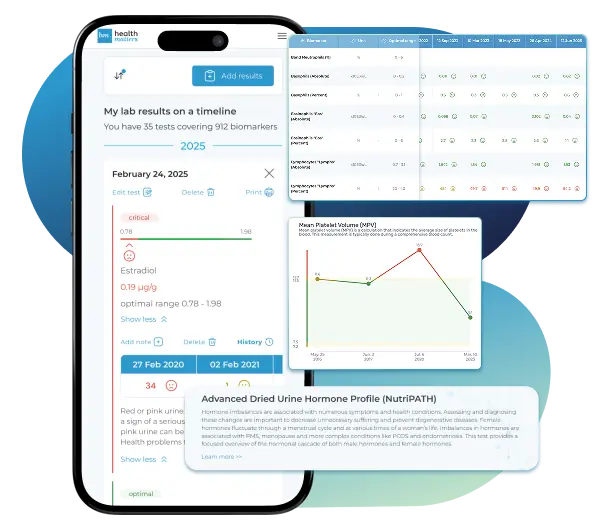
Bring all your results together to compare, track progress, export your history, and share securely.
What Healthmatters Members Are Saying

I have been using Healthmatters.io since 2021. I travel all over the world and use different doctors and health facilities. This site has allowed me to consolidate all my various test results over 14 years in one place. And every doctor that I show this to has been impressed. Because with any health professional I talk to, I can pull up historical results in seconds. It is invaluable. Even going back to the same doctor, they usually do not have the historical results from their facility in a graph format. That has been very helpful.
Anthony
Unlimited Plan Member since 2021
What fantastic service and great, easy-to-follow layouts! I love your website; it makes it so helpful to see patterns in my health data. It's truly a pleasure to use. I only wish the NHS was as organized and quick as Healthmatters.io. You've set a new standard for health tracking!
Karin
Advanced Plan Member since 2020
As a PRO member and medical practitioner, Healthmatters.io has been an invaluable tool for tracking my clients' data. The layout is intuitive, making it easy to monitor trends and spot patterns over time. The ability to customize reports and charts helps me present information clearly to my clients, improving communication and outcomes. It's streamlined my workflow, saving me time and providing insights at a glance. Highly recommended for any practitioner looking for a comprehensive and user-friendly solution to track patient labs!
Paul
Healthmatters Pro Member since 2024

We implement proven measures to keep your data safe.
At HealthMatters, we're committed to maintaining the security and confidentiality of your personal information. We've put industry-leading security standards in place to help protect against the loss, misuse, or alteration of the information under our control. We use procedural, physical, and electronic security methods designed to prevent unauthorized people from getting access to this information. Our internal code of conduct adds additional privacy protection. All data is backed up multiple times a day and encrypted using SSL certificates. See our Privacy Policy for more details.