
ALA/Creatinine Ratio
 Optimal Result:
0.7 - 3.6 mg/g creat.
Optimal Result:
0.7 - 3.6 mg/g creat.

What is the ALA/Creatinine Ratio?
The ALA/Creatinine Ratio measures the amount of delta-aminolevulinic acid (ALA) in your urine, standardized against creatinine to account for urine concentration differences.
ALA is a key intermediate in the heme synthesis pathway, which your body uses to make heme—a crucial component of hemoglobin in red blood cells.
This ratio is especially useful in diagnosing acute porphyrias and other disorders of heme metabolism. By adjusting for creatinine, the test gives a more accurate view of ALA excretion regardless of how diluted or concentrated the urine is.
Why is this test ordered?
This test is often ordered when a healthcare provider suspects a porphyria, particularly:
-
Acute Intermittent Porphyria (AIP)
-
Hereditary Coproporphyria (HCP)
-
Variegate Porphyria (VP)
-
Lead poisoning
-
Tyrosinemia Type I (in infants/children)
You may be asked to do this test if you're experiencing unexplained, recurring symptoms, such as:
-
Severe abdominal pain
-
Nausea or vomiting
-
Muscle weakness
-
Anxiety, confusion, or hallucinations
-
Seizures
-
Reddish or dark urine (especially during acute episodes)
What does an elevated ALA/Creatinine Ratio mean?
An elevated ALA/Creatinine Ratio typically indicates increased production and urinary excretion of delta-aminolevulinic acid. This often points to disrupted heme biosynthesis, and is most commonly seen in:
1. Acute Hepatic Porphyrias
When an enzyme deficiency prevents the body from completing heme synthesis, intermediates like ALA build up and spill into the urine. ALA and porphobilinogen (PBG) are both elevated during acute attacks.
2. Lead Poisoning
Lead inhibits multiple enzymes in the heme synthesis pathway, especially ALA dehydratase, causing a marked rise in urinary ALA without a proportional rise in PBG. This pattern helps distinguish lead toxicity from porphyria.
3. Tyrosinemia Type I
In infants, especially those with failure to thrive, liver dysfunction, or neurological symptoms, high ALA levels may point to this rare metabolic disorder.
What should you do if your ALA/Creatinine Ratio is elevated?
If your ALA/Creatinine Ratio is high:
-
Your doctor may order additional confirmatory tests, including:
-
Porphobilinogen (PBG)/Creatinine Ratio
-
Total urine porphyrins
-
Blood lead levels
-
Genetic testing for porphyrias
-
-
If porphyria is suspected, it's critical to collect urine during an acute attack, as levels may normalize between episodes.
-
Avoid known triggers of porphyria attacks, such as:
-
Fasting or crash diets
-
Alcohol
-
Hormonal shifts (e.g., menstruation)
-
Certain prescription drugs (barbiturates, sulfa drugs, some anticonvulsants)
-
If lead poisoning is suspected, urgent chelation therapy and environmental investigation may be required.
How is this different from just measuring ALA?
Urine concentration can vary widely depending on hydration. Measuring ALA alone can be misleading—dilute urine might show a falsely low level. By expressing it as a ratio to creatinine, clinicians get a clearer, more reliable picture of your body’s ALA excretion, allowing for better diagnostic accuracy.
Bottom Line
An elevated ALA/Creatinine Ratio in random urine is a strong biochemical clue for acute porphyria, lead poisoning, or other heme-related metabolic disorders. If you're experiencing recurrent, unexplained symptoms—especially involving the nervous system or abdomen—this test may provide critical answers. Follow-up testing and early treatment can prevent serious complications.
Lab Results Explained and Tracked
What does it mean if your ALA/Creatinine Ratio result is too high?
What does it mean if your ALA/Creatinine Ratio is elevated?
An elevated ALA/Creatinine Ratio means your body is producing and excreting too much delta-aminolevulinic acid (ALA) in the urine. ALA is a natural substance your body uses to make heme, a vital component of red blood cells that helps carry oxygen.
Too much ALA in your urine can signal a problem in the heme production process, often due to a rare condition called porphyria or, in some cases, lead poisoning.
Possible causes of elevated ALA/Creatinine Ratio
-
Acute Hepatic Porphyrias
These are rare genetic disorders that affect how your body makes heme. When certain enzymes don’t work properly, substances like ALA build up and cause symptoms, especially during attacks. -
Lead Poisoning
Lead interferes with enzymes in the heme pathway, causing ALA to rise without a corresponding increase in other markers like PBG. This can affect both children and adults. -
Tyrosinemia Type I (in infants/children)
A rare inherited disorder that can also increase ALA levels, often showing up early in life with liver or kidney problems.
Symptoms to watch for
If you have high ALA levels, you may experience:
-
Severe, unexplained abdominal pain
-
Nausea or vomiting
-
Muscle weakness or numbness
-
Anxiety, confusion, or hallucinations
-
Seizures
-
Reddish or dark urine (especially during attacks)
These symptoms can come on suddenly and may be mistaken for other conditions, so testing is key.
What to do next if your levels are elevated
-
Talk to your healthcare provider
Elevated ALA levels require follow-up. Your doctor may recommend:-
Repeat testing during a symptomatic episode
-
A Porphobilinogen (PBG)/Creatinine Ratio
-
Total urine porphyrins
-
Blood lead level testing
-
Genetic testing for porphyria, if indicated
-
-
Avoid potential triggers (if porphyria is suspected):
-
Fasting or crash diets
-
Alcohol
-
Certain medications (like sulfa drugs, barbiturates, or some antibiotics)
-
Hormonal changes (such as around menstruation)
-
-
Seek emergency care if symptoms worsen
Acute porphyria attacks can be life-threatening if untreated. If you’re experiencing severe symptoms—especially abdominal pain, confusion, or seizures—go to the emergency room and tell them you are being evaluated for porphyria.
Can elevated ALA/Creatinine Ratio go back to normal?
Yes. In some cases, levels return to normal once the underlying trigger is removed or the acute episode resolves. But if you have an underlying disorder like porphyria, lifelong management may be needed.
Bottom Line
An elevated ALA/Creatinine Ratio is a strong clue that something may be disrupting your body’s ability to make heme. Whether it’s a rare genetic disorder like acute porphyria or lead exposure, early diagnosis and action can help prevent serious complications. Don’t ignore this result—follow up with your provider to get the answers and care you need.

All Your Lab Results.
One Simple Dashboard.
Import, Track, and Share Your Lab Results Easily
Import, Track, and Share Your Lab Results
Import lab results from multiple providers, track changes over time, customize your reference ranges, and get clear explanations for each result. Everything is stored securely, exportable in one organized file, and shareable with your doctor—or anyone you choose.
Cancel or upgrade anytime
Article Review & Sources
All our content is backed by peer-reviewed studies, academic research, and trusted medical sources. We're committed to accuracy and transparency — see our editorial policy for details.
Laboratories
Bring All Your Lab Results Together — In One Place
We accept reports from any lab, so you can easily collect and organize all your health information in one secure spot.











Pricing Table
Gather Your Lab History — and Finally Make Sense of It
Finally, Your Lab Results Organized and Clear

Personal plans

$79/ year
Advanced Plan
Access your lab reports, explanations, and tracking tools.
- Import lab results from any provider
- Track all results with visual tools
- Customize your reference ranges
- Export your full lab history anytime
- Share results securely with anyone
- Receive 5 reports entered for you
- Cancel or upgrade anytime
$250/ once
Unlimited Account
Pay once, access everything—no monthly fees, no limits.
- Import lab results from any provider
- Track all results with visual tools
- Customize your reference ranges
- Export your full lab history anytime
- Share results securely with anyone
- Receive 10 reports entered for you
- No subscriptions. No extra fees.
$45/ month
Pro Monthly
Designed for professionals managing their clients' lab reports
- Import lab results from any provider
- Track lab results for multiple clients
- Customize reference ranges per client
- Export lab histories and reports
- Begin with first report entered by us
- Cancel or upgrade anytime
About membership
What's included in a Healthmatters membership
 Import Lab Results from Any Source
 See Your Health Timeline
 Understand What Your Results Mean

 Visualize Your Results

 Data Entry Service for Your Reports
 Securely Share With Anyone You Trust
Let Your Lab Results Tell the Full Story
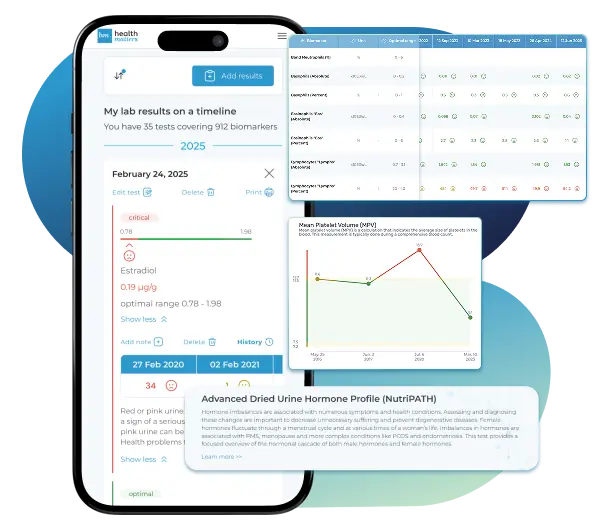
Once your results are in one place, see the bigger picture — track trends over time, compare data side by side, export your full history, and share securely with anyone you trust.




Bring all your results together to compare, track progress, export your history, and share securely.
What Healthmatters Members Are Saying

I have been using Healthmatters.io since 2021. I travel all over the world and use different doctors and health facilities. This site has allowed me to consolidate all my various test results over 14 years in one place. And every doctor that I show this to has been impressed. Because with any health professional I talk to, I can pull up historical results in seconds. It is invaluable. Even going back to the same doctor, they usually do not have the historical results from their facility in a graph format. That has been very helpful.
Anthony
Unlimited Plan Member since 2021
What fantastic service and great, easy-to-follow layouts! I love your website; it makes it so helpful to see patterns in my health data. It's truly a pleasure to use. I only wish the NHS was as organized and quick as Healthmatters.io. You've set a new standard for health tracking!
Karin
Advanced Plan Member since 2020
As a PRO member and medical practitioner, Healthmatters.io has been an invaluable tool for tracking my clients' data. The layout is intuitive, making it easy to monitor trends and spot patterns over time. The ability to customize reports and charts helps me present information clearly to my clients, improving communication and outcomes. It's streamlined my workflow, saving me time and providing insights at a glance. Highly recommended for any practitioner looking for a comprehensive and user-friendly solution to track patient labs!
Paul
Healthmatters Pro Member since 2024

We implement proven measures to keep your data safe.
At HealthMatters, we're committed to maintaining the security and confidentiality of your personal information. We've put industry-leading security standards in place to help protect against the loss, misuse, or alteration of the information under our control. We use procedural, physical, and electronic security methods designed to prevent unauthorized people from getting access to this information. Our internal code of conduct adds additional privacy protection. All data is backed up multiple times a day and encrypted using SSL certificates. See our Privacy Policy for more details.