
HSV-1 IgG Type-Specific Ab: What Positive, Reactive & "High" Results Mean
Other names: HSV 1 IgG, Type Spec, HSV Type 1-Specific Ab IgG, HSV 1 IgG Type Spec, HSV-1 IgG Type Specific Ab, HSV 1 IgG Type Specific Ab, HSV-1 IgG, Type Specific, Herpes Simplex Virus Type 1 Specific Ab IgG, Herpes Simplex Virus 1 IgG, HSV-1 Type-Specific IgG, HSV-1 gG1 Antibody, HSV-1 Glycoprotein G Antibody IgG, HerpeSelect HSV-1 IgG, HSV-1 IgG Index, HSV 1 IgG Positive, HSV 1 IgG Reactive, HSV 1 IgG High, HSV 1 IgG Abnormal, HSV-1 Reactive Meaning, HSV-1 IgG Type Spec Reactive, HSV-1 Index Value, HSV 1 IgG Type Specific Ab Meaning, Herpes 1 IgG Positivo, Virus Herpes Simplex 1 IgG Positivo
 Optimal Result:
0 - 0.9 / index.
Optimal Result:
0 - 0.9 / index.

A positive HSV-1 IgG means your immune system has encountered herpes simplex virus type 1 (HSV-1) at some point and made antibodies to it. This is one of the most common findings in all of laboratory medicine — most adults carry HSV-1, usually from childhood, and usually without ever having symptoms. A positive result is a marker of past exposure, not danger, not an active infection, and not an emergency.
The one idea that explains this whole page: HSV-1 IgG is a memory test, not a severity test. The antibody it measures is your immune system's memory of meeting the virus — not the virus itself, not how much of it you carry, and not how sick you are. Hold onto that and almost every question below answers itself.
Clinical takeaway. A positive HSV-1 IgG is one of the most common results in medicine. It means past exposure to a usually-mild, extremely common virus — not active disease, and not something the number can grade as "bad."
If you remember only one thing: "Positive," "reactive," "high," and "abnormal" all mean the same ordinary thing here — your body has met HSV-1 before. Those are lab labels, not a measure of how sick you are.
At a glance
- What it measures: IgG antibodies specific to HSV-1 (via glycoprotein G1), showing past exposure.
- Why it's ordered: to confirm past HSV-1 exposure and to tell HSV-1 apart from HSV-2.
- Most common reason it's positive: ordinary, often childhood, HSV-1 exposure — shared by most adults.
- What "high/abnormal/reactive" means: antibodies detected. Nothing more alarming than that.
- What it can't tell you: when, where (oral vs genital), from whom, or whether you're contagious now.
- Read it with: HSV-2 IgG, and — if you have symptoms — a swab (PCR) of the actual lesion.
Your result, and what it does not mean
The fastest way to read an HSV-1 IgG result is to hold what it usually means next to what people wrongly assume it means. Almost every fear attached to this test lives in that second column.
| Your result | Usually means | Does not mean |
|---|---|---|
| Negative (index ≤ 0.90) | No HSV-1 antibodies detected — no evidence of past exposure | That you're immune, or that a very recent exposure is ruled out (antibodies take weeks to months to appear) |
| Equivocal (index 0.91–1.09) | Borderline — repeat in 4–6 weeks to settle it | That you definitely do, or definitely don't, have HSV-1 |
| Positive (index ≥ 1.10) | Past exposure to HSV-1 — extremely common, usually oral, and lifelong | An active outbreak, a recent infection, or that you're contagious today |
| Positive, high index (e.g. 40, 58, ">23.00") | A strong antibody response — common with a long-standing infection | A worse, newer, or more contagious infection. The number is not a severity score |
The bottom row is the one people search for most. Once the test is clearly positive, the size of the index — 5, 40, or 58 — does not grade your infection.
Is a positive HSV-1 IgG dangerous?
For almost everyone, no. HSV-1 is extremely common and, for the majority of people, either causes occasional cold sores or no symptoms at all. A positive antibody test means your body met the virus and responded — exactly as it's supposed to. It is not a medical emergency, it doesn't shorten your life, and it doesn't mean you're currently sick or infectious.
The situations that genuinely warrant a conversation with a clinician are specific: active genital symptoms (where knowing HSV-1 vs HSV-2 changes counseling), pregnancy, a weakened immune system, or frequent, bothersome outbreaks. Outside those, a positive HSV-1 IgG is usually a fact to understand rather than a problem to treat.
Can you be HSV-1 positive and never have symptoms?
Yes — and it's the rule, not the exception. Most people who carry HSV-1 never have a cold sore or any recognized outbreak. It's one of the main reasons people are surprised by a positive result: the virus can sit dormant for a lifetime without ever announcing itself, and many people only discover they carry it when an antibody test is run for another reason.
So a positive HSV-1 IgG with no symptoms you've ever noticed is not a sign that symptoms are coming, that you caught it recently, or that something was missed. It's the most ordinary version of this result. "I'm positive but I've never had a cold sore" describes a large share of adults — the antibody simply records an exposure your immune system handled quietly, often in childhood.
How did I get HSV-1? (Even if you've never kissed anyone with a cold sore)
For most people, the honest answer is: probably in childhood, from ordinary close contact, and there's no way to know exactly when or from whom. HSV-1 is usually not sexually transmitted. It most often passes through everyday, nonsexual contact — a kiss from a relative, shared cups or utensils, a caregiver, close family life — long before anyone is thinking about it. The person who passed it on frequently had no visible sore at the time and never knew they carried it either.
This is worth saying plainly because the test can feel like an accusation, and it isn't one. A positive HSV-1 IgG doesn't imply anything about your relationships, your hygiene, or a specific encounter you can trace. It also can't tell you when you were infected or from whom — IgG is lifelong and undateable. If your result is positive and you can't think of any exposure, that's not a contradiction; it's the most common story there is.
(HSV-1 can also be acquired later in life, including genitally through oral-genital contact. But an antibody test alone can't tell an oral exposure from a genital one — only a swab of an actual sore can.)
Why does my result say "reactive," "abnormal," or "high"?
Because of how labs label antibody tests — not because anything is wrong. An antibody test has only two meaningful states: antibodies detected or not detected. When they're detected, the lab's software marks the result "reactive," "positive," or flags it "H" (high) or "abnormal," because it sits above the reference cutoff.
For most blood tests, "high" and "abnormal" signal a problem. For an antibody test like this one, they simply mean the thing the test looks for is present — which, for a virus most people carry, is expected. A reactive HSV-1 IgG is not a severity grade; it's a yes.
My HSV-1 IgG result is…
Results are reported as an index value against a cutoff (this page uses 0–0.9 as negative). Read yours against your own report's range:
My HSV-1 IgG is negative / non-reactive (index ≤ 0.90)
No HSV-1 antibodies detected — no evidence of past exposure. If a recent exposure is suspected, retest in a few weeks, since antibodies take time to develop.
My HSV-1 IgG is equivocal (index 0.91–1.09)
Borderline — neither clearly positive nor negative. The usual next step is a repeat test in 4–6 weeks.
My HSV-1 IgG is positive / reactive (index ≥ 1.10)
Antibodies present — past exposure to HSV-1. This is where "high," "abnormal," and "reactive" flags apply. For most people it's an ordinary, expected finding.
What does a high index value (40, 58, ">23") mean?
Less than the number suggests. The index is a detection ratio — how much antibody was found relative to the cutoff — not a severity, recency, or contagiousness score. A value of 40 is not "worse" than a value of 5; both mean positive. Very high numbers are common with long-standing infection, and some labs cap the display (for example, reporting ">23.00" once the signal exceeds the assay's ceiling). A bigger number does not mean a bigger problem.
Put a few values side by side and the point becomes obvious:
| Index value | What it means |
|---|---|
| 2.4 | Positive |
| 8.6 | Positive |
| 24 | Positive |
| 58 | Positive |
Once you're clearly positive, the exact number usually doesn't change medical management. A 58 and a 2.4 lead to the same place.
About the number. The index only means something as above or below your lab's cutoff. Its exact size doesn't grade your infection, and it can't be compared meaningfully across different assays or labs.
The reasoning matrix: HSV-1 IgG read with HSV-2 IgG
Type-specific testing is designed to be read as a pair. This is the table that answers "HSV-1 positive, HSV-2 negative — what does that mean?":
| HSV-1 IgG | HSV-2 IgG | What it means |
|---|---|---|
| Positive | Negative | Past HSV-1 exposure (oral, sometimes genital); no evidence of HSV-2 — the most common pattern |
| Negative | Positive | HSV-2 exposure (usually genital); no HSV-1 |
| Positive | Positive | Exposure to both virus types at some point |
| Negative | Negative | No detectable exposure to either — or tested too soon after a recent exposure |
See HSV-2 IgG, Type-Specific Ab for the other half of the pair.
Two people, the same HSV-1 IgG
The same positive result — even the same index — can mean different things:
| Person A | Person B | |
|---|---|---|
| HSV-1 IgG | Positive, index 45 | Positive, index 45 |
| Situation | Cold sore as a child; no symptoms since | A new genital sore this month |
| What it means | Ordinary lifelong oral HSV-1, like most adults | Possible genital HSV-1 — needs a swab of the sore to confirm |
Identical blood result, identical index — and the antibody test alone cannot tell these two apart. What distinguishes them is symptoms and, where needed, a swab of the actual lesion. The number on the page isn't what carries the meaning.
What this test cannot tell you
This is the honest heart of it. A positive HSV-1 IgG cannot tell you:
- When you were infected — it could be decades ago; IgG is lifelong and undateable.
- Where the virus lives — oral or genital. A blood antibody test can't localize; HSV-1 causes both.
- From whom you got it, or how recently.
- Whether you'll ever have symptoms — many people with a positive test never do.
- Whether you're contagious right now — IgG reflects past exposure, not current viral activity.
- How "bad" it is — there's no severity built into an antibody result, and the index doesn't supply one.
To answer where and is it active, the test is a swab (PCR or culture) of an actual sore, not blood serology.
What usually happens next
For most people: nothing beyond understanding the result. The useful way to read this is which result actually changes your next step — and for most, it doesn't:
| Situation | What actually changes your next step |
|---|---|
| No symptoms, positive result | Usually nothing — reassurance; no treatment for a positive antibody test alone |
| Cold sores (oral) | Symptom management only — treat outbreaks if they bother you |
| Genital symptoms | A swab (PCR) of the lesion to confirm the virus and its site |
| Equivocal result | Repeat serology in 4–6 weeks |
| Frequent or severe outbreaks | Discuss episodic or daily suppressive antiviral therapy |
| Pregnant, or immunocompromised | Individualized clinical advice |
Antivirals (acyclovir, valacyclovir, famciclovir) treat symptoms — they aren't prescribed for a positive antibody test in someone who feels well.
Questions your doctor may ask
- Do you get cold sores, or have you ever?
- Do you have any genital symptoms or sores now?
- Is this a new result, or have you known for a while?
- Are you pregnant, or planning to be?
- Is your immune system compromised in any way?
- Is a partner's status part of why you're testing?
Common misconceptions
Flat facts, each one correcting a common fear:
- A high HSV-1 IgG does not mean a severe infection. "High" and "abnormal" only mean antibodies were detected.
- A positive HSV-1 IgG does not mean a current outbreak, and does not mean you're contagious today. IgG reflects past exposure, not current viral activity.
- The index number does not grade the infection. It's a detection ratio, not a severity, recency, or contagiousness score — 58 is not worse than 5.
- HSV-1 IgG cannot tell you when you were infected, or from whom. It's lifelong and undateable.
- HSV-1 IgG cannot tell whether the infection is oral or genital. Only a swab of an actual sore can localize it; a positive test alone does not mean genital herpes.
- HSV-1 IgG is not worth retesting to "monitor." It's lifelong and stable, and a drifting index doesn't mean better or worse.
- Many HSV-1-positive people never develop symptoms. Most adults would test positive — it's an ordinary finding, not something to panic over.
Clinical pearls
- The antibody is the memory, not the virus — HSV-1 IgG measures your immune system's record of exposure, not active infection or viral load.
- A positive HSV-1 IgG is a yes/no about past exposure — the number attached to it is not a grade.
- Serology can't localize herpes; only a swab of a lesion can say oral vs genital.
- IgG is preferred over IgM for HSV — major guidelines (CDC, IDSA, ASM) favor it, because HSV IgM is unreliable and doesn't reliably indicate a recent infection.
- The low-positive false-positive problem people read about is mainly an HSV-2 issue, not HSV-1.
Read together with
HSV-1 IgG lives inside a small network of tests:
- HSV-2 IgG, Type-Specific Ab — the other half of type-specific serology; read the two together.
- HSV IgM — often ordered alongside, but far less reliable; a positive IgM does not confirm a recent infection.
- Lesion PCR / culture — the test that actually localizes the virus and confirms active infection when you have a sore.
- Your symptoms and history — which outrank the antibody number in every case.
In one sentence
A positive HSV-1 IgG means you were exposed to herpes simplex virus type 1 — one of the world's most common infections — at some point in the past, and it does not indicate danger, timing, location, severity, or whether you are contagious now.
The bottom line
A positive, "reactive," or "high" HSV-1 IgG means your body has met a very common virus and remembers it — usually from long ago, usually harmlessly. It's past exposure, not an active infection or an emergency, and the index number doesn't grade how serious it is. If you have no symptoms, it's a fact to understand; if you have genital symptoms, are pregnant, or are immunocompromised, that's the time to talk with your clinician.
FAQ about HSV Type 1-Specific Ab, IgG
-
Is a positive HSV-1 IgG dangerous?
For almost everyone, no. HSV-1 is one of the most common infections in the world, carried by most adults, and it usually causes either occasional cold sores or no symptoms at all. A positive IgG means past exposure and a normal immune response — not an active infection or an emergency. The situations that warrant medical advice are specific: genital symptoms, pregnancy, a weakened immune system, or frequent troublesome outbreaks. -
What does "reactive" or "abnormal" HSV-1 IgG mean?
The same thing as "positive": HSV-1 antibodies were detected. An antibody test only has two real states — detected or not detected — and when they're detected, lab software labels it "reactive," "positive," or flags it "high" or "abnormal" because it's above the cutoff. For a virus most people carry, that flag is expected and doesn't indicate anything is wrong. -
What does my HSV-1 IgG index value (like 40 or 58) mean? Is a higher number worse?
No. The index is a detection ratio — how much antibody was found relative to the cutoff — not a severity, recency, or contagiousness score. A value of 40 is not "worse" than a value of 5; both simply mean positive. High numbers are common with long-standing infection, and some labs cap the display (for example ">23.00"). A bigger number does not mean a bigger problem. -
Why is my HSV-1 IgG so high?
Because you've carried HSV-1 for a while and your immune system has built up a strong antibody response — which is normal, not dangerous. "High" here reflects the amount of antibody detected, not the severity of any infection. It doesn't mean an active outbreak, a recent infection, or that anything is getting worse. -
I'm HSV-1 positive but HSV-2 negative — what does that mean?
It's the most common pattern: you've been exposed to HSV-1 (usually oral, sometimes genital) and show no evidence of HSV-2. HSV-1 and HSV-2 are different viruses tested separately, and being positive for one says nothing about the other. It does not mean you have genital herpes — the blood test can't tell oral from genital. -
Does a positive HSV-1 IgG mean I have genital herpes?
Not necessarily. HSV-1 most often causes oral herpes (cold sores), though it can cause genital herpes through oral-genital contact. A blood antibody test cannot tell where the virus is — only a swab of an actual sore can localize it. A positive HSV-1 IgG on its own, with no genital symptoms, usually reflects ordinary oral exposure. -
Does a positive result mean I'm contagious right now?
Not directly. IgG shows past exposure, not current viral activity, so a positive test doesn't mean you have an active outbreak or are shedding the virus today. HSV-1 can occasionally spread even without visible sores (asymptomatic shedding), but the antibody test itself can't tell you whether that's happening. -
Is HSV-1 forever? Is there a cure?
HSV-1 stays in the body for life, and there is no cure that removes it — which is why IgG antibodies remain positive permanently. That sounds heavier than it is: for most people the virus is dormant and harmless, and antiviral medications can shorten and reduce outbreaks for the minority who get frequent ones. A positive lifelong antibody is not the same as lifelong illness. -
Should I retest my HSV-1 IgG to track it over time?
Generally no. HSV-1 IgG is lifelong and stable, so repeat testing to "monitor" it isn't meaningful, and an index that drifts up or down between tests doesn't indicate improvement or worsening. The exception is an equivocal (borderline) result, which is worth repeating in 4–6 weeks to settle whether it's positive or negative. -
Can you have HSV-1 and never get cold sores or any symptoms?
Yes — and it's the most common experience. Most people who carry HSV-1 never have a recognized outbreak, which is why many don't know they have it until an antibody test is run. A positive HSV-1 IgG with no symptoms you've ever noticed is an ordinary, expected result — not a sign that symptoms are on the way. -
Can HSV-1 IgG ever go back to negative?
Generally no. Once your immune system has made HSV-1 IgG antibodies, they typically persist for life, so a positive result usually stays positive on any future test. There's no treatment that clears the antibody, and a positive one isn't something you can or need to "get rid of." The rare exception is a borderline (equivocal) result sitting right at the cutoff, which can read differently on a repeat — which is exactly why equivocal results are retested.
Lab Results Explained and Tracked
What does it mean if your HSV Type 1-Specific Ab, IgG result is too high?
Seeing your HSV-1 IgG flagged as "high," "reactive," or "abnormal" can be alarming — but this is one of the most common results in all of medicine, and it is usually nothing to fear. It means your immune system has produced antibodies to herpes simplex virus type 1 (HSV-1) because you were exposed to it at some point, often years ago, frequently in childhood. The majority of adults worldwide carry HSV-1, most without ever knowing.
A few things this result does not mean:
- It does not mean an active outbreak, or that you're contagious right now — IgG reflects past exposure, not current activity.
- It does not tell you when you were infected. IgG stays positive for life and can't be dated.
- It does not tell you where — oral (cold sores) versus genital. A blood antibody test can't localize the virus; only a swab of an actual sore can.
- The index number (whether it's 5, 40, or 58) is not a severity score. A higher number simply means more antibody was detected — common with long-standing infection — not a worse or more recent one.
"High," "positive," "reactive," and "abnormal" are all just labels for the same finding: antibodies present. If you have no symptoms, a positive HSV-1 IgG usually needs nothing more than understanding. If you have genital symptoms, are pregnant, or are immunocompromised, that's worth a conversation with your clinician — see the sections below.
Related Health Conditions

All Your Lab Results.
One Simple Dashboard.
Import, Track, and Share Your Lab Results Easily
Import, Track, and Share Your Lab Results
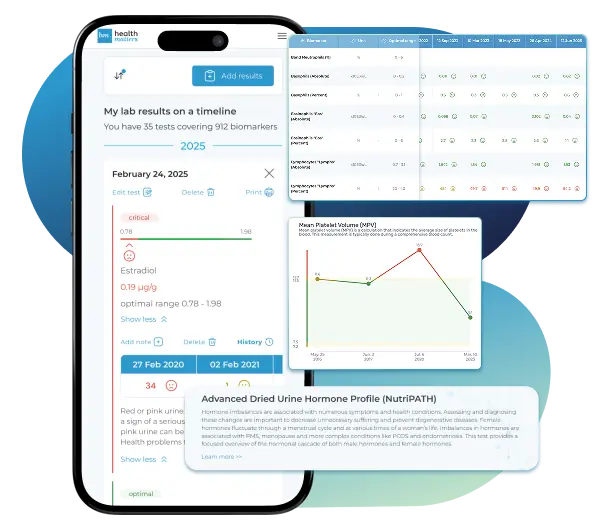
Import lab results from multiple providers, track changes over time, customize your reference ranges, and get clear explanations for each result. Everything is stored securely, exportable in one organized file, and shareable with your doctor—or anyone you choose.
Cancel or upgrade anytime
What does it mean if your HSV Type 1-Specific Ab, IgG result is too low?
A negative (or "non-reactive") HSV-1 IgG means no HSV-1 antibodies were detected — your immune system shows no evidence of past exposure to the virus. Given how common HSV-1 is, this is genuinely a negative result rather than a reassuring-but-meaningless one. Two caveats: antibodies take a few weeks to a few months to develop, so a very recent exposure can read negative before your body has responded — retesting later is advised if a recent exposure is suspected. And a negative result doesn't rule out HSV-2, which is a separate test. If a borderline (equivocal) result was flagged instead of a clear negative, a repeat test in 4–6 weeks is the usual next step.
Related Biomarkers
Article Review & Sources
All our content is backed by peer-reviewed studies, academic research, and trusted medical sources. We're committed to accuracy and transparency — see our editorial policy for details.
Laboratories
Bring All Your Lab Results Together — In One Place
We accept reports from any lab, so you can easily collect and organize all your health information in one secure spot.











Pricing Table
Gather Your Lab History — and Finally Make Sense of It
Finally, Your Lab Results Organized and Clear

Personal plans

$79/ year
Advanced Plan
Access your lab reports, explanations, and tracking tools.
- Import lab results from any provider
- Track all results with visual tools
- Customize your reference ranges
- Export your full lab history anytime
- Share results securely with anyone
- Receive 5 reports entered for you
- Cancel or upgrade anytime
$250/ once
Unlimited Account
Pay once, access everything—no monthly fees, no limits.
- Import lab results from any provider
- Track all results with visual tools
- Customize your reference ranges
- Export your full lab history anytime
- Share results securely with anyone
- Receive 10 reports entered for you
- No subscriptions. No extra fees.
$45/ month
Pro Monthly
Designed for professionals managing their clients' lab reports
- Import lab results from any provider
- Track lab results for multiple clients
- Customize reference ranges per client
- Export lab histories and reports
- Begin with first report entered by us
- Cancel or upgrade anytime
About membership
What's included in a Healthmatters membership
 Import Lab Results from Any Source
 See Your Health Timeline
 Understand What Your Results Mean

 Visualize Your Results

 Data Entry Service for Your Reports
 Securely Share With Anyone You Trust
Let Your Lab Results Tell the Full Story
Once your results are in one place, see the bigger picture — track trends over time, compare data side by side, export your full history, and share securely with anyone you trust.




Bring all your results together to compare, track progress, export your history, and share securely.
What Healthmatters Members Are Saying

I have been using Healthmatters.io since 2021. I travel all over the world and use different doctors and health facilities. This site has allowed me to consolidate all my various test results over 14 years in one place. And every doctor that I show this to has been impressed. Because with any health professional I talk to, I can pull up historical results in seconds. It is invaluable. Even going back to the same doctor, they usually do not have the historical results from their facility in a graph format. That has been very helpful.
Anthony
Unlimited Plan Member since 2021
What fantastic service and great, easy-to-follow layouts! I love your website; it makes it so helpful to see patterns in my health data. It's truly a pleasure to use. I only wish the NHS was as organized and quick as Healthmatters.io. You've set a new standard for health tracking!
Karin
Advanced Plan Member since 2020
As a PRO member and medical practitioner, Healthmatters.io has been an invaluable tool for tracking my clients' data. The layout is intuitive, making it easy to monitor trends and spot patterns over time. The ability to customize reports and charts helps me present information clearly to my clients, improving communication and outcomes. It's streamlined my workflow, saving me time and providing insights at a glance. Highly recommended for any practitioner looking for a comprehensive and user-friendly solution to track patient labs!
Paul
Healthmatters Pro Member since 2024

We implement proven measures to keep your data safe.
At HealthMatters, we're committed to maintaining the security and confidentiality of your personal information. We've put industry-leading security standards in place to help protect against the loss, misuse, or alteration of the information under our control. We use procedural, physical, and electronic security methods designed to prevent unauthorized people from getting access to this information. Our internal code of conduct adds additional privacy protection. All data is backed up multiple times a day and encrypted using SSL certificates. See our Privacy Policy for more details.