
Gluten (f79) IgE
 Reference range:

The allergen-specific IgE antibody test is a crucial tool for diagnosing gluten allergies. It quantifies an individual's IgE response to gluten, an essential protein in wheat, and is conducted as an in vitro quantitative assay. This test should be used alongside other clinical information to aid in food allergy diagnosis. While similar in many respects to skin testing, organizations like the American Academy of Allergy, Asthma, and Immunology and the American College of Allergy, Asthma, and Immunology recognize certain situations where serum IgE testing is preferred. These include cases of widespread skin disease, recent antihistamine use, uncooperative patients, or where skin testing poses a significant risk of a serious allergic reaction.
Food-specific IgE tests, while sensitive, only indicate sensitization and don't confirm an allergy; many sensitized individuals don't develop symptoms upon ingestion. Therefore, a trained medical provider should make a food allergy diagnosis after a comprehensive clinical evaluation. Detection of food-specific IgE in serum is evidence of IgE sensitization, but clinical reactivity history to the food is essential for an IgE-mediated food allergy diagnosis. Some forms of food hypersensitivity don't involve food-specific IgE in serum.
Gluten, the main storage protein in wheat, is a major food allergen affecting an estimated 0.4% of the global population. Symptoms of wheat allergy can range from gastrointestinal issues to skin and respiratory reactions, and even systemic anaphylactic responses. These can occur quickly after ingestion or exposure to wheat products.
Wheat kernel contains 8-15% protein, primarily gluten, composed of gliadins and glutenins. Gluten is heat stable and often used as an additive in processed foods. Gluten or similar proteins are also found in other grains like rye, barley, and oats. Gluten is the trigger for immune-mediated disorders like celiac disease. Wheat allergy, including Baker's asthma/rhinitis, is often linked to the albumin/globulin protein group in wheat, with omega-5 gliadin being a common allergen in exercise-induced anaphylaxis.
Worldwide, wheat allergy prevalence varies but is most common in children, many of whom outgrow the allergy by age 6. The prevalence of wheat allergy varies globally and is associated with atopic disorders like dermatitis, asthma, and allergic rhinitis in children. Environmental factors may influence the development of wheat allergy, though findings are inconclusive.
For wheat allergy management, the main approach is dietary avoidance, with the ability to tolerate other cereal grains generally. Epinephrine auto-injectors are prescribed for systemic reactions, and specific measures are recommended for occupational exposures. Oral immunotherapy with vital wheat gluten has shown varying degrees of desensitization, but adverse reactions are possible.
Lab Results Explained and Tracked

All Your Lab Results.
One Simple Dashboard.
Import, Track, and Share Your Lab Results Easily
Import, Track, and Share Your Lab Results
Import lab results from multiple providers, track changes over time, customize your reference ranges, and get clear explanations for each result. Everything is stored securely, exportable in one organized file, and shareable with your doctor—or anyone you choose.
Cancel or upgrade anytime
Article Review & Sources
All our content is backed by peer-reviewed studies, academic research, and trusted medical sources. We're committed to accuracy and transparency — see our editorial policy for details.
Laboratories
Bring All Your Lab Results Together — In One Place
We accept reports from any lab, so you can easily collect and organize all your health information in one secure spot.











Pricing Table
Gather Your Lab History — and Finally Make Sense of It
Finally, Your Lab Results Organized and Clear

Personal plans

$79/ year
Advanced Plan
Access your lab reports, explanations, and tracking tools.
- Import lab results from any provider
- Track all results with visual tools
- Customize your reference ranges
- Export your full lab history anytime
- Share results securely with anyone
- Receive 5 reports entered for you
- Cancel or upgrade anytime
$250/ once
Unlimited Account
Pay once, access everything—no monthly fees, no limits.
- Import lab results from any provider
- Track all results with visual tools
- Customize your reference ranges
- Export your full lab history anytime
- Share results securely with anyone
- Receive 10 reports entered for you
- No subscriptions. No extra fees.
$45/ month
Pro Monthly
Designed for professionals managing their clients' lab reports
- Import lab results from any provider
- Track lab results for multiple clients
- Customize reference ranges per client
- Export lab histories and reports
- Begin with first report entered by us
- Cancel or upgrade anytime
About membership
What's included in a Healthmatters membership
 Import Lab Results from Any Source
 See Your Health Timeline
 Understand What Your Results Mean

 Visualize Your Results

 Data Entry Service for Your Reports
 Securely Share With Anyone You Trust
Let Your Lab Results Tell the Full Story
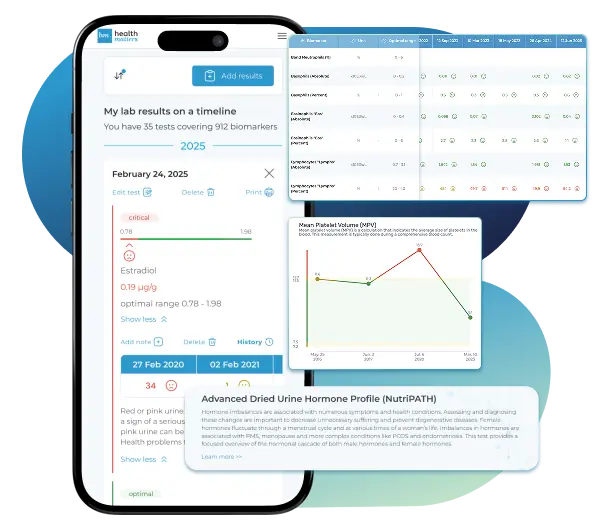
Once your results are in one place, see the bigger picture — track trends over time, compare data side by side, export your full history, and share securely with anyone you trust.




Bring all your results together to compare, track progress, export your history, and share securely.
What Healthmatters Members Are Saying

I have been using Healthmatters.io since 2021. I travel all over the world and use different doctors and health facilities. This site has allowed me to consolidate all my various test results over 14 years in one place. And every doctor that I show this to has been impressed. Because with any health professional I talk to, I can pull up historical results in seconds. It is invaluable. Even going back to the same doctor, they usually do not have the historical results from their facility in a graph format. That has been very helpful.
Anthony
Unlimited Plan Member since 2021
What fantastic service and great, easy-to-follow layouts! I love your website; it makes it so helpful to see patterns in my health data. It's truly a pleasure to use. I only wish the NHS was as organized and quick as Healthmatters.io. You've set a new standard for health tracking!
Karin
Advanced Plan Member since 2020
As a PRO member and medical practitioner, Healthmatters.io has been an invaluable tool for tracking my clients' data. The layout is intuitive, making it easy to monitor trends and spot patterns over time. The ability to customize reports and charts helps me present information clearly to my clients, improving communication and outcomes. It's streamlined my workflow, saving me time and providing insights at a glance. Highly recommended for any practitioner looking for a comprehensive and user-friendly solution to track patient labs!
Paul
Healthmatters Pro Member since 2024

We implement proven measures to keep your data safe.
At HealthMatters, we're committed to maintaining the security and confidentiality of your personal information. We've put industry-leading security standards in place to help protect against the loss, misuse, or alteration of the information under our control. We use procedural, physical, and electronic security methods designed to prevent unauthorized people from getting access to this information. Our internal code of conduct adds additional privacy protection. All data is backed up multiple times a day and encrypted using SSL certificates. See our Privacy Policy for more details.