
Formaldehyde and Glutaraldehyde IgG+IgA
 Optimal Result:
0.6 - 2.4 ELISA Index.
Optimal Result:
0.6 - 2.4 ELISA Index.

Formaldehyde is an organic compound. Formaldehyde-based materials are common to the manufacture of automobiles. Formaldehyde-containing resins – melamine formaldehyde, ureaformaldehyde, phenolformaldehyde, carbamide formaldehyde – are used as a binder in plywood and particleboard production, home furnishings, household cleaners, paints, textiles, landscape and yard products, medicinal and personal care products, pesticides, fire retardation, increased water repellency, stiffness, carpeting made with synthetic fibers, and wrinkle-resistance in fabric finishing; paper products treated with formaldehyde include paper bags, waxed paper, paper towels, and disposable sanitary products; in the health care industry, formaldehyde is used in disinfectants, preservatives, and embalming fluid. Thus, formaldehyde exposure occurs in multiple home and work environments. Formaldehyde has been classified as a known human carcinogen by the International Agency for Research on Cancer.
Glutaraldehyde is an organic compound. Glutaraldehyde is commonly used to disinfect medical and dental equipment; it is also used for industrial water treatment and as a preservative. The variety of uses for glutaraldehyde includes:
- cold sterilizer in the health care industry
- tanning agent
- biocide in metalworking fluids and in oil and gas pipelines
- antimicrobial in water-treatment systems
- slimicide in paper manufacturing
- preservative in cosmetics
- disinfectant in animal housing tissue fixative in histology and pathology labs
- hardening agent in the development of X-rays
- embalming solutions
- preparation of grafts and prostheses
- various clinical applications
In the healthcare industry, glutaraldehyde is most often used to disinfect equipment that cannot be heat sterilized such as dialysis instruments, surgical instruments, suction bottles, bronchoscopes, endoscopes, and ear, nose, and throat instruments. The possible routes of exposure to formaldehyde are ingestion, inhalation, dermal absorption and, rarely, blood exchange as in dialysis.
Because formaldehyde is so soluble, it is quickly absorbed in the respiratory and the gastrointestinal tracts.
Inhalation exposure to formaldehyde has been identified as a potential cause of asthma. Inhalation of formaldehyde leads to the formation of DNA–protein crosslinks, DNA single-strand breaks, chromosomal aberrations, sister chromatid exchange and gene mutation in human cells in vitro. This mechanism may be the cause of the carcinogenic, mutagenic and sensitizing action of formaldehyde. The most common adverse health effects resulting from formaldehyde exposure include:
- respiratory tract irritation
- increased incidence of infectious diseases
- sensitization
- mutagenic
- carcinogenic action
In March of 1986, a railroad tanker car containing 190,000 pounds of ureaformaldehyde resin underwent uncontrolled venting in Crown Point, Alaska. Following the event, residents of Crown Point showed significantly high IgM and IgG titers to formaldehyde. Symptoms included nasal congestion, sore throat, headache, cough, conjunctivitis, fatigue, rash, dizziness, diarrhea, shortness of breath, nausea, and nose bleeds; additionally, 50% of residents had recurrent, unresolved health complaints approximately 60 days following the spill.
Studies on healthcare workers (laboratory, dental, hospital, veterinary), show that personnel in these industries are among the most affected by formaldehyde exposure. Formaldehyde is a well-known mucous membrane irritant and a primary skin sensitizing agent associated with both contact dermatitis (Type IV allergy), and immediate, anaphylactic reactions (Type I allergy).
Significantly increased sensitization rates common to the healthcare sector were found for the vaccine preservative thimerosal, as well as for glutaraldehyde, formaldehyde and glyoxal. In a 5-year study conducted by the University of Kansas, 468 patients were patch tested to glutaraldehyde. A higher than expected co-reactivity between glutaraldehyde and formaldehyde was noted among healthcare workers, which cannot fully be explained by concomitant exposure. A significantly increased risk for occupational allergic dermatitis was induced most frequently by glutaraldehyde. It is therefore of great practical importance to evaluate the appearance of concomitant sensitization to glutaraldehyde and formaldehyde, respectively.
In dental practice it is common to have concomitant exposures to formaldehyde and glutaraldehyde. Chronic inhalation of glutaraldehyde caused considerable non-neoplastic lesions in the noses of study rats and mice. Glutaraldehyde disinfectant replacement in the hospital setting can cause a rapid increase in the environmental pollution levels for short periods of time.
The detection of antibodies to Formaldehyde + Glutaraldehyde bound to human protein in serum indicates a breakdown in immunological tolerance and induction of chemical intolerance. Formaldehyde and Glutaraldehyde can bind to human tissue proteins and form neo-antigens. These new antigens are comprised of the haptenic chemical plus the tissue antigen. The formation of neo-antigens initiates an immune response, which may result in antibody production against the chemical and the human tissue. Continued exposure to the chemical and the subsequent production of antibodies against various tissue antigens, may result in autoimmune reactivity.
References:
- World Health Organization. Formaldehyde. Air quality guidelines (2nd ed). Regional Office for Europe, Copenhagen, Denmark, 2001: Chapter 5, p 8.
- Lyapina M, Kisselova-Yaneva A, Krasteva A, et al. Allergic contact dermatitis from formaldehyde exposure. J IMAB, 2012; 18(4):255-262.
- Bernstein RS, Stayner LT, Elliott LJ, et al. Inhalation exposure to formaldehyde: an overview of its toxicology, epidemiology, monitoring, and control. Am Ind Hyg Assoc J, 1984; 45(11):778- 785.
- Madison RE, Broughton A, Thrasher JD. Immunologic biomarkers associated with an acute exposure to exothermic byproducts of a ureaformaldehyde spill. Environ Health Perspect, 1991; 94:219-223.
- Shaffer MP, Belsito DV. Allergic contact dermatitis from glutaraldehyde in health-care workers. Contact Dermatitis, 2000; 43(3);150-156.
- Schnuch A, Uter W, Geier J, et al. Contact allergies inhealthcare workers. Results from the IVDK. Acta Derm Venerol, 1998; 78(5):358-363.
- Krecisz B, Kiec-Swierczynska M. The role of formaldehyde in the occurrence of contact allergy. [Article in Polish] Med Pr, 1998; 49(6):609-614.
- van Birgelen AP, Chou BJ, Renne RA, et al. Effects of glutaraldehyde in a 2-year study in rats and mice. Toxicologic Sci, 2000; 55(1):195-205.
- Pacenti M, Dugheri S, Boccalon P, et al. Evaluation of the Occupational Exposure to Glutaraldehyde in some Endoscopic Services in an Italian Hospital. Indoor Built Environ, 2006; 15(1):63–68.
Lab Results Explained and Tracked
What does it mean if your Formaldehyde and Glutaraldehyde IgG+IgA result is too high?
Persons with antibodies to Formaldehyde + Glutaraldehyde bound to human protein in serum should avoid exposure to these substances, with special attention taken to clean up the home and work environments.
Quick List Sources of Formaldehyde:
- Particle board and plywood
- Automobile interiors
- Disinfectant
- Paper product coatings
- Permanent press fabrics, synthetic fiber carpeting
- Glue
- Germicide
- Fungicide
Quick List Sources of Glutaraldehyde:
- Disinfectants
- Cosmetics
- Anti-microbial treated water
- Tanning agents

All Your Lab Results.
One Simple Dashboard.
Import, Track, and Share Your Lab Results Easily
Import, Track, and Share Your Lab Results
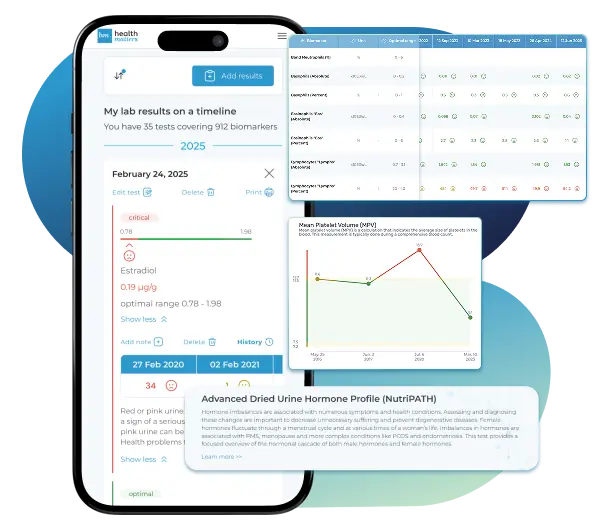
Import lab results from multiple providers, track changes over time, customize your reference ranges, and get clear explanations for each result. Everything is stored securely, exportable in one organized file, and shareable with your doctor—or anyone you choose.
Cancel or upgrade anytime
Article Review & Sources
All our content is backed by peer-reviewed studies, academic research, and trusted medical sources. We're committed to accuracy and transparency — see our editorial policy for details.
Laboratories
Bring All Your Lab Results Together — In One Place
We accept reports from any lab, so you can easily collect and organize all your health information in one secure spot.










Pricing Table
Gather Your Lab History — and Finally Make Sense of It
Finally, Your Lab Results Organized and Clear

Personal plans

$79/ year
Advanced Plan
Access your lab reports, explanations, and tracking tools.
- Import lab results from any provider
- Track all results with visual tools
- Customize your reference ranges
- Export your full lab history anytime
- Share results securely with anyone
- Receive 5 reports entered for you
- Cancel or upgrade anytime
$250/ once
Unlimited Account
Pay once, access everything—no monthly fees, no limits.
- Import lab results from any provider
- Track all results with visual tools
- Customize your reference ranges
- Export your full lab history anytime
- Share results securely with anyone
- Receive 10 reports entered for you
- No subscriptions. No extra fees.
$45/ month
Pro Monthly
Designed for professionals managing their clients' lab reports
- Import lab results from any provider
- Track lab results for multiple clients
- Customize reference ranges per client
- Export lab histories and reports
- Begin with first report entered by us
- Cancel or upgrade anytime
About membership
What's included in a Healthmatters membership
 Import Lab Results from Any Source
 See Your Health Timeline
 Understand What Your Results Mean

 Visualize Your Results

 Data Entry Service for Your Reports
 Securely Share With Anyone You Trust
Let Your Lab Results Tell the Full Story
Once your results are in one place, see the bigger picture — track trends over time, compare data side by side, export your full history, and share securely with anyone you trust.




Bring all your results together to compare, track progress, export your history, and share securely.
What Healthmatters Members Are Saying

I have been using Healthmatters.io since 2021. I travel all over the world and use different doctors and health facilities. This site has allowed me to consolidate all my various test results over 14 years in one place. And every doctor that I show this to has been impressed. Because with any health professional I talk to, I can pull up historical results in seconds. It is invaluable. Even going back to the same doctor, they usually do not have the historical results from their facility in a graph format. That has been very helpful.
Anthony
Unlimited Plan Member since 2021
What fantastic service and great, easy-to-follow layouts! I love your website; it makes it so helpful to see patterns in my health data. It's truly a pleasure to use. I only wish the NHS was as organized and quick as Healthmatters.io. You've set a new standard for health tracking!
Karin
Advanced Plan Member since 2020
As a PRO member and medical practitioner, Healthmatters.io has been an invaluable tool for tracking my clients' data. The layout is intuitive, making it easy to monitor trends and spot patterns over time. The ability to customize reports and charts helps me present information clearly to my clients, improving communication and outcomes. It's streamlined my workflow, saving me time and providing insights at a glance. Highly recommended for any practitioner looking for a comprehensive and user-friendly solution to track patient labs!
Paul
Healthmatters Pro Member since 2024

We implement proven measures to keep your data safe.
At HealthMatters, we're committed to maintaining the security and confidentiality of your personal information. We've put industry-leading security standards in place to help protect against the loss, misuse, or alteration of the information under our control. We use procedural, physical, and electronic security methods designed to prevent unauthorized people from getting access to this information. Our internal code of conduct adds additional privacy protection. All data is backed up multiple times a day and encrypted using SSL certificates. See our Privacy Policy for more details.