
Benzene Ring Compounds IgG+IgA
 Optimal Result:
0.4 - 1.6 ELISA Index.
Optimal Result:
0.4 - 1.6 ELISA Index.

Classified as a hydrocarbon, Benzene [C6H6] is an organic chemical compound composed of 6 carbon atoms forming a hexagonal ring arrangement. Benzene is a solvent found in crude oil; because it has a high octane number, it is utilized in gasoline. Benzene is also used as a precursor to heavy chemicals (i.e. ethylbenzene, cumene from which acetone and phenols are derived). Most solvents are neurotoxic and many are carcinogenic.
Acute inhalation exposure to high concentrations of benzene can cause drowsiness, fatigue, nausea, vertigo, narcosis, and other symptoms of central nervous system (CNS) depression; however, the most damaging health effects associated with benzene exposure are chronic effects due to repeated exposure to low concentrations over many years.
Benzene causes bone marrow failure. Many epidemiologic, clinical, and laboratory data link benzene to aplastic anemia, acute leukemia, and bone marrow abnormalities. Specific hematologic malignancies directly related to benzene include: acute myeloid leukemia (AML), aplastic anemia, myelodysplastic syndrome (MDS), acute lymphoblastic leukemia (ALL), and chronic myeloid leukemia (CML). The American Petroleum Institute (API) stated in 1948 that "it is generally considered that the only absolutely safe concentration for benzene is zero.”
Due to their lipophilicity, most organic solvents, like benzene ring compounds, tend to accumulate in lipid-rich organs, such as nerve tissues in both the peripheral and the central nervous systems. Studies with adult populations exposed to occupational benzene ring compounds support the finding that changes in the visual function can serve as an early marker of neurotoxic damage, especially that resulting from chronic low-level exposure.
Benzene is known to cross the placenta and has been found in cord blood at levels equal to or higher than maternal blood; furthermore, an association between maternal airborne benzene exposure and birth defects has been noted. Texas ranks number one in the United States for benzene levels in ambient air and accounts for 48% of all benzene emissions in the nation. In a study conducted in Texas, it was shown that the risk of having a spina bifida-affected infant more than doubled for mothers living in census tracts with estimated benzene levels of ≥ 3 μg/m3.
Benzene can lead to genetic toxicity by covalently binding to DNA and forming DNA adducts, which, if not repaired, disrupt the microenvironment of the cell, leading to inhibition of important enzymes, cell death, and alteration of other cells. If this occurs during the critical window of fetal development, the complex cellular processes involved in neurulation (e.g., folate metabolism, cell proliferation, cellular adhesion, and vascular development) may be disturbed. The end result could be neural tube defects.
The detection of antibodies to Benzene Ring Compounds bound to human protein in serum indicates a breakdown in immunological tolerance and induction of chemical intolerance. Benzene or its metabolites can bind to human tissue proteins and form neo-antigens. These new antigens are comprised of the haptenic chemical plus the tissue antigen. The formation of neo-antigens initiates an immune response, which may result in antibody production against the chemical and the human tissue. Continued exposure to the chemical and the subsequent production of antibodies against various tissue antigens, may result in autoimmune reactivity. Persons with antibodies to Benzene Ring Compounds bound to human protein in serum should avoid exposure to these substances, with special attention taken to clean up the home and work environments.
Quick List Sources of Benzene Ring Compounds:
- Tobacco Smoke
- Industrial emissions
- Auto exhaust
- Glues
- Paints
- Furniture wax
Lab Results Explained and Tracked
What does it mean if your Benzene Ring Compounds IgG+IgA result is too high?
EXPOSURE ASSOCIATED WITH:
- Acquired dyschromatopsia
- Aplastic anemia
- Cognitive function problems
- Hand-eye coordination problems
- Leukemia
- Memory problems
- Speed stimulation of motor nerve
- Vision problems

All Your Lab Results.
One Simple Dashboard.
Import, Track, and Share Your Lab Results Easily
Import, Track, and Share Your Lab Results
Import lab results from multiple providers, track changes over time, customize your reference ranges, and get clear explanations for each result. Everything is stored securely, exportable in one organized file, and shareable with your doctor—or anyone you choose.
Cancel or upgrade anytime
Article Review & Sources
All our content is backed by peer-reviewed studies, academic research, and trusted medical sources. We're committed to accuracy and transparency — see our editorial policy for details.
Laboratories
Bring All Your Lab Results Together — In One Place
We accept reports from any lab, so you can easily collect and organize all your health information in one secure spot.











Pricing Table
Gather Your Lab History — and Finally Make Sense of It
Finally, Your Lab Results Organized and Clear

Personal plans

$79/ year
Advanced Plan
Access your lab reports, explanations, and tracking tools.
- Import lab results from any provider
- Track all results with visual tools
- Customize your reference ranges
- Export your full lab history anytime
- Share results securely with anyone
- Receive 5 reports entered for you
- Cancel or upgrade anytime
$250/ once
Unlimited Account
Pay once, access everything—no monthly fees, no limits.
- Import lab results from any provider
- Track all results with visual tools
- Customize your reference ranges
- Export your full lab history anytime
- Share results securely with anyone
- Receive 10 reports entered for you
- No subscriptions. No extra fees.
$45/ month
Pro Monthly
Designed for professionals managing their clients' lab reports
- Import lab results from any provider
- Track lab results for multiple clients
- Customize reference ranges per client
- Export lab histories and reports
- Begin with first report entered by us
- Cancel or upgrade anytime
About membership
What's included in a Healthmatters membership
 Import Lab Results from Any Source
 See Your Health Timeline
 Understand What Your Results Mean

 Visualize Your Results

 Data Entry Service for Your Reports
 Securely Share With Anyone You Trust
Let Your Lab Results Tell the Full Story
Once your results are in one place, see the bigger picture — track trends over time, compare data side by side, export your full history, and share securely with anyone you trust.




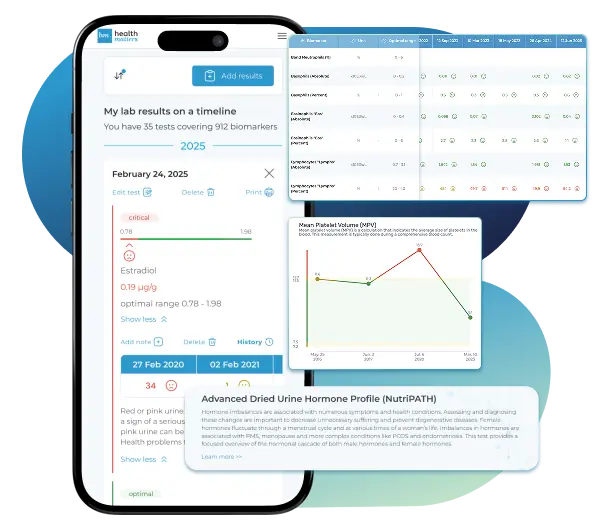
Bring all your results together to compare, track progress, export your history, and share securely.
What Healthmatters Members Are Saying

I have been using Healthmatters.io since 2021. I travel all over the world and use different doctors and health facilities. This site has allowed me to consolidate all my various test results over 14 years in one place. And every doctor that I show this to has been impressed. Because with any health professional I talk to, I can pull up historical results in seconds. It is invaluable. Even going back to the same doctor, they usually do not have the historical results from their facility in a graph format. That has been very helpful.
Anthony
Unlimited Plan Member since 2021
What fantastic service and great, easy-to-follow layouts! I love your website; it makes it so helpful to see patterns in my health data. It's truly a pleasure to use. I only wish the NHS was as organized and quick as Healthmatters.io. You've set a new standard for health tracking!
Karin
Advanced Plan Member since 2020
As a PRO member and medical practitioner, Healthmatters.io has been an invaluable tool for tracking my clients' data. The layout is intuitive, making it easy to monitor trends and spot patterns over time. The ability to customize reports and charts helps me present information clearly to my clients, improving communication and outcomes. It's streamlined my workflow, saving me time and providing insights at a glance. Highly recommended for any practitioner looking for a comprehensive and user-friendly solution to track patient labs!
Paul
Healthmatters Pro Member since 2024

We implement proven measures to keep your data safe.
At HealthMatters, we're committed to maintaining the security and confidentiality of your personal information. We've put industry-leading security standards in place to help protect against the loss, misuse, or alteration of the information under our control. We use procedural, physical, and electronic security methods designed to prevent unauthorized people from getting access to this information. Our internal code of conduct adds additional privacy protection. All data is backed up multiple times a day and encrypted using SSL certificates. See our Privacy Policy for more details.