
Antiscleroderma-70 Antibodies (SCL-70, Anti-Topoisomerase I): What a Positive Result Means
Other names: Antiscleroderma-70 Antibodies, Anti-SCL-70 Antibodies, SCL-70 Antibody, SCL-70, SCL-70 Ab, Anti-Scl-70, Anti-Scl 70, Anti-Topoisomerase I Antibody, Anti-Topoisomerase I, Antitopoisomerase I, Anti-DNA Topoisomerase I, Anti-Topoisomerase, SCL-70 Ab RDL, Anti-SCL-70 Ab (RDL), Anti-SCL-70 Ab (RDL) High, Scleroderma Antibody SCL-70, SCL-70 Scleroderma Ab, Antiscleroderma 70, Antiscleroderma-70, Antiscleroderma-70 Antibodies High, Antiscleroderma-70 Antibodies 0.2, Antiscleroderma-70 Antibodies Range, Antiscleroderma-70 Antibodies Normal Range, SCL-70 Positive, SCL-70 Positive Meaning, SCL-70 Antibody Positive, SCL-70 Positive Range, Anti-SCL-70 Normal Range, SCL-70 Blood Test, SCL 70 Blood Test, Scleroderma Blood Test SCL-70, SCL-70 Ab Blood Test, Does Positive SCL-70 Always Mean Scleroderma, No Signs of Scleroderma But Positive SCL-70, SCL-70 False Positive, SCL-70 Antibody Test Results, ENA SCL-70, ENA SCL70, SCL70 Ab, Scleroderma 70 Antibody, Diffuse Scleroderma Antibody, Systemic Sclerosis Antibody SCL-70, SCL-70 Antibody Systemic Sclerosis, Anticorps Anti-Scl-70 (French), Anticorps Anti-Scl-70 Positif (French), Anticorps Anti-Scl-70 Taux (French), Anti Scl-70 Valores Normales (Spanish), Anticuerpos Anti Scl-70 (Spanish), Esclerodermia SCL-70 (Spanish), Anti SCL 70 Positivo (Spanish), SCL 70 Antikörper (German), SCL-70 Positiv Bedeutung (German), SCL-70 Schwach Positiv (German), SCL-70 Grenzwertig (German), Антитела к SCL-70 (Russian), SCL-70 Норма (Russian), Anti SCL 70 تحليل (Arabic), SCL 70 Dodatni Co To Znaczy (Polish), Przeciwciała SCL-70 (Polish), SCL-70 Dodatni (Polish)
 Optimal Result:
0 - 0.9 AI.
Optimal Result:
0 - 0.9 AI.

QUICK ANSWER
Antiscleroderma-70 antibodies (SCL-70) are highly specific markers for systemic sclerosis (scleroderma) — particularly the diffuse, more widespread form. A positive result is clinically significant but does not by itself diagnose scleroderma.
| Result | What it means |
|---|---|
| Negative (<0.2 U/mL) | No antiscleroderma-70 antibodies detected above the threshold — does not exclude scleroderma |
| Positive (≥0.2 U/mL) | Antiscleroderma-70 antibodies detected — highly specific for systemic sclerosis; rheumatology evaluation warranted |
| High positive (>1.0–2.0 U/mL) | Strongly positive — higher values generally associated with greater likelihood of diffuse systemic sclerosis |
Common questions at a glance:
| Question | Short answer |
|---|---|
| What are antiscleroderma-70 antibodies? | Autoantibodies targeting DNA topoisomerase I; highly specific for systemic sclerosis (scleroderma) |
| Does a positive SCL-70 always mean scleroderma? | No — but a positive SCL-70 is highly specific and warrants rheumatology evaluation |
| What does "0.2" mean on my result? | 0.2 U/mL is the assay cutoff — results below 0.2 are negative, at or above 0.2 are positive |
| Is SCL-70 the same as anti-topoisomerase I? | Yes — SCL-70 and anti-topoisomerase I are different names for the same antibody |
| Is SCL-70 the same as DFS70? | No — these are completely different antibodies with opposite clinical implications |
| What does a negative SCL-70 mean? | Negative does not exclude scleroderma — only 30–40% of patients with systemic sclerosis are SCL-70 positive |
WHAT ARE ANTISCLERODERMA-70 ANTIBODIES? — TERMINOLOGY DECODER
Antiscleroderma-70 antibodies appear under several different names on lab reports and medical records. All of the following refer to the same antibody:
| Term on your report | Same antibody? |
|---|---|
| Antiscleroderma-70 Antibodies | Yes — the HealthMatters/LabCorp panel name |
| SCL-70 | Yes — historical name based on a 70 kDa band on immunodiffusion |
| Anti-SCL-70 | Yes |
| Anti-Topoisomerase I | Yes — the modern scientific name; targets DNA topoisomerase I enzyme |
| Anti-Topo I | Yes — abbreviation for anti-topoisomerase I |
| Anti-DNA Topoisomerase I | Yes |
| Anti-SCL-70 Ab (RDL) | Yes — "(RDL)" identifies the LabCorp/RDL testing platform |
| ENA SCL-70 | Yes — SCL-70 is one of the extractable nuclear antigens (ENA) |
| SCL-70 Ab IgG | Yes — indicates the IgG immunoglobulin class of the antibody |
| Scleroderma (SCL-70) Ab, IgG | Yes |
What SCL-70 is NOT the same as:
- DFS70 — a completely different antibody (dense fine speckled 70/LEDGF protein) with different clinical meaning — see dedicated section below
- PM/SCL-75 or PM/SCL-100 — different antibodies associated with polymyositis/scleroderma overlap
- Anti-centromere antibody (ACA/CENP-B) — a different scleroderma antibody associated with the limited form
CAN SCL-70 BE A FALSE POSITIVE?
SCL-70 is one of the most specific autoantibodies in clinical use — approximately 99% specificity — which means false positives are uncommon but not impossible. Understanding the scenarios where a positive result may not reflect true systemic sclerosis is important.
| Scenario | Likelihood of false positive | Recommended action |
|---|---|---|
| Weak positive right at cutoff (0.2 U/mL) | Highest — this is the zone where borderline results are most common | Repeat testing with same or different assay; clinical correlation |
| Positive SCL-70 + positive ANA | Lower — ANA positivity supports a true autoimmune signal | Clinical evaluation and rheumatology referral |
| Positive SCL-70 + negative ANA | Unusual — most scleroderma patients are ANA positive; consider confirmatory testing | Repeat both tests; discuss with ordering physician |
| Different assay gives discordant result | Possible — different laboratory methods have slightly different cutoffs and sensitivities | Use same assay for follow-up comparisons; discuss discordancy with rheumatologist |
| No symptoms, isolated weak positive | Higher concern for borderline result | Repeat in 3–6 months; rheumatology referral if persistent |
| Strong positive (>1.0 U/mL) | Very unlikely to be false positive | Clinical evaluation as true positive |
The most important context: A weakly positive SCL-70 at 0.2–0.4 U/mL without other positive antibodies (ANA, anti-centromere, anti-RNA polymerase III) and without clinical features of scleroderma should prompt repeat testing before clinical conclusions are drawn. A strongly positive SCL-70 (>1.0 U/mL) in the right clinical context is very unlikely to be a false positive and warrants prompt rheumatology evaluation.
WHAT DOES THE 0.2 VALUE MEAN?
On the LabCorp/RDL antiscleroderma-70 assay, results are reported as a numerical value in U/mL (units per milliliter). The cutoff is 0.2 U/mL:
| Reported value | Interpretation |
|---|---|
| <0.2 U/mL | Negative — no significant antiscleroderma-70 antibodies detected |
| 0.2 U/mL | At the borderline threshold — weakly positive; may warrant repeat testing; clinical correlation essential |
| 0.3–0.9 U/mL | Low positive — confirmed positive; clinical evaluation for systemic sclerosis recommended |
| 1.0–2.9 U/mL | Moderately positive — clinically significant; systemic sclerosis evaluation warranted |
| 3.0–7.9 U/mL | High positive — strongly associated with systemic sclerosis |
| ≥8.0 U/mL | Very high positive — highly suggestive; prompt rheumatology evaluation |
What does "antiscleroderma-70 antibodies 0.2" mean? A result of exactly 0.2 U/mL is at the assay's detection threshold. On some LabCorp reports, this is reported as "0.2" without a "<" sign, indicating the value is at or near the positive cutoff. It may represent a true early or weak positive, or borderline laboratory variation. Repeat testing and clinical correlation are typically recommended before drawing clinical conclusions from a borderline value.
Does a higher number mean more severe disease? Higher antibody titers are generally associated with greater likelihood of systemic sclerosis and more extensive organ involvement, but antibody levels do not reliably track disease activity over time. A very high result at diagnosis does not predict how severe the disease course will be.
SCL-70 AND ANA TOGETHER — WHAT YOUR COMBINATION MEANS
SCL-70 is almost always ordered as part of an ANA panel (such as the ANA 12 Plus Profile). Interpreting SCL-70 alongside the ANA screen adds important clinical context.
| ANA | SCL-70 | Most likely interpretation |
|---|---|---|
| Positive | Positive | Strong systemic sclerosis signal — most consistent with true scleroderma; rheumatology referral |
| Positive | Negative | Many autoimmune possibilities (lupus, Sjögren's, MCTD, others) — SCL-70 negativity does not exclude scleroderma; check anti-centromere and other ENA antibodies |
| Negative | Positive (strong, >1.0) | Unusual pattern — scleroderma patients are almost always ANA positive; confirm SCL-70 with repeat testing; discuss discordancy with rheumatologist |
| Negative | Positive (weak, 0.2–0.4) | Most likely borderline/false positive — repeat both tests before clinical action |
| Borderline | Borderline (0.2) | Uncertain — repeat testing with fasting morning specimen; rheumatology consultation if persistent |
| Positive | Positive + DFS70 positive | DFS70 may reduce the specificity of the ANA; SCL-70 positivity still clinically significant; rheumatology evaluation |
Why this combination matters: Approximately 95% of patients with systemic sclerosis have a positive ANA on HEp-2 IFA. A positive SCL-70 without a positive ANA screen is unusual and warrants confirmatory testing before proceeding with a scleroderma diagnosis.
MOST COMMON SCL-70 RESULTS
| Result (U/mL) | Category | Typical interpretation |
|---|---|---|
| <0.2 | Negative | No antiscleroderma-70 antibodies detected |
| 0.2 | Borderline | At assay threshold — repeat testing recommended; clinical correlation essential |
| 0.3–0.9 | Low positive | Confirmed positive; scleroderma evaluation warranted |
| 1.0–2.9 | Moderate positive | Clinically significant; systemic sclerosis evaluation and rheumatology referral |
| 3.0–7.9 | High positive | Strongly associated with diffuse systemic sclerosis |
| ≥8.0 | Very high positive | Highly suggestive of systemic sclerosis; prompt rheumatology evaluation |
Does the number predict severity? Higher values are generally more diagnostically specific, but SCL-70 levels do not reliably track disease activity — a patient may have a very high titer at diagnosis and decline as immunosuppression begins, or levels may remain elevated in quiescent disease. The clinical picture and organ function tests are more important for monitoring disease course than the antibody level itself.
DOES A POSITIVE SCL-70 ALWAYS MEAN SCLERODERMA?
No — but the clinical implications are significant and require careful interpretation.
What a positive SCL-70 means:
- The antibody is highly specific for systemic sclerosis — approximately 99% specificity means a positive result rarely occurs in people without systemic sclerosis or a closely related condition
- It is associated primarily with diffuse cutaneous systemic sclerosis (dcSSc) — the form with more widespread skin involvement and higher risk of organ complications
- Positivity can precede clinical symptoms of scleroderma by months to years — some patients test positive before developing skin thickening or other features
What a positive SCL-70 does not mean:
- It does not diagnose scleroderma by itself — diagnosis requires clinical criteria including skin thickening, Raynaud's phenomenon, and/or characteristic organ involvement
- A positive antibody without symptoms does not mean active or severe disease is currently present
- Very rarely, SCL-70 can be weakly positive in other autoimmune conditions (lupus, overlap syndromes) or in healthy individuals
The clinical algorithm: A positive SCL-70 warrants rheumatology referral. The rheumatologist will assess for clinical features of systemic sclerosis including skin changes (tightening, thickening), Raynaud's phenomenon, pulmonary symptoms, and characteristic findings on examination. If clinical features and antibody positivity align, a scleroderma diagnosis may be established.
"No signs of scleroderma but positive SCL-70 test": This is a genuinely important and anxiety-provoking situation. Current evidence suggests that individuals with a positive SCL-70 antibody without symptoms represent a pre-clinical or very early phase. VEDOSS (Very Early Diagnosis of Systemic Sclerosis) criteria have been developed to identify and monitor these individuals. Regular follow-up with a rheumatologist is recommended; most of these patients benefit from monitoring without immediate treatment.
Most common early symptoms of systemic sclerosis to watch for:
| Symptom | Frequency in early disease | Why it matters |
|---|---|---|
| Raynaud's phenomenon (fingers turning white/blue/red with cold or stress) | Very common — often the first symptom, sometimes years before diagnosis | Key VEDOSS criterion; most SCL-70 positive patients have Raynaud's |
| Puffy or swollen fingers (especially in the morning) | Common early sign | Reflects early skin edema before fibrosis develops |
| Skin tightening (particularly fingers or face) | Common | May start subtly as shiny skin; should prompt rheumatology referral |
| Reflux or difficulty swallowing | Common | Esophageal dysmotility from smooth muscle involvement |
| Shortness of breath or dry cough | Concerning if new | May indicate developing interstitial lung disease — warrants pulmonary function testing |
| Joint pain or stiffness | Common but nonspecific | Less specific than skin or lung changes but often present early |
| Fatigue | Very common | Nonspecific but relevant in context of other features |
If you have a positive SCL-70 and experience any of these symptoms — particularly Raynaud's phenomenon, puffy fingers, or new respiratory symptoms — contact a rheumatologist promptly rather than waiting for a scheduled follow-up.
SCL-70 VS DFS70 — TWO COMPLETELY DIFFERENT ANTIBODIES
This distinction is critical. Many patients confuse SCL-70 and DFS70 because both contain "70" in the name. They are not related.
| Feature | SCL-70 (Anti-Topoisomerase I) | DFS70 (Anti-LEDGF/p75) |
|---|---|---|
| Full name | Anti-DNA Topoisomerase I antibody | Dense fine speckled 70 / Anti-LEDGF protein antibody |
| What it targets | DNA topoisomerase I enzyme | Lens epithelium-derived growth factor (LEDGF/p75) |
| ANA pattern | Speckled or nucleolar on HEp-2 cells | Dense fine speckled (AC-29 pattern) |
| Primary disease association | Systemic sclerosis (scleroderma) — highly specific | When isolated (without other autoantibodies): associated with lower likelihood of systemic autoimmune disease |
| Clinical significance of positive | High — strong scleroderma marker | Low when isolated — often seen in healthy individuals, atopic diseases, and inflammatory eye conditions |
| What to do if positive | Rheumatology referral | Clinical correlation; if isolated, reassurance; other autoantibodies should be negative |
Why DFS70 matters: A positive DFS70 result in isolation — without other positive autoantibodies like SCL-70, anti-dsDNA, or anti-Smith — is associated with a substantially lower probability of systemic autoimmune rheumatic disease (SARD) compared with a positive SCL-70 alone. DFS70 often appears as an incidental positive ANA pattern. If your report shows DFS70 positive alongside negative SCL-70 and other specific antibodies, this is generally reassuring.
SCL-70 VS ANTI-CENTROMERE ANTIBODY — DIFFUSE VS LIMITED SCLERODERMA
Scleroderma has two main subtypes, each associated with a different antibody. A third major antibody — anti-RNA polymerase III — completes the picture:
| Feature | SCL-70 (Anti-Topoisomerase I) | Anti-Centromere (ACA/CENP-B) | Anti-RNA Polymerase III |
|---|---|---|---|
| Scleroderma subtype | Diffuse cutaneous (dcSSc) | Limited cutaneous (lcSSc/CREST) | Diffuse cutaneous (dcSSc) |
| Skin involvement | Widespread — trunk, face, limbs | Limited — fingers, hands, face | Rapid widespread skin thickening |
| Major organ risks | Interstitial lung disease (ILD) | Pulmonary arterial hypertension | Scleroderma renal crisis |
| Prevalence in SSc | ~30–40% of SSc patients | ~20–30% of SSc patients | ~10–25% of SSc patients |
| Cancer association | Not specifically increased | Not specifically increased | Higher association with cancer at scleroderma onset |
| Prognosis | Variable; ILD drives mortality | Generally slower | Rapid skin progression; renal crisis risk |
| CREST features | Less associated | Classic CREST presentation | Less associated |
The three-antibody framework: Rheumatologists typically classify systemic sclerosis using SCL-70, anti-centromere, and anti-RNA polymerase III as the three primary antibodies. Most patients have only one of these three antibodies — finding two simultaneously is unusual and warrants discussion with a rheumatologist about overlap or assay discordancy.
SCLERODERMA ORGAN MONITORING — BIOMARKERS TO TRACK
A positive SCL-70 in a patient with systemic sclerosis has direct implications for which biomarkers to monitor over time. HealthMatters users with scleroderma may already be tracking several of these:
| Biomarker | Organ system | Why monitored in SCL-70 positive patients |
|---|---|---|
| Creatinine / eGFR | Kidneys | Scleroderma renal crisis can develop rapidly in dcSSc — creatinine rises acutely; early detection is essential |
| NT-proBNP / BNP | Heart | Cardiac involvement (heart failure, pulmonary hypertension) — elevated BNP suggests cardiac stress |
| CRP (C-Reactive Protein) | Systemic inflammation | Tracks general inflammatory activity; may rise with disease flares |
| ESR (Sedimentation Rate) | Systemic inflammation | Less specific but useful for monitoring overall inflammatory burden |
| Hemoglobin / CBC | Bone marrow, GI | Anemia is common in scleroderma from GI blood loss or chronic disease |
| ALT / AST / Bilirubin | Liver | Primary biliary cholangitis overlap is more common in scleroderma than the general population |
| FVC (% predicted) | Lungs (ILD) | Forced vital capacity — the primary pulmonary function marker for interstitial lung disease progression |
| DLCO (% predicted) | Lungs / Pulmonary vasculature | Diffusing capacity — reduced in both ILD and pulmonary arterial hypertension |
| Blood pressure | Kidneys / Heart | Hypertension in scleroderma may herald renal crisis — blood pressure monitoring is essential |
The most critical markers for SCL-70 positive diffuse scleroderma: FVC and DLCO (lung function), creatinine (kidney function), and NT-proBNP (cardiac). Baseline measurements at diagnosis provide the reference point for detecting deterioration.
WHEN SHOULD I SEE A RHEUMATOLOGIST?
| Situation | Urgency | Recommended action |
|---|---|---|
| Positive SCL-70 (any level) + Raynaud's phenomenon | Moderate-High | Rheumatology referral within weeks |
| Positive SCL-70 + skin tightening or puffiness of fingers | High | Prompt rheumatology evaluation |
| Positive SCL-70 + new shortness of breath or dry cough | High | Rheumatology + pulmonary assessment; consider HRCT |
| Positive SCL-70 + rapidly rising blood pressure | Urgent | Rule out scleroderma renal crisis — seek care promptly |
| Strong positive SCL-70 (>1.0) + no current symptoms | Moderate | Rheumatology referral for monitoring; VEDOSS evaluation |
| Borderline SCL-70 (0.2) without symptoms | Low | Repeat testing in 3–6 months; rheumatology if persistent |
| Negative SCL-70 + clinical features of scleroderma | Moderate | Rheumatology evaluation regardless — SCL-70 negative in ~60–70% of scleroderma |
| Positive SCL-70 + family history of scleroderma or autoimmune disease | Moderate | Early rheumatology referral |
MOST COMMON CLINICAL SCENARIOS
SCL-70 positive without current symptoms — what it typically means:
| Situation | Typical interpretation | Recommended action |
|---|---|---|
| Positive SCL-70 + Raynaud's phenomenon only | Possible early/VEDOSS-stage systemic sclerosis | Rheumatology referral; nailfold capillaroscopy; baseline pulmonary function tests |
| Positive SCL-70 + puffy fingers + Raynaud's | High likelihood of evolving systemic sclerosis | Prompt rheumatology referral; HRCT baseline |
| Positive SCL-70 + completely normal exam + no symptoms | Pre-clinical phase or isolated antibody positivity | Rheumatology referral for monitoring; reassess every 6–12 months |
| Positive SCL-70 + abnormal nailfold capillaries | Elevated progression risk — scleroderma-pattern capillaroscopy strongly supports diagnosis | Rheumatology evaluation; organ screening |
| Positive SCL-70 + borderline 0.2 + no symptoms | Borderline — may resolve on repeat | Repeat testing in 3–6 months before further action |
| Pattern | Most likely interpretation | Recommended next step |
|---|---|---|
| SCL-70 positive + skin tightening + Raynaud's phenomenon | Classic diffuse systemic sclerosis presentation | Rheumatology evaluation; scleroderma workup (HRCT, PFTs, echocardiogram) |
| SCL-70 positive 0.2–0.4 + no symptoms | Possible early/pre-clinical; borderline positive | Repeat testing; rheumatology referral; VEDOSS monitoring |
| SCL-70 positive + positive ANA + no other diagnosis | Systemic sclerosis most likely | Rheumatology evaluation |
| SCL-70 negative + clinical features of scleroderma | Negative does not exclude scleroderma; SCL-70 positive in only ~30–40% of cases | Check anti-centromere, anti-RNA polymerase III; rheumatology evaluation |
| SCL-70 borderline (0.2) + repeat negative | Initial borderline result may have been lab variation | Monitor; no urgent action if repeat negative and no symptoms |
| DFS70 positive + SCL-70 negative + other antibodies negative | DFS70 in isolation — lower likelihood of systemic autoimmune disease | Clinical correlation; reassurance if isolated and asymptomatic |
| SCL-70 positive + anti-centromere positive | Unusual; both rarely positive simultaneously | Rheumatology evaluation; complex overlap |
| SCL-70 high positive (>3.0) + pulmonary symptoms | High concern for ILD in dcSSc context | Urgent rheumatology; HRCT; pulmonary function tests |
FAQ about Antiscleroderma-70 Antibodies
-
What are antiscleroderma-70 antibodies?
Antiscleroderma-70 antibodies (also called SCL-70 or anti-topoisomerase I antibodies) are autoantibodies — immune proteins produced by the immune system that mistakenly target the body's own cells. Specifically, SCL-70 antibodies target DNA topoisomerase I, an enzyme that helps unwind DNA strands during cell replication. These antibodies are found almost exclusively in patients with systemic sclerosis (scleroderma), particularly the diffuse cutaneous form, making them one of the most specific diagnostic markers for this condition. They are measured as part of the ANA 12 Plus Profile or ordered separately when scleroderma is clinically suspected. -
Does a positive SCL-70 always mean I have scleroderma?
Not necessarily — but a positive SCL-70 is a clinically significant finding that warrants rheumatology evaluation. The antibody has approximately 99% specificity for systemic sclerosis, meaning a positive result very rarely occurs in people without scleroderma or a closely related autoimmune condition. However, a positive antibody alone does not diagnose scleroderma — diagnosis requires clinical features including skin thickening (sclerodactyly, diffuse skin tightening), Raynaud's phenomenon, and/or characteristic internal organ involvement. Some individuals have a positive SCL-70 years before developing clinical symptoms — this represents a pre-clinical phase that requires monitoring. If you have a positive SCL-70 without symptoms, rheumatology referral and regular monitoring are appropriate rather than assuming a benign result. -
What does "antiscleroderma-70 antibodies 0.2" mean?
A value of 0.2 U/mL is at the exact cutoff threshold of the LabCorp/RDL assay. Results reported as less than 0.2 (<0.2) are negative. A result of exactly 0.2, or any value above 0.2, is considered positive. A result right at 0.2 is the weakest possible positive — it may represent a true early or weak antibody response, or it may reflect borderline laboratory variation. Repeat testing after several weeks and clinical correlation (your symptoms, physical examination, and other lab findings) are typically recommended before drawing firm conclusions from a borderline 0.2 result. -
Is SCL-70 the same as anti-topoisomerase I?
Yes — SCL-70 and anti-topoisomerase I are different names for exactly the same antibody. "SCL-70" is the historical name, derived from a 70 kilodalton band that appeared on immunodiffusion testing when the antibody was first characterized. "Anti-topoisomerase I" is the modern scientific name, reflecting the actual protein target — DNA topoisomerase I, an enzyme involved in DNA replication. Both names appear on lab reports and in medical literature. If your rheumatologist refers to "anti-topoisomerase I" and your lab report says "SCL-70," they are discussing the same finding. -
Is SCL-70 the same as DFS70?
No — SCL-70 and DFS70 are completely different antibodies with very different clinical implications. SCL-70 (anti-topoisomerase I) is a marker of systemic sclerosis and a positive result is clinically concerning. DFS70 (anti-LEDGF/p75) targets a completely different protein, produces a different ANA fluorescence pattern (dense fine speckled), and when found in isolation without other specific autoantibodies, is associated with a lower likelihood of systemic autoimmune disease — essentially the opposite clinical significance from SCL-70. If your report shows DFS70 positive with SCL-70 negative, this is generally reassuring and does not indicate scleroderma risk. -
What does a negative SCL-70 mean?
A negative SCL-70 means the antibody was not detected above the threshold. This does not rule out scleroderma — SCL-70 is positive in only approximately 30–40% of patients with systemic sclerosis. The majority of scleroderma patients are SCL-70 negative. Other antibodies associated with scleroderma include anti-centromere antibody (associated with the limited/CREST form), anti-RNA polymerase III (associated with diffuse disease and renal crisis), and others. If clinical features suggest scleroderma but SCL-70 is negative, additional antibody testing and rheumatology evaluation remain appropriate. -
What does SCL-70 positive mean for my prognosis?
A positive SCL-70 in confirmed systemic sclerosis indicates the diffuse cutaneous subtype, which carries higher risk of serious organ complications — particularly interstitial lung disease (ILD), the leading cause of death in diffuse scleroderma. Regular pulmonary function testing and high-resolution CT imaging are typically recommended for SCL-70 positive patients to monitor for ILD. Kidney function and blood pressure monitoring are also important, as scleroderma renal crisis — though rare — is more common in diffuse disease. The antibody level itself does not reliably predict disease severity or trajectory, but SCL-70 positivity is an indication for closer monitoring. Treatment is now increasingly effective — immunosuppressants (mycophenolate mofetil, cyclophosphamide) and antifibrotic agents have significantly improved outcomes. -
Que signifie un anticorps anti-Scl-70 positif ? (What does a positive anti-SCL-70 antibody mean?)
Un résultat positif pour l'anticorps anti-Scl-70 (également appelé anticorps anti-topo-isomérase I ou anticorps anti-sclérodermie-70) signifie que le système immunitaire produit des anticorps dirigés contre la topo-isomérase I, une enzyme impliquée dans la réplication de l'ADN. Ces anticorps sont très spécifiques de la sclérodermie systémique — en particulier de la forme diffuse, qui peut affecter largement la peau et les organes internes tels que les poumons, les reins et le cœur. Un résultat positif ne permet pas à lui seul de poser un diagnostic de sclérodermie — le diagnostic nécessite des critères cliniques incluant le phénomène de Raynaud, un épaississement cutané ou d'autres manifestations caractéristiques. Si votre résultat anti-Scl-70 est positif, une consultation en rhumatologie est recommandée. Un faible taux (0,2 U/mL) peut nécessiter une confirmation par un nouveau dosage ; un taux élevé (supérieur à 1,0 U/mL) dans un contexte clinique compatible est un marqueur fort de sclérodermie diffuse.
Lab Results Explained and Tracked
What does it mean if your Antiscleroderma-70 Antibodies result is too high?
A positive antiscleroderma-70 antibody (SCL-70 or anti-topoisomerase I) result means antibodies targeting DNA topoisomerase I were detected in the blood above the assay threshold. These antibodies are highly specific for systemic sclerosis (scleroderma) — particularly diffuse cutaneous systemic sclerosis (dcSSc), the form associated with more widespread skin involvement and higher risk of organ complications including interstitial lung disease, scleroderma renal crisis, and cardiac involvement. A positive result does not by itself diagnose scleroderma — diagnosis requires clinical criteria including skin thickening, Raynaud's phenomenon, and characteristic internal organ features — but it is a strong immunological marker that warrants rheumatology evaluation. In patients without current symptoms, a positive SCL-70 may represent an early or pre-clinical phase that benefits from regular monitoring. Higher antibody values (particularly above 1.0–2.0 U/mL) are generally associated with greater likelihood of active disease, though antibody levels do not reliably track disease severity over time.
Related Health Conditions

All Your Lab Results.
One Simple Dashboard.
Import, Track, and Share Your Lab Results Easily
Import, Track, and Share Your Lab Results
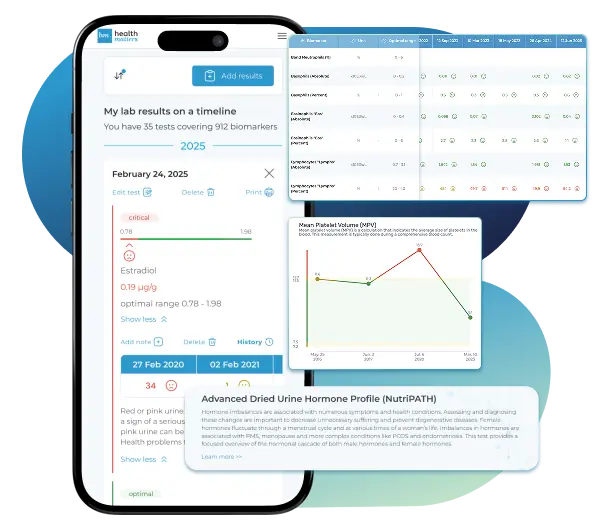
Import lab results from multiple providers, track changes over time, customize your reference ranges, and get clear explanations for each result. Everything is stored securely, exportable in one organized file, and shareable with your doctor—or anyone you choose.
Cancel or upgrade anytime
What does it mean if your Antiscleroderma-70 Antibodies result is too low?
A negative antiscleroderma-70 antibody result means SCL-70 antibodies were not detected above the assay threshold (<0.2 U/mL on the LabCorp/RDL assay). A negative result does not exclude systemic sclerosis — the antibody is positive in only approximately 30–40% of patients with confirmed systemic sclerosis, meaning the majority of scleroderma patients will have a negative SCL-70. Other scleroderma-associated antibodies (anti-centromere antibody, anti-RNA polymerase III, anti-PM/SCL) may be positive when SCL-70 is negative. If clinical features suggest systemic sclerosis — including Raynaud's phenomenon, skin tightening, characteristic nailfold capillaroscopy changes, or unexplained pulmonary symptoms — further evaluation with a rheumatologist is appropriate regardless of SCL-70 negativity.
Related Biomarkers
Article Review & Sources
All our content is backed by peer-reviewed studies, academic research, and trusted medical sources. We're committed to accuracy and transparency — see our editorial policy for details.
Laboratories
Bring All Your Lab Results Together — In One Place
We accept reports from any lab, so you can easily collect and organize all your health information in one secure spot.











Pricing Table
Gather Your Lab History — and Finally Make Sense of It
Finally, Your Lab Results Organized and Clear

Personal plans

$79/ year
Advanced Plan
Access your lab reports, explanations, and tracking tools.
- Import lab results from any provider
- Track all results with visual tools
- Customize your reference ranges
- Export your full lab history anytime
- Share results securely with anyone
- Receive 5 reports entered for you
- Cancel or upgrade anytime
$250/ once
Unlimited Account
Pay once, access everything—no monthly fees, no limits.
- Import lab results from any provider
- Track all results with visual tools
- Customize your reference ranges
- Export your full lab history anytime
- Share results securely with anyone
- Receive 10 reports entered for you
- No subscriptions. No extra fees.
$45/ month
Pro Monthly
Designed for professionals managing their clients' lab reports
- Import lab results from any provider
- Track lab results for multiple clients
- Customize reference ranges per client
- Export lab histories and reports
- Begin with first report entered by us
- Cancel or upgrade anytime
About membership
What's included in a Healthmatters membership
 Import Lab Results from Any Source
 See Your Health Timeline
 Understand What Your Results Mean

 Visualize Your Results

 Data Entry Service for Your Reports
 Securely Share With Anyone You Trust
Let Your Lab Results Tell the Full Story
Once your results are in one place, see the bigger picture — track trends over time, compare data side by side, export your full history, and share securely with anyone you trust.




Bring all your results together to compare, track progress, export your history, and share securely.
What Healthmatters Members Are Saying

I have been using Healthmatters.io since 2021. I travel all over the world and use different doctors and health facilities. This site has allowed me to consolidate all my various test results over 14 years in one place. And every doctor that I show this to has been impressed. Because with any health professional I talk to, I can pull up historical results in seconds. It is invaluable. Even going back to the same doctor, they usually do not have the historical results from their facility in a graph format. That has been very helpful.
Anthony
Unlimited Plan Member since 2021
What fantastic service and great, easy-to-follow layouts! I love your website; it makes it so helpful to see patterns in my health data. It's truly a pleasure to use. I only wish the NHS was as organized and quick as Healthmatters.io. You've set a new standard for health tracking!
Karin
Advanced Plan Member since 2020
As a PRO member and medical practitioner, Healthmatters.io has been an invaluable tool for tracking my clients' data. The layout is intuitive, making it easy to monitor trends and spot patterns over time. The ability to customize reports and charts helps me present information clearly to my clients, improving communication and outcomes. It's streamlined my workflow, saving me time and providing insights at a glance. Highly recommended for any practitioner looking for a comprehensive and user-friendly solution to track patient labs!
Paul
Healthmatters Pro Member since 2024

We implement proven measures to keep your data safe.
At HealthMatters, we're committed to maintaining the security and confidentiality of your personal information. We've put industry-leading security standards in place to help protect against the loss, misuse, or alteration of the information under our control. We use procedural, physical, and electronic security methods designed to prevent unauthorized people from getting access to this information. Our internal code of conduct adds additional privacy protection. All data is backed up multiple times a day and encrypted using SSL certificates. See our Privacy Policy for more details.