
Human Epididymis Protein 4 (HE4)
Other names: Human Epididymis Protein 4, HE4, OVARIAN CANCER MONITORING
 Optimal Result:
0 - 140 pmol/L.
Optimal Result:
0 - 140 pmol/L.

Clinical Takeaway
A high HE4 result does not diagnose cancer, and a normal result does not exclude it. During epithelial ovarian cancer follow-up, rising HE4 may signal progression or recurrence. Kidney dysfunction and assay changes can also affect the result. [1, 2]
At a Glance
Human epididymis protein 4 (HE4) is a serum tumor marker reported in pmol/L. HE4 helps monitor epithelial ovarian cancer, particularly when it was elevated before treatment. HE4 is not a cancer screening test. Before planned surgery for a pelvic mass, HE4 may instead be measured as part of a ROMA risk assessment. [1–4]
Understanding your HE4 result
| Result or context | What it suggests | What to check next |
|---|---|---|
| HE4 within your report's range | Cancer or recurrence remains possible. | Whether HE4 was elevated before treatment; symptoms and imaging. [1, 2] |
| HE4 above your report's range | Cancer is one possibility. Mayo also lists benign gynecologic conditions, hypertension, congestive heart failure, and kidney or liver disease. | Prior values and clinical findings; the specific benign conditions are listed below. [1] |
| HE4 rising during cancer follow-up | Progression or recurrence may need evaluation. | The overall clinical assessment and whether the measurements are comparable. [1, 2] |
| HE4 falling during treatment | Response is possible if HE4 was elevated initially. | Other evidence of response; a fall alone cannot establish remission. [1, 2] |
| HE4 ordered with CA 125 before surgery for a pelvic mass | The ROMA score combines HE4, CA 125, and menopausal status to help assess malignancy risk. HE4 alone is not that score. | The reported ROMA result, imaging, and existing surgical plan. ROMA does not determine whether surgery is needed. [3, 4] |
Which reference range applies?
HE4 upper reference limits depend on the laboratory, assay, and population. The examples below come from the named laboratories, not from a universal cancer cutoff. [1, 3]
| Laboratory | Assay | HE4 upper reference limit |
|---|---|---|
| Mayo Clinic Laboratories | ECLIA | Mayo lists ≤140 pmol/L for females; males: not applicable. [1] |
| Quest Diagnostics, ROMA panel | Abbott ARCHITECT CMIA | Quest lists ≤70 pmol/L before menopause and ≤140 pmol/L after menopause. [3] |
Use the reference range on your own laboratory report. The default range shown on this website cannot represent every assay or menopausal group. A reference limit is not a treatment target or a threshold that proves or excludes cancer.
If you remember only one thing
HE4 is a monitoring clue, not a cancer verdict. Mayo Clinic Laboratories considers a change in serum HE4 of 20% or more significant. That is Mayo's guidance, not a universal recurrence cutoff; a change still needs clinical assessment. [1]
Two people, same result
The following HE4 value is hypothetical, not a diagnostic threshold. Both people have HE4 of 180 pmol/L.
| Context | What it suggests | What to check next |
|---|---|---|
| Person A: HE4 has risen from a steady baseline; kidney function is stable. | A change warrants evaluation, but stable kidney function does not establish cancer as the cause. | Prior HE4 results, assay method, symptoms, and imaging. |
| Person B: the same HE4 value occurs while eGFR is falling. | Reduced kidney function may contribute; it does not exclude simultaneous cancer progression. | Creatinine/eGFR trend and the oncology assessment. |
Why kidney function matters
Kidney disease can raise HE4 without establishing cancer progression. Read HE4 alongside creatinine and estimated glomerular filtration rate (eGFR). Kidney dysfunction can complicate interpretation; it cannot provide an all-clear about the cancer. [1, 2]
What HE4 cannot tell you
HE4 alone cannot diagnose cancer, determine its stage, or prove remission. Mayo does not recommend HE4 monitoring for mucinous or germ cell ovarian tumors because those tumors rarely express HE4. Normal HE4 should not override concerning symptoms or imaging. [1, 2]
Common interpretation mistakes
HE4 interpretation goes wrong when a reference flag becomes a diagnosis. Other mistakes include treating a normal value as proof of remission, treating Mayo's change guidance as a universal recurrence rule, or confusing HE4 concentration with a ROMA score. ROMA assesses preoperative risk in an eligible pelvic-mass population; it is not a substitute for post-treatment monitoring. [1–4]
Questions your doctor may ask
HE4 follow-up starts with why the test was ordered. Was HE4 elevated before treatment? Is the current result part of monitoring or a preoperative ROMA panel? Does the result fit symptoms and imaging? If it does not fit, could laboratory interference be involved? Mayo describes rare interference from heterophile/HAMA, streptavidin, or ruthenium antibodies. [1]
Read together with
HE4 is interpreted with CA 125, creatinine/eGFR, imaging, treatment dates, and tumor histology. For a preoperative pelvic-mass assessment, read the actual ROMA result and its laboratory interpretation. [1–4]
Clinical pearls
HE4 values from different assay methods are not interchangeable. Mayo reports that its current method gives HE4 concentrations averaging 28% higher than its previous ELISA method. This specific comparison is not a conversion factor for other assays or individual patients. When methods change, parallel testing can help establish a new baseline. [1]
In one sentence
HE4 helps follow epithelial ovarian cancer when the marker was informative before treatment; HE4 alone cannot establish the cancer's status. [1, 2]
Bottom line
An unexpected HE4 result deserves review with the team that ordered it. Use the clinical context and your own report's range to interpret the number.
FAQ about Human Epididymis Protein 4 (HE4)
-
Does a high HE4 result mean cancer?
No. High HE4 does not prove cancer. Mayo lists mild elevations with ovarian cysts, cystadenomas, fibroids, fibromas, endometriosis, hypertension, congestive heart failure, and kidney or liver disease. An elevated result needs clinical interpretation. [1] -
What is a normal HE4 level?
HE4 reference limits vary. Mayo Clinic Laboratories lists a female upper limit of 140 pmol/L. Quest's ROMA panel lists upper limits of 70 pmol/L before menopause and 140 pmol/L after menopause. Use your own report's range. A result within that range does not exclude cancer. [1, 3] -
Can a normal HE4 result rule out ovarian cancer?
No. Some ovarian cancers do not produce elevated HE4. A normal result cannot establish remission or exclude recurrence. Symptoms, imaging, and the clinical assessment remain relevant. [1, 2] -
Can I compare HE4 results from different laboratories?
Check which HE4 assay each laboratory used. Results obtained using different methods are not interchangeable. A method change may require parallel testing to establish a new baseline. [1, 2] -
Is HE4 the same as ROMA?
No. HE4 is a measured protein concentration. ROMA combines HE4, CA 125, and menopausal status to help assess ovarian malignancy risk before planned surgery for a pelvic mass. ROMA must accompany clinical and imaging assessment; it is not a screening test or a standalone diagnosis. [3, 4]
Lab Results Explained and Tracked
What does it mean if your Human Epididymis Protein 4 (HE4) result is too high?
High HE4 does not prove cancer. During epithelial ovarian cancer follow-up, a rise may warrant evaluation for progression or recurrence. Mayo also lists mild elevations with ovarian cysts, cystadenomas, fibroids, fibromas, endometriosis, hypertension, congestive heart failure, and kidney or liver disease. Review an unexpected result with the ordering team. [1]
All Your Lab Results.
One Simple Dashboard.
Import, Track, and Share Your Lab Results Easily
Import, Track, and Share Your Lab Results
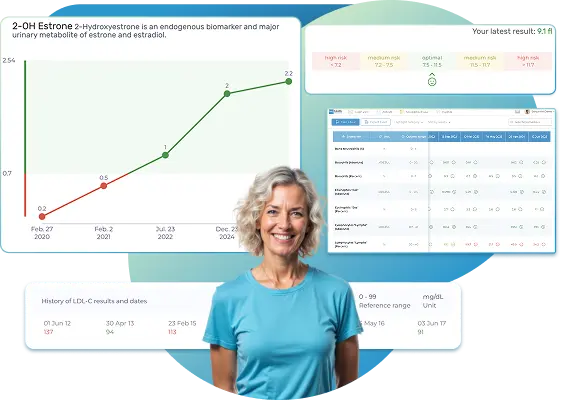
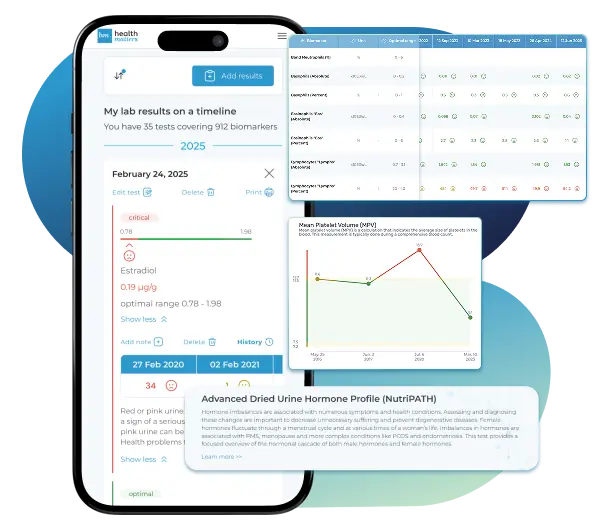
Import lab results from multiple providers, track changes over time, customize your reference ranges, and get clear explanations for each result. Everything is stored securely, exportable in one organized file, and shareable with your doctor—or anyone you choose.
Cancel or upgrade anytime
What does it mean if your Human Epididymis Protein 4 (HE4) result is too low?
A low HE4 result does not identify a deficiency. During cancer monitoring, a decrease may support a treatment response when HE4 was elevated before treatment. A low or normal result does not establish remission or exclude cancer; some tumors do not produce elevated HE4. [1, 2]
Article Review & Sources
All our content is backed by peer-reviewed studies, academic research, and trusted medical sources. We're committed to accuracy and transparency — see our editorial policy for details.
Laboratories
Bring All Your Lab Results Together — In One Place
We accept reports from any lab, so you can easily collect and organize all your health information in one secure spot.











Pricing Table
Gather Your Lab History — and Finally Make Sense of It
Finally, Your Lab Results Organized and Clear

Personal plans

$79/ year
Advanced Plan
Access your lab reports, explanations, and tracking tools.
- Import lab results from any provider
- Track all results with visual tools
- Customize your reference ranges
- Export your full lab history anytime
- Share results securely with anyone
- Receive 5 reports entered for you
- Cancel or upgrade anytime
$250/ once
Unlimited Account
Pay once, access everything—no monthly fees, no limits.
- Import lab results from any provider
- Track all results with visual tools
- Customize your reference ranges
- Export your full lab history anytime
- Share results securely with anyone
- Receive 10 reports entered for you
- No subscriptions. No extra fees.
$45/ month
Pro Monthly
Designed for professionals managing their clients' lab reports
- Import lab results from any provider
- Track lab results for multiple clients
- Customize reference ranges per client
- Export lab histories and reports
- Begin with first report entered by us
- Cancel or upgrade anytime
About membership
What's included in a Healthmatters membership
 Import Lab Results from Any Source
 See Your Health Timeline
 Understand What Your Results Mean

 Visualize Your Results

 Data Entry Service for Your Reports
 Securely Share With Anyone You Trust
Let Your Lab Results Tell the Full Story
Once your results are in one place, see the bigger picture — track trends over time, compare data side by side, export your full history, and share securely with anyone you trust.




Bring all your results together to compare, track progress, export your history, and share securely.
What Healthmatters Members Are Saying

I have been using Healthmatters.io since 2021. I travel all over the world and use different doctors and health facilities. This site has allowed me to consolidate all my various test results over 14 years in one place. And every doctor that I show this to has been impressed. Because with any health professional I talk to, I can pull up historical results in seconds. It is invaluable. Even going back to the same doctor, they usually do not have the historical results from their facility in a graph format. That has been very helpful.
Anthony
Unlimited Plan Member since 2021
What fantastic service and great, easy-to-follow layouts! I love your website; it makes it so helpful to see patterns in my health data. It's truly a pleasure to use. I only wish the NHS was as organized and quick as Healthmatters.io. You've set a new standard for health tracking!
Karin
Advanced Plan Member since 2020
As a PRO member and medical practitioner, Healthmatters.io has been an invaluable tool for tracking my clients' data. The layout is intuitive, making it easy to monitor trends and spot patterns over time. The ability to customize reports and charts helps me present information clearly to my clients, improving communication and outcomes. It's streamlined my workflow, saving me time and providing insights at a glance. Highly recommended for any practitioner looking for a comprehensive and user-friendly solution to track patient labs!
Paul
Healthmatters Pro Member since 2024

We implement proven measures to keep your data safe.
At HealthMatters, we're committed to maintaining the security and confidentiality of your personal information. We've put industry-leading security standards in place to help protect against the loss, misuse, or alteration of the information under our control. We use procedural, physical, and electronic security methods designed to prevent unauthorized people from getting access to this information. Our internal code of conduct adds additional privacy protection. All data is backed up multiple times a day and encrypted using SSL certificates. See our Privacy Policy for more details.